


Most mornings begin with a quiet commute through the San Francisco Bay Area inside an autonomous Waymo vehicle. The experience is an everyday exercise in outsourcing human effort. The car performs physical labor, moving five thousand pounds of metal and glass across complex urban terrain. Simultaneously, it executes advanced cognitive tasks, reading the road and making split-second predictions that yield a safety record resulting in significantly fewer serious-injury crashes than human drivers.
This routine trip encapsulates two distinct historical revolutions. The physical transformation is two centuries old, while the cognitive shift has barely begun. Yet, public discourse surrounding the emerging age of artificial intelligence is currently a dizzying cocktail of optimism, skepticism, and existential anxiety. Conversations are dominated by talk of technological singularities, recursive self-improvement, trillion-dollar data clusters, superintelligence, widespread unemployment, profound social disruption, and a high-stakes race between global superpowers.
Despite the prevailing anxiety, a historical perspective offers a grounding lens. Humanity has already undergone a massive transition that strongly rhymes with the unfolding AI revolution: the Industrial Revolution. By examining how society navigated the mechanization of physical labor, economists, technologists, and policymakers can better understand the trajectory, challenges, and ultimate triumphs of the impending Cognitive Revolution.
Two Kinds of Work
Human labor can be broadly bifurcated into physical work and cognitive work, though most valuable tasks necessitate a combination of both. Agriculture serves as one of the oldest examples of this dual requirement. Working the land demanded raw muscle power—provided by humans and domesticated animals alike—for ten thousand years. Yet, it also required deep insight: reading the shifting seasons, observing microclimates, and knowing which seeds yielded the best harvests.
These two categories of work are fundamentally different in execution. Physical work is defined by force multiplied by distance, involving the movement of physical mass through space. Cognitive work is the realm of thinking, reasoning, and calculation. However, both forms of labor share core economic characteristics. Both are scarce, both carry a price, and both are applied to tasks society wants completed. Historically, whenever the price of either physical or cognitive labor has collapsed due to technological breakthroughs, supply has flooded in, and overall economic demand has rapidly expanded to meet that new supply.
What Happened to Physical Work
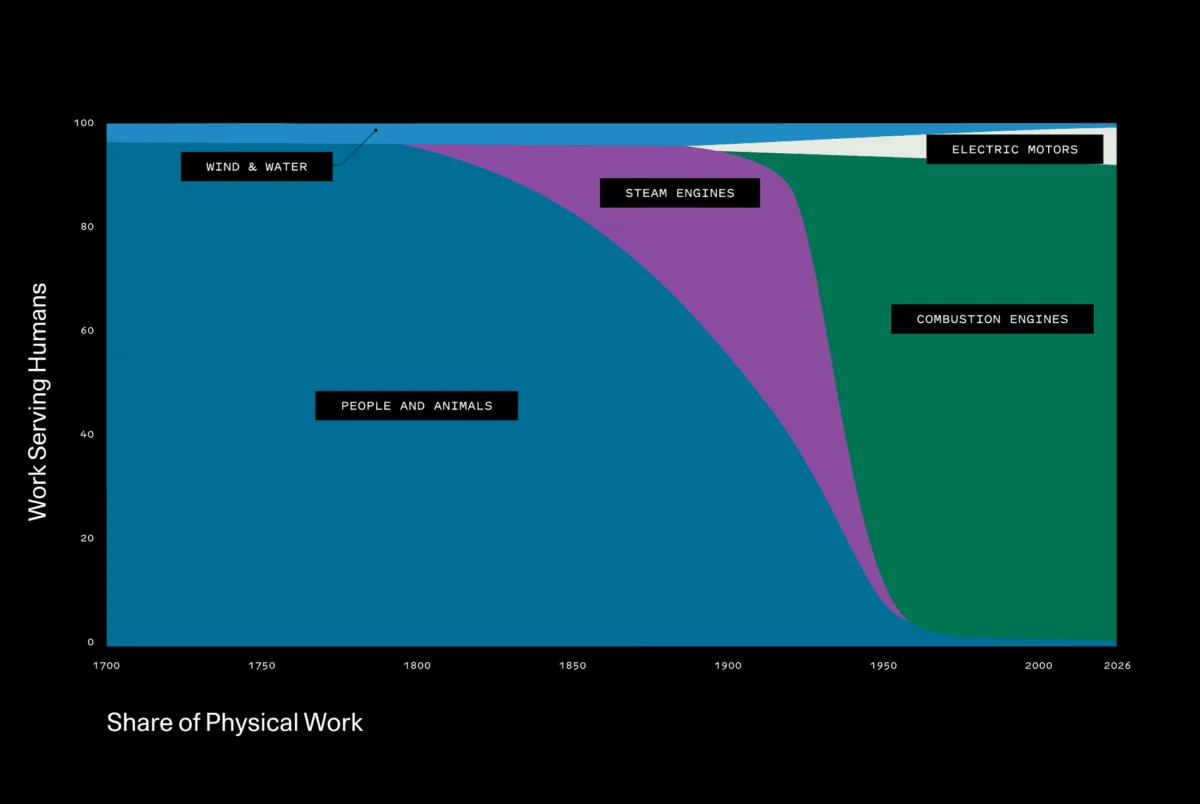
For the vast majority of human history, nearly all physical work was performed by biological muscle. Historical charts tracking global energy inputs remain virtually flat for millennia, reflecting a baseline dependence on human and animal exertion until the dawn of the modern era.
In the late 1700s and early 1800s, that paradigm shifted dramatically. The introduction of the steam engine, followed by internal combustion and the electric motor, fundamentally altered the global economy. Each wave of technological advancement absorbed a larger share of the world’s physical work. Over the course of approximately two centuries, physical work transitioned from being 99 percent biological to 99.9 percent mechanized.
The physical results of this transition are now ubiquitous. They are visible in the digital screens people read daily, the manufacturing of nearly every article of clothing, the commercial aircraft connecting distant continents, and the vast logistics lattice of ships, trains, and trucks supporting modern supply chains. Today, human muscle power is essentially a statistical rounding error in the global energy budget.
History Rhymes: What’s Happening to Cognitive Work
For most of human history, essentially all cognitive work was executed by humans, with minimal assistance from working animals like sheepdogs. This biological foundation was supplemented only by a thin mechanical sliver of basic calculating tools, such as clocks and early mechanical calculators.
The landscape transformed with the advent of electronic computation. Within less than a century, digital computing scaled from simple numerical processing and spreadsheets to trillions and quadrillions of operations running continuously. Navigating a daily commute, processing corporate payrolls, and calculating actuarial risk in the insurance sector are all forms of cognitive work that have already been largely delegated to machines.
The current wave of neural networks represents an exponential leap forward, drastically expanding the types of cognitive labor machines can perform. Just as combustion engines magnified the scope and scale of the Industrial Revolution, neural networks are accelerating the Cognitive Revolution. A century ago, roughly 99 percent of cognitive work was executed by humans. In the near future, an estimated 99.9 percent will be handled by machines—not because humans will stop thinking, but because computational systems will process vastly more information.
The parallels between the two curves are striking. The Cognitive Revolution mirrors the Industrial Revolution, but it is unfolding at a much faster pace and on a larger scale. When dividing the global economy by the nature of work, cognitive and physical labor roughly split a 120-trillion-dollar world economy down the middle. While the physical half has undergone mechanization for two hundred years, the cognitive half is only at the beginning of its transformation.

Inputs Scale Massively and Get Cheap
The industrial age required the massive scaling of input commodities: first coal and iron, followed by oil and steel. Industrial milestones included foundational metallurgical innovations like the puddling process for iron and the Bessemer process for mass-producing steel.
A clear modern parallel exists in the infrastructure of the AI era, where the critical inputs are electricity and advanced compute, driven forward by algorithmic breakthroughs like the Transformer architecture. The corporate titans of the industrial era—figures like Andrew Carnegie with U.S. Steel and John D. Rockefeller with Standard Oil—find their modern equivalents in leaders like NVIDIA CEO Jensen Huang, TSMC founder Morris Chang, the pioneering authors of foundational AI research, and the hyperscalers pouring trillions of dollars into global data centers. Consequently, nations that once measured their geopolitical power in refining capacity and steel output now measure it in electrical grid capacity and intelligence output.
During the industrial age, the cost of a unit of mechanical work plummeted, making mass production economically viable and transforming technologies once reserved for the wealthy into universal goods. The cost of artificial cognition is collapsing at an even faster rate, with intelligence output per watt falling by more than a factor of ten annually. As this price declines, consumers and enterprises will dramatically increase their consumption of machine intelligence.
Demand Explodes to Meet Supply
In 1800, no one envisioned flying to Tokyo, shipping fresh strawberries across hemispheres during winter, or artificially cooling the climate of desert cities like Phoenix. These physical processes were either entirely impossible or economically prohibitive. Once new industrial technologies emerged and input costs collapsed, demand for physical work exploded. Economist William Jevons identified this dynamic in 1865, observing that more efficient steam engines did not reduce Britain’s coal consumption, but instead multiplied it.
Cognition is following an identical trajectory, supported by a latent demand that is virtually unbounded. Countless problems across the globe currently go unexamined simply because human thinking is scarce and expensive. A physician operating under strict time constraints may lack the hours required to review the latest medical literature; a radiologist may study a complex scan for minutes rather than hours; and a small business owner rarely has the financial resources to hire a dedicated financial analyst.
When the marginal cost of cognitive tasks approaches zero, every human curiosity can theoretically be paired with analytical resources. The sheer volume of thinking performed by machines will expand by orders of magnitude, raising fundamental questions about how that intellectual capacity will be directed.
The Application Era
The primal application of the Industrial Revolution was the mechanization of textiles. Spinning and weaving were once highly respected, skilled crafts passed down through generations within specialized trade guilds and family lineages. In 1764, James Hargreaves invented the Spinning Jenny, enabling a single operator to spin multiple threads simultaneously. As a result, clothing prices fell rapidly and global consumption surged.
The fundamental shift involved moving the human worker from performing the manual task to supervising the machinery. A single operator tending a mechanical frame could produce what an entire room of hand-spinners once managed.
In the current era, AI-assisted coding serves a similar foundational role. Software engineering has long represented an elite, highly skilled, and well-compensated craft requiring years of mastery. Today, it is among the first cognitive domains where the operational paradigm has shifted: machines complete the bulk of the foundational work, while engineers direct, review, and refine the output. It is no coincidence that software development was the first domain to experience commercial traction in the Cognitive Revolution.
However, just as textile manufacturing did not define the entirety of the industrial era—which ultimately found its defining innovation in the automobile and the modern infrastructure of highways and suburbs—the first wave of AI coding agents represents only an initial step. The defining consumer and societal innovations of the cognitive era may still be unbuilt, pointing toward domains like machine-speed scientific discovery, advanced personal agents acting as executive assistants for everyday life, or entirely new modes of human connection and coordination.
Employment: Where the Anxiety Lives
At the dawn of the nineteenth century, more than 75 percent of the American workforce was employed in agriculture. As machinery automated farming labor, employment in the sector dropped to roughly one percent of the U.S. workforce. By pessimistic economic calculations, that shift should have resulted in chronic, mass unemployment for three-quarters of the population.
Instead, society generated entirely new categories of work that a farmer in 1800 could not have imagined, ranging from software engineers and podcasters to flight attendants and medical specialists. Mechanization did not end human labor; rather, it eliminated specific categories of routine work while vastly expanding total employment. More people are employed globally today than at any point in history, and living standards have risen significantly.

A parallel transition is taking shape during the Cognitive Revolution. Despite early disruptions in fields like software development, employment demand in highly AI-exposed occupations has shown resilience and adaptation. Machines executing cognitive tasks will not stop humans from thinking, just as tractors did not stop humans from engaging in physical activity. Specific tasks will evolve, and entirely new categories of employment will emerge, much as the profession of the modern engineer was born from the invention of the engine.
While the aggregate macroeconomic story remains broadly positive, the individual transition can be painful. The handloom weavers of nineteenth-century Lancashire were not successfully retrained as locomotive engineers; many faced severe economic displacement that spanned a generation. Economic historian Robert Allen termed this period "Engels’ pause," noting that between 1780 and 1840, British output per worker rose significantly while real wages lagged behind.
However, Luddites were ultimately mistaken about the long-term prospects of future generations. Between 1840 and 1900, real wages caught up with productivity gains and eventually surpassed them. Meta CEO Meta Zuckerberg recently emphasized this dynamic, noting that artificial intelligence does not inherently automate tasks faster than it expands individual capabilities and the demand for new skills.
The critical variable this time is velocity. The Industrial Revolution allowed decades for a rural laborer’s family to transition into industrial work, whereas the current transformation may compress that timeline significantly. Society’s traditional shock absorbers—including educational institutions, retraining programs, and social safety nets—were designed for a slower historical clock. The central policy challenge of the coming decades is ensuring that human workforce adaptation can keep pace with technological change.
Education
The Industrial Revolution shaped modern educational systems in two profound ways. First, it made mass education economically possible. When agricultural survival required the labor of every family member, children worked the land. The mechanization of physical labor freed children to enter classrooms and enabled societies to fund public education. The modern university system expanded because society no longer required every able-bodied citizen in the fields, redirecting youth toward cognitive skill-building.
Second, industrial labor shaped the structure of schooling itself. Factories required a workforce capable of reading instructions, performing basic arithmetic, arriving on time, and executing standardized tasks in synchronized shifts. Consequently, schools adopted industrial organizational models characterized by bells, rigid rows, fixed schedules, batch processing by age, and standardized outputs. Mass education functioned largely as industrial job training.
The Cognitive Revolution challenges both dynamics. If machines handle baseline cognitive processing, factory-model schooling risks training students for obsolete tasks. Furthermore, the delivery mechanisms of education are shifting. Throughout history, the primary constraint on educational efficacy has been the teacher-to-student ratio. Educational researcher Benjamin Bloom quantified this constraint in 1984, demonstrating that students receiving one-to-one tutoring with mastery learning outperformed the vast majority of peers in conventional classrooms.
That constraint is now dissolving, with the marginal cost of an infinitely patient, knowledgeable digital tutor approaching zero. Studies indicate that hybrid human-AI tutoring systems can offer enhanced educational efficacy at reduced costs, potentially expanding access to quality education in regions where traditional public schooling has been cost-prohibitive.
Health
Modern medicine was similarly shaped by the industrial era, which provided the mass production necessary to scale penicillin manufacturing, the refrigeration required for vaccine distribution, and the chemical industry that birthed modern pharmaceuticals.
The Cognitive Revolution promises to accelerate medical advancement significantly. Drug discovery relies on navigating a chemical and biological search space too vast for human researchers to comprehend—a challenge ideally suited for scalable, low-cost cognition. By predicting the 3D structures of virtually known proteins, systems like AlphaFold solved grand challenges that previously consumed entire human careers. Thousands of diseases currently lack effective treatments not because they are fundamentally unsolvable, but because the economic cost of investigating every rare condition could not be justified by patient populations. As investigation costs decline, these long-tail medical challenges become addressable.
In clinical practice, global shortages of physicians mean patient demand frequently exceeds clinical supply. Accessible cognitive tools will not replace clinicians; instead, they will allow practitioners to manage larger patient loads while delivering higher-quality care. By supporting scalable intelligence, healthcare systems can gradually transition from reactive treatments to proactive, preventative care models.
The Shape of Daily Life
Beyond labor and education, industrialization thoroughly altered the texture of ordinary life. The Cognitive Revolution is poised to reshape modern social structures in similar ways.

The concept of clock time was an industrial invention. Before factories, rural labor followed natural sunlight and seasonal cycles, but factory owners required hundreds of employees to begin and end shifts simultaneously. The Cognitive Revolution loosens this rigid adherence to synchronized timekeeping. As AI agents and digital colleagues operate continuously and asynchronously, the necessity for large groups of humans to think in unison from nine to five diminishes, allowing work to drift back toward task-based rhythms.
Similarly, industrialization physically separated home and work because labor had to occur wherever heavy machinery was housed, giving rise to the modern daily commute. Because digital intelligence is ubiquitous and powerful tools fit inside personal devices, the physical boundaries between home and workspace are beginning to recombine.
In global trade, industrial nations historically imported raw materials and exported finished manufactured goods, an asymmetry that defined international relations and imperialism. In the modern era, the foundational inputs are energy, compute, and algorithms, while the finished product is intelligence. Just as industrial infrastructure supported both civilian transport and military capabilities, artificial intelligence represents a dual-use technology that will rapidly influence international security. Observers note that while the Industrial Revolution ultimately elevated global living standards, regulatory and social safeguards arrived late, underscoring the need for proactive navigation this time around.
What Remains Human
Underlying much of the public anxiety surrounding artificial intelligence is a fundamental question: if machines perform advanced thinking, what is the role of humanity?
The Industrial Revolution answered a similar physical version of this question. At the conclusion of that era, humans did not stop moving their bodies. While proportionally fewer individuals engaged in grueling physical labor, participation in sports, fitness, and recreational physical activity surged, leading to modern fitness cultures and global athletic events.
A parallel migration is occurring in cognitive domains. When IBM’s Deep Blue defeated world chess champion Garry Kasparov in 1997, Kasparov described himself as an early knowledge worker whose profession was threatened by a machine. Yet, chess did not disappear; more people play the game today than at any point in history. When AlphaGo defeated professional Go player Lee Sedol, researchers observed that the novelty and creativity of moves played by human professionals subsequently increased. Superhuman systems enhanced human creativity rather than replacing it.
Critics often argue that the AI era is fundamentally different because previous technological revolutions displaced physical muscle, whereas artificial intelligence encroaches upon human cognition. However, thinking is not an exclusively human trait; animals process complex environmental information, and natural systems operate according to sophisticated patterns. Furthermore, humans have long externalized uniquely human skills to tools, ranging from making fire with a stove to transferring information over the internet and manufacturing complex instruments.
Economically, the traits that remain uniquely human are those that were never purely cognitive processing: forming desires, making choices, accepting accountability, and building trust among peers. While an artificial intelligence system can draft a legal treaty, a human must still choose to sign it. As the ancient Greek philosopher Protagoras noted, human perspective remains the ultimate measure of value, rooted in what individuals offer to one another.
Conclusion
Viewed from a wide historical perspective, the mechanization of muscle and the automation of cognition are part of a continuous narrative. Throughout history, humanity has performed labor using biological muscles and minds. Twice, societies have engineered systems capable of externalizing that work.
While the initial phase of industrialization generated widespread fear, those short-term anxieties gave way to a world characterized by unprecedented material abundance, improved health, and higher living standards. The current economic trade is unfolding on a larger scale and at an accelerated velocity. The Cognitive Revolution will undoubtedly prove turbulent, unevenly distributed, and socially challenging. Yet, if history serves as a guide, it will culminate in a transformed society woven so completely into daily life that future generations will inhabit its benefits naturally, utilizing the externalization of cognitive labor to elevate the human experience.




Comments (0)