


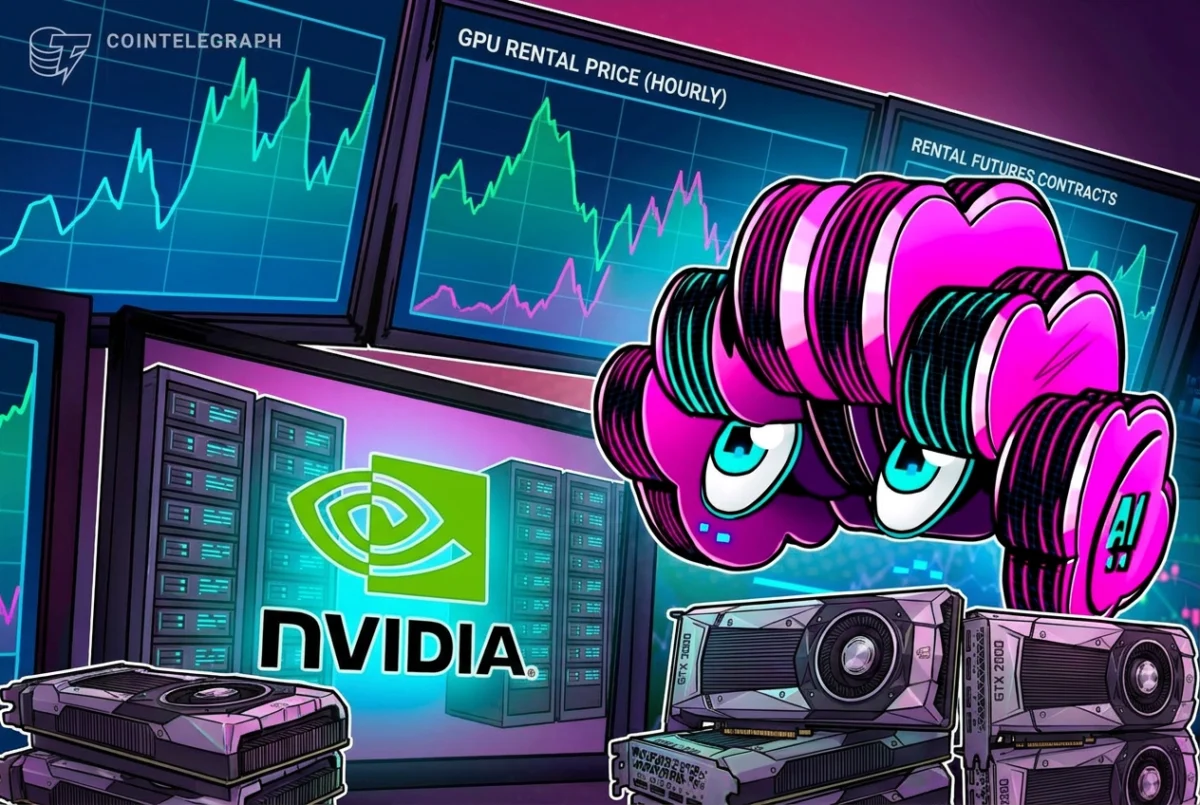
Layer-1 blockchain network Injective has officially launched a specialized perpetual futures market designed to track the rental prices of five distinct Nvidia graphics processing units (GPUs). The new financial instrument allows crypto traders and market participants to speculate on fluctuations in artificial intelligence computing costs, offering up to 10x leverage using USDC as margin.
The underlying benchmark for this new market is the Super Intelligence Compute Index (SICI). This index is engineered to monitor real-time and historical rental prices for a carefully selected suite of high-performance Nvidia chips, which includes the H100, B200, H200, A100, and RTX 4090 models. To ensure accuracy and reliability, the index relies on comprehensive compute marketplace data compiled by London-based financial market data firm LO:TECH.
According to Injective’s announcement, the SICI utilizes a weighted allocation model to reflect the varying market significance of each piece of hardware. The flagship Nvidia H100 chip commands the largest individual weight in the index at 40%, closely followed by the next-generation B200 chip at 25%. The remaining weight is distributed among the other supported models. To maintain a smooth and responsive market feed without falling victim to short-term price manipulation or extreme intraday volatility, the index is updated on an hourly basis, utilizing a trailing seven-day moving average of actual rental prices. Traders interacting with the platform can take directional positions, speculating on whether the overall cost of computing power will rise or fall over time.
This latest offering represents a significant expansion of Injective’s decentralized finance (DeFi) product suite. It directly builds upon an earlier milestone achieved in August 2025, when the blockchain network introduced a localized perpetual market tied exclusively to Nvidia H100 rental prices. By scaling the concept from a single hardware model into a multi-chip index, Injective aims to capture a broader snapshot of the AI infrastructure economy.
The economic mechanics behind the product serve a dual purpose within the broader technology landscape. Companies developing sophisticated large language models and other AI applications typically avoid the staggering upfront capital expenditure required to purchase Nvidia GPUs outright. Instead, they routinely rent computing capacity on a pay-as-you-go basis from specialized cloud providers, often referred to as neoclouds, such as CoreWeave and Nebius. Because these rental rates fluctuate dynamically based on supply and demand shifts across the global market, Injective’s new futures product provides a vital financial tool. AI model developers can utilize the derivatives market to hedge against sudden spikes in computing costs, locking in predictability for their operational expenses. Conversely, GPU infrastructure providers and cloud hosts can use the market to protect their balance sheets against declining rental revenues should hardware demand soften.
AI infrastructure boom raises financial concerns
The introduction of the Super Intelligence Compute Index arrives at a delicate juncture for the technology sector, as industry observers, lenders, and market analysts increasingly question whether the companies renting out AI computing power can sustainably recover the astronomical costs associated with building and operating massive GPU data centers.
These underlying financial anxieties were highlighted in a research note published in October by market research firm Gartner. The firm warned that more than 80% of specialist AI cloud providers, commonly known as neoclouds, could face severe financial distress and cease operating independently by the year 2030. According to Gartner’s assessment, many of these smaller or mid-tier providers struggle to generate sufficient and reliable returns on their heavy investments in hardware and facility infrastructure.
Technology entrepreneur Elon Musk echoed these pressing concerns publicly, stating that more than 200 neocloud providers could face imminent failure or forced industry consolidation. Musk pointed out that traditional lenders are becoming progressively more reluctant to finance companies whose business models depend heavily on volatile AI data center revenue streams.
Musk himself maintains deep financial and operational interests in the sector through SpaceX. The aerospace company’s burgeoning "Super Intelligence" business unit recently reported an impressive $7.6 billion in third-quarter revenue, marking an 830% increase compared to the same period the previous year. This substantial growth was driven in significant part by new cloud services agreements and enterprise partnerships.
Concurrently, major legacy technology corporations are actively restructuring their corporate operations and trimming overhead costs as they pour tens of billions of dollars into constructing the backbone of the global AI boom.
Recent corporate actions underscore the immense financial pressure facing the sector. Bloomberg reported that Microsoft, which has projected a staggering capital expenditure budget of approximately $175 billion for the 2026 fiscal year, has begun offering voluntary buyout packages to roughly 60,000 eligible employees. The workforce reduction initiative is part of Microsoft’s broader strategy to optimize its internal cost structure while simultaneously accelerating its aggressive spending on AI infrastructure and data center expansion.
Similarly, social media giant Meta has engaged in aggressive structural trimming to offset its own massive capital outlays. Having already poured well over $100 billion into artificial intelligence research and infrastructure development, Meta executed a targeted round of job cuts affecting 8,000 employees as part of an ongoing corporate reorganization aimed at preserving long-term operational efficiency.





Comments (0)