


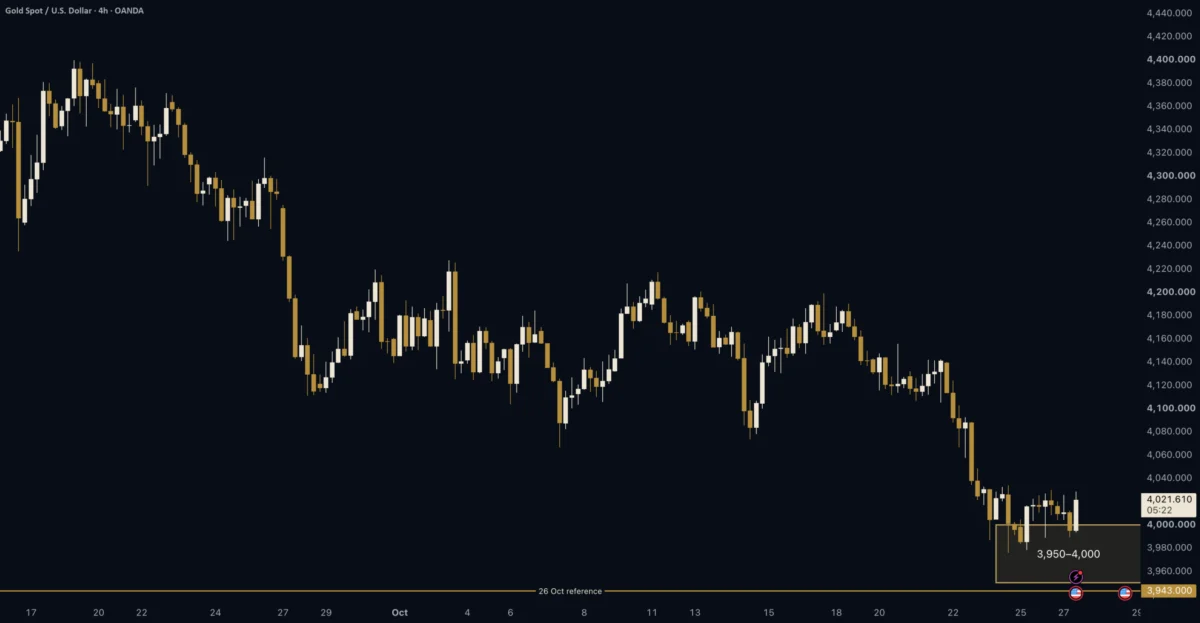
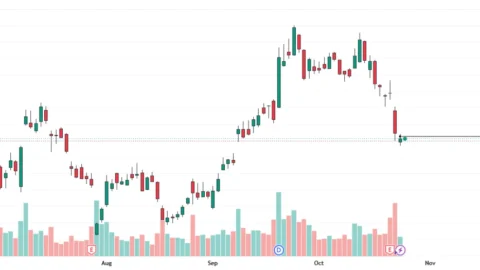
Gold prices hovered around the $4,024 mark at 12:48 UTC on October 27, maintaining a position above the crucial $3,950 to $4,000 demand area that drew significant market attention during Monday’s New York trading session. The precious metal’s ability to stay afloat above this psychological and technical zone has kept market participants closely monitoring price action as they attempt to decipher whether recent downside momentum represents a temporary retracement within a broader secular bull market or the nascent stages of a more severe correction.
During the earlier New York session, the primary question dominating market discussions was whether the prevailing sell-off was merely a routine correction within a larger, established uptrend or if it signaled the beginning of a deeper downward movement. Central to that assessment was the $3,943 level, which served as a critical technical reference point sitting directly beneath the $3,950 to $4,000 band. Even as prices retreated toward these tested zones, simply reaching recognized support levels was not deemed a sufficient signal to initiate long positions, reflecting a cautious and disciplined approach to market participation amidst heightened volatility.
The subsequent recovery pushing prices back above the $4,000 threshold has certainly made the market’s response worth watching closely, yet analysts emphasize that this rebound does not, by itself, establish a valid long entry signal. Financial markets frequently experience technical bounces off established support levels without changing the underlying macro structure or the dominant short-term momentum. Consequently, market participants are weighing two distinct potential scenarios as they evaluate the evolving price action.

A sustained recovery that manages to consolidate above these reclaimed levels would lend substantial weight to the correction scenario, implying that the recent pullback was simply a healthy cooling-off period before the resumption of the primary upward trend. Conversely, a failure back through the established area, particularly if prices breach the vital downside marker below $3,943, would immediately put the deeper-decline scenario back into focus. Such a breakdown would suggest that selling pressure remains dominant and that the market could be vulnerable to further downward revisions in the near term.
It remains a fundamental principle of technical market assessment that these identified thresholds act strictly as reference levels for evaluating price behavior and market structure, rather than serving as automated entry triggers, stop-loss markers, or specific price targets. Navigating these volatile conditions requires continuous observation of how prices interact with key historical zones rather than relying on isolated bounces.
As trading progresses following the mid-day update, market participants continue to parse incoming data and volume dynamics around these critical technical boundaries. The interplay between buyers defending the $4,000 handle and sellers testing the resolve of the recent correction will likely dictate the next directional move for gold as the weekly session unfolds.

Comments (0)