



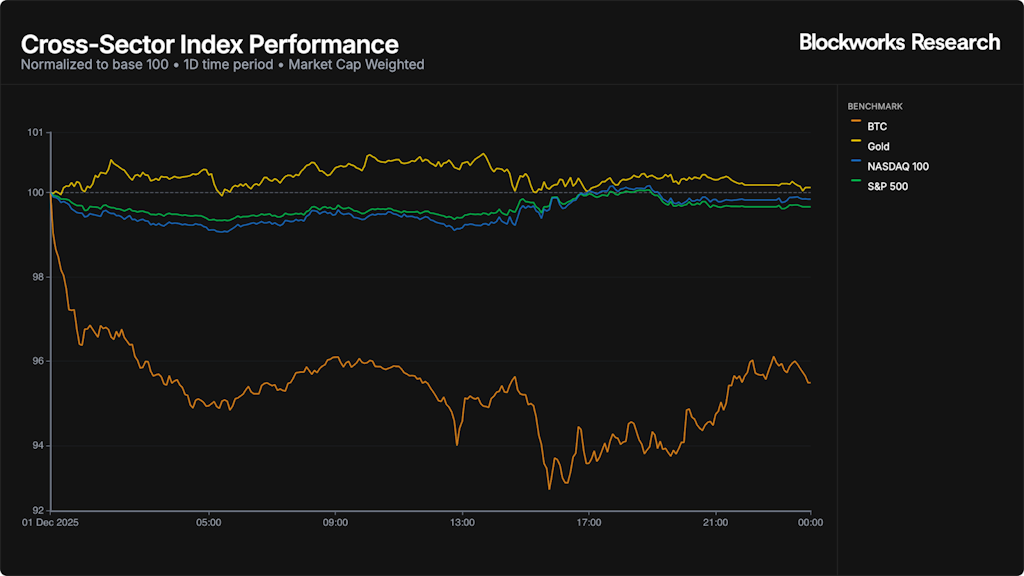
Global financial markets faced renewed selling pressure on Monday, with the cryptocurrency sector taking a particularly sharp hit even as expectations for a near-term Federal Reserve interest rate cut remained firmly elevated. While traditional equities experienced only modest pullbacks and gold continued to hover near recent highs, digital assets suffered a broad-based retreat that underscored ongoing risk aversion among investors.

Throughout Monday’s trading session, Bitcoin drifted lower, plunging by more than 6% at its lowest point before stabilizing to finish the day down approximately 4.5%. Broader risk assets showed far more resilience. The Nasdaq 100 slipped a meager 0.2%, and the S&P 500 declined by just 0.3%. Meanwhile, gold managed a slight gain of 0.1%, once again outpacing Bitcoin and maintaining its position near recent trading highs.
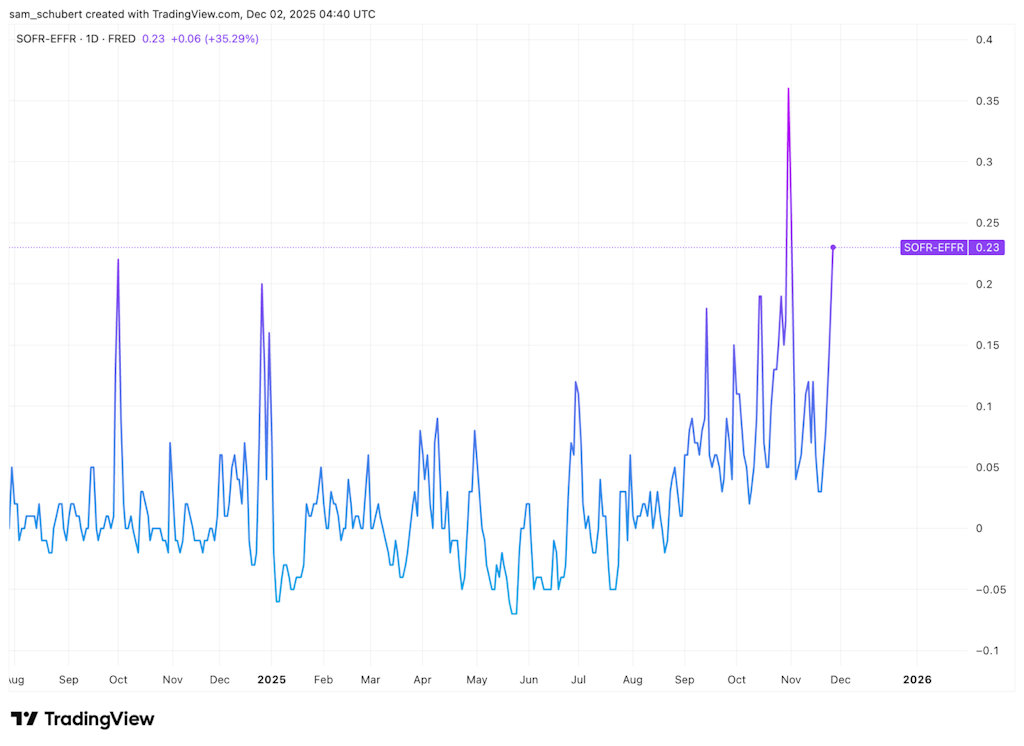
Market participants remain hyperfocused on United States monetary policy developments and liquidity dynamics. The CME FedWatch Tool indicates an 87% probability that the central bank will implement a 25-basis-point rate cut during its upcoming December meeting. However, analysts point to recent movements in the Secured Overnight Financing Rate (SOFR)—which has climbed materially above the Federal Reserve’s upper bound—as a clear signal of emerging liquidity and bank reserve stress. When key overnight secured rates persistently trade through the top of the policy corridor, it typically suggests that bank reserves are becoming increasingly scarce at the margin and that balance sheet capacity is constrained. Market participants are now closely monitoring the Federal Reserve’s next operational steps, as adjustments to balance sheet management or administered rates will likely be required to alleviate this tension and re-anchor money market pricing safely within the target range.
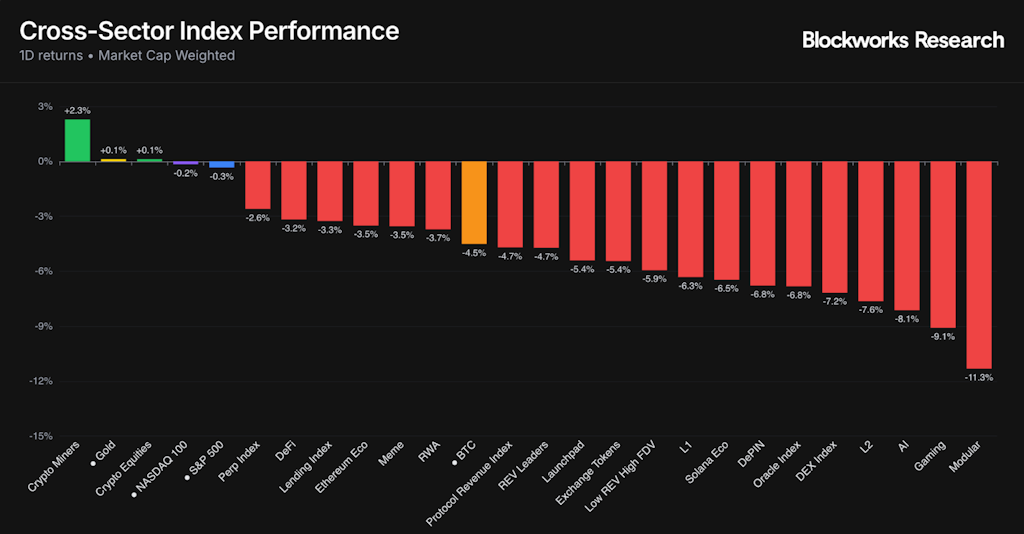
Within the digital asset ecosystem, performance was overwhelmingly negative, with most sector indices underperforming Bitcoin following a punishing month for risk-on assets. Crypto miners emerged as a rare bright spot, rising 2.3% and continuing to decouple from the wider digital asset complex, while crypto equities eked out a marginal 0.1% gain. At the opposite end of the performance spectrum, modular blockchain tokens suffered the steepest losses with an 11.3% decline, followed by gaming tokens down 9.1% and artificial intelligence-related baskets dropping 8.1%. Decentralized finance sectors, including layer-2 networks, decentralized exchanges, and decentralized physical infrastructure networks, recorded losses ranging between 6% and 8% on the day. Market observers view this pattern as entirely consistent with ongoing risk reduction and capital preservation across higher-beta tokens as participants await clearer confirmation that macroeconomic policymakers will act to soothe current liquidity concerns.
Market Update
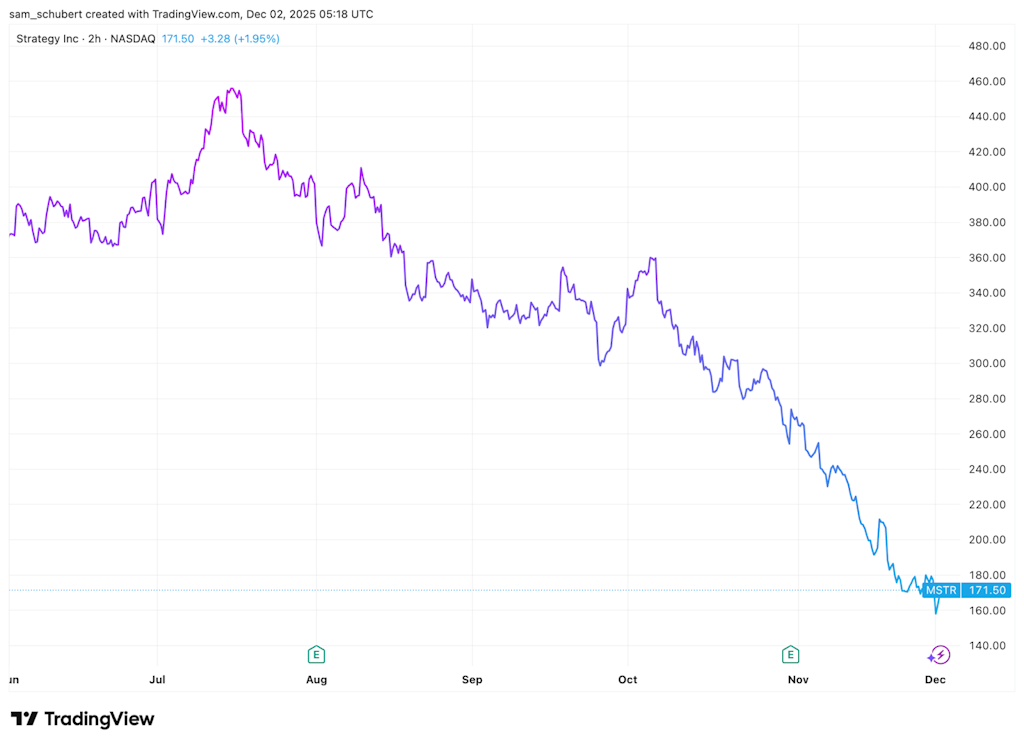
Strategy (MSTR) dominated market conversations as its shares extended a severe multi-week drawdown. The stock dropped below $160 during Monday’s session before recovering slightly to close near $171. This latest downward movement leaves MSTR down roughly 37% over the past month and more than 60% below its July highs.
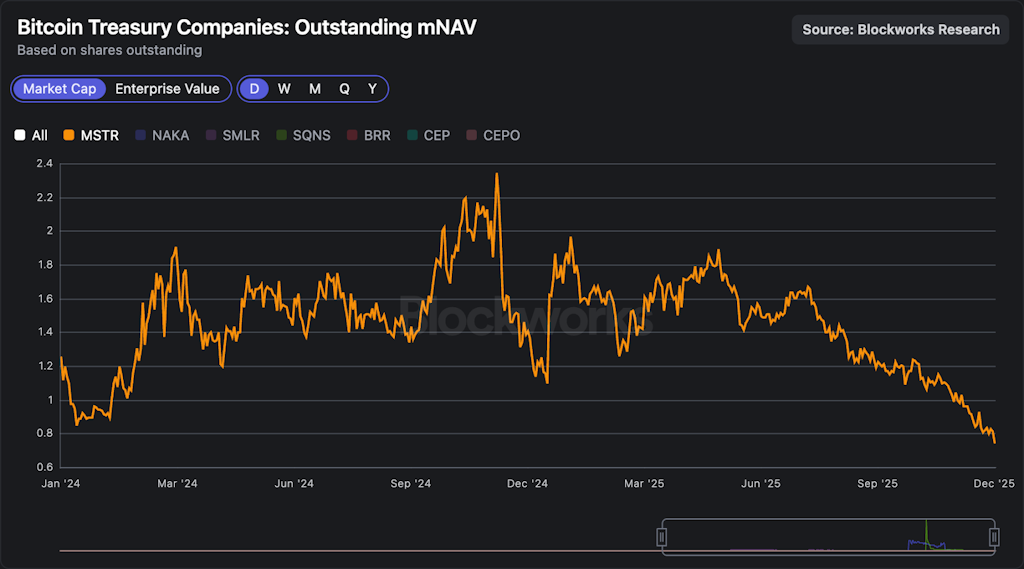
The company’s outstanding market-to-net-asset-value (mNAV) ratio, which dipped below parity in early November, has continued to slide toward 0.75, reflecting the prevailing risk-off sentiment across digital asset holding vehicles. This compression raises valid concerns regarding potential cascading effects, as investment vehicles trading at persistent discounts to their underlying assets can amplify drawdowns and trigger forced selling pressures. When a corporate vehicle of this scale trades significantly below its net asset value, issuing new equity ceases to be accretive and instead becomes value-destructive, effectively removing one of its primary funding levers. That dynamic forces management toward alternative strategies, such as liquidating Bitcoin holdings or executing derivative transactions on the asset, precisely when both the token and the equity are already suffering under heavy downward pressure.
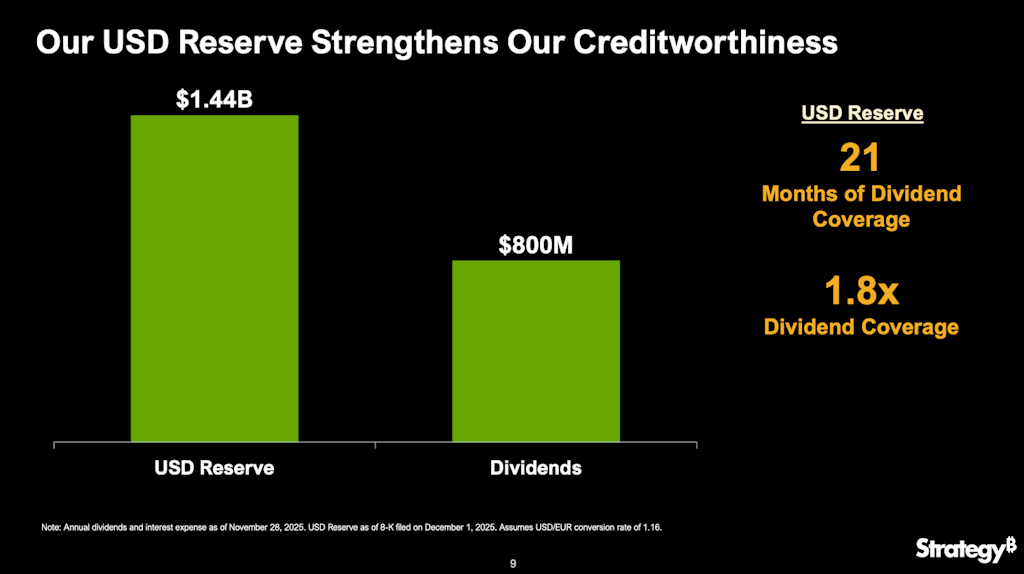
Despite these headwinds, corporate disclosures released recently revealed that Strategy has successfully accumulated a cash reserve of approximately $1.4 billion, funded through prior equity issuance. This capital has been explicitly earmarked to cover a minimum of 12 months of dividend obligations, with management stating an ultimate goal of extending that runway to 24 months. This financial buffer is designed to ensure the company can continue meeting its dividend commitments without needing to liquidate any portion of its roughly 650,000 Bitcoin treasury, even in the event of a prolonged market downturn. The announcement helped the stock recover a portion of its intraday losses by offering reassurance to nervous shareholders.
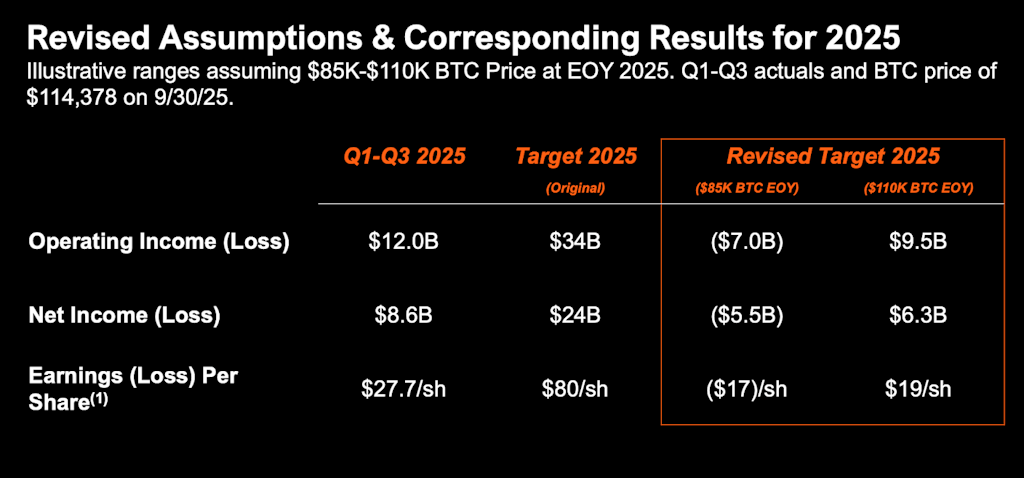
Concurrently, corporate leadership adjusted its year-end Bitcoin price assumptions downward from $150,000 to a conservative range of $85,000 to $110,000, reducing its projected dollar-gain targets accordingly. During an investor conference call, executives emphasized that full-year GAAP earnings remain exceptionally sensitive to the final Bitcoin price at year-end, noting that a price falling below roughly $94,000 would result in operational net losses, whereas a print above that threshold would support positive net income.
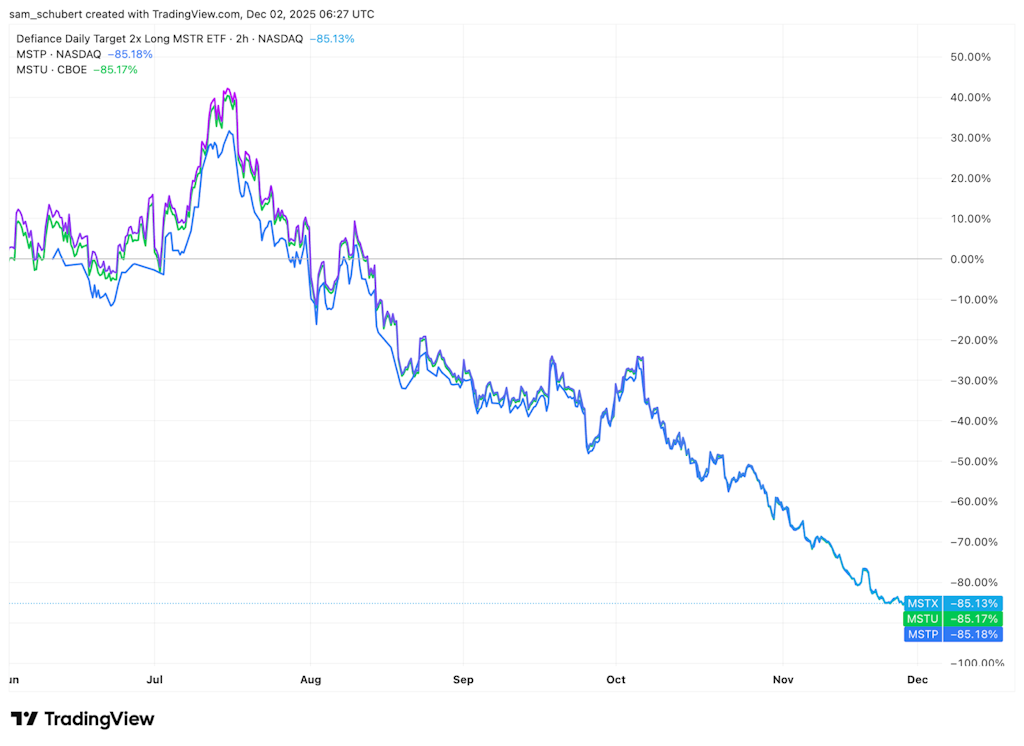
Leveraged exchange-traded funds tied to Strategy have borne the brunt of the recent equity volatility. Products such as MSTX and MSTU, which are designed to deliver twice the daily return of Strategy stock, rank among the ten worst-performing US exchange-traded funds this year, having sustained losses exceeding 80%. A newer fund, MSTP, has experienced a similarly steep decline since its inception. Consequently, the combined assets under management for this trio of leveraged products have shrunk from more than $2.3 billion in early October to approximately $800 million. These products vividly illustrate how a 60% correction in an underlying stock, combined with a 30% pullback in Bitcoin, can be drastically magnified by volatility decay. The continuous compounding of daily gains and losses steadily erodes investor capital even if the underlying asset eventually rebounds, leaving late-entering retail participants with substantial losses and turning a once wildly popular trade into a classic case of negative reflexivity.
HumidiFi’s ICO: Dark AMM, Darker Disclosures
In the decentralized finance arena, attention has turned to the upcoming token sale for HumidiFi’s WET token. WET is scheduled to debut as the first initial coin offering on Jupiter’s Decentralized Token Formation platform, with spot trading slated to go live on Meteora and HumidiFi. HumidiFi operates as a proprietary automated market maker developed by Temporal, a Solana-native research and development firm that also oversees Nozomi, a transaction landing service, and Harmonic, a block-building system designed to compete with Jito. Ahead of the token generation event, the project team published detailed documentation outlining the tokenomics for WET.
The token will feature a maximum supply of 1 billion units, with 10% specifically carved out for initial coin offering participants. Eligible participants fall into several defined categories, and a snapshot taken in mid-November was utilized to determine pre-sale allocations reserved for active platform users, heavily skewing toward top-tier traders. Historical platform data indicates that traders generating lifetime volumes exceeding $100 million have consistently accounted for more than half of HumidiFi’s daily trading activity. These high-volume wallets are widely believed to represent sophisticated market makers and arbitrage bots that are expected to secure whitelist access for the offering.
According to the token distribution schedule, the remaining 90% of the supply is divided among the Zero Position Foundation, which receives 40%, alongside the ecosystem and labs allocations, which receive 25% each. While official announcements do not explicitly attribute the operation of the Zero Position Foundation to a specific legal entity, it is widely presumed to be managed by Temporal. Similarly, the labs allocation corresponds to Temporal’s role as the primary engineering contributor to the platform. Platform developers have also acknowledged the contributions of a broader network of partners, including engineering teams, market makers, and liquidity providers, suggesting that the ecosystem bucket will serve to incentivize these key stakeholders.
WET is set to launch with an initial circulating float of 23%, bearing a resemblance to the low-float, high-fully-diluted-valuation token distributions that have historically drawn criticism across the Solana decentralized finance ecosystem. Industry observers have expressed surprise at this structural choice, given how severely the broader market has penalized low-float assets over the past two years. Documentation indicates that 19.25% of the total supply will be unlocked incrementally every six months over a two-year period following the token generation event.
From a fundamental perspective, HumidiFi has rapidly consolidated its position as a dominant proprietary automated market maker by trading volume over recent months. During November, the protocol captured 51% of Solana-native token pairs involving stablecoins and accounted for 36% of total decentralized exchange volume across the entire blockchain, outperforming traditional automated market makers such as Orca, Raydium, and Meteora.
Furthermore, HumidiFi’s trading activity has frequently eclipsed major centralized exchanges for spot trading pairs. The platform has averaged over $1 billion in daily volume for native token pairs, occasionally surpassing Binance to claim the top spot globally. This meteoric rise since the platform’s inception highlights the swift adoption of its proprietary market-making architecture.
Despite this fundamental strength, market participants note that the upcoming token launch will not provide a direct vehicle for investors seeking exposure to proprietary automated market making. Prior to this release, the primary method for expressing a bullish view on this sector’s market share growth involved shorting tokens associated with traditional automated market makers. Token utility for WET will primarily center around staking to earn fee rebates, though project documentation explicitly cautions that the asset should not be viewed as an investment. As the token sale approaches, several fundamental questions remain unanswered regarding the rationale behind a profitable proprietary trading desk utilizing a public token sale for fundraising, the lack of explicit equity ownership rights tied to the token, and the governance structure governing the foundation controlling 40% of the supply.





Comments (0)