



The perpetrators behind the estimated $6.3 billion hack of Binance continue to maintain control over billions of dollars in stolen cryptocurrency, even as token issuers, decentralized finance protocols, and blockchain security firms scramble to freeze and track the proceeds. The security breach, which stands as the largest heist in the history of the digital asset industry, unfolded rapidly beginning at 8:04 pm UTC on a Thursday.
Investigators tracking the incident have linked the threat actors to the same North Korean hacker collectives associated with previous major exploits, including last month’s high-profile attack on the Bitget exchange. Moving with extreme operational speed, the attackers immediately executed a carefully calculated plan designed to bypass the defensive mechanisms of modern blockchain infrastructure. Their primary objective was clear: rapidly convert crypto assets equipped with centralized freeze capabilities into native, decentralized cryptocurrencies that cannot be arbitrarily paused or blocked by a central issuer.
According to onchain data traced by CertiK engineer Dickson Wu, the attackers moved swiftly to exploit centralized stablecoins. Wu tracked a staggering $500 million in USDT sent to a single malicious address, out of which $325 million was dumped onto the open market and swapped for Ether with market makers by 20:59 UTC—less than an hour after the initial breach began.
This aggressive liquidation strategy was part of a desperate race against some of the most powerful gatekeepers in the digital asset ecosystem. Stablecoin heavyweights like Tether and Circle were instantly alerted to the unauthorized outflows and initiated emergency response protocols, blacklisting addresses tied to the theft in an effort to neutralize the stolen capital before it could be laundered further.
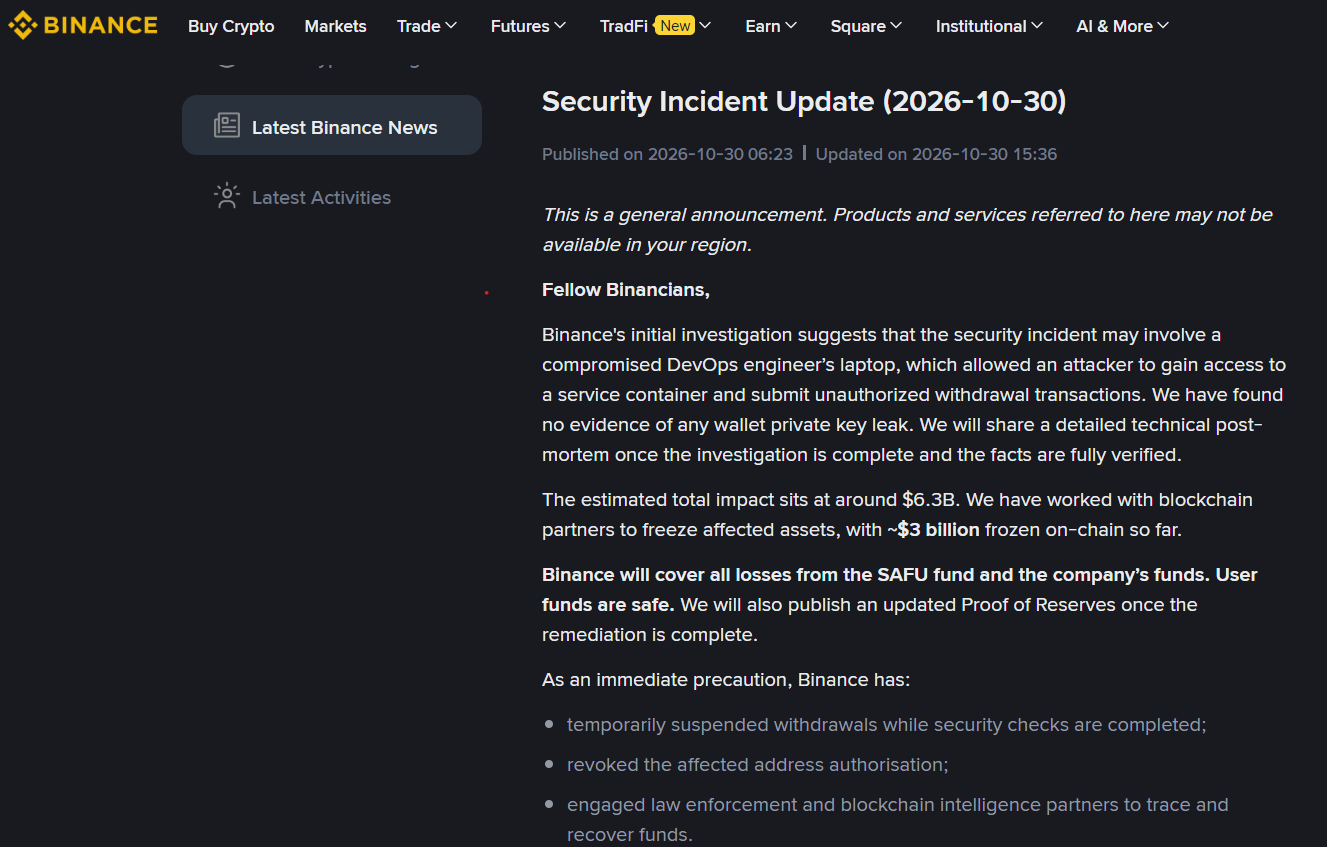
By the following day, Binance reported that approximately $3 billion worth of the stolen assets had been successfully frozen onchain out of the estimated $6.3 billion total. The exchange confirmed that it is actively collaborating with international law enforcement agencies, token issuers, and prominent blockchain analytics firms to trace the remainder of the funds and identify the individuals behind the operation.
While the sheer financial scale of the incident is staggering, the fact that roughly half of the stolen funds were frozen within hours raises critical questions regarding the shifting dynamics of blockchain security, asset recoverability, and the limitations of centralized control within a decentralized financial ecosystem.
Crypto with an Off Switch
The chaotic hours following the Binance exploit highlighted a fundamental division within the cryptocurrency landscape: the stark operational differences between decentralized native assets and centralized digital tokens. Unlike decentralized cryptocurrencies such as Bitcoin and Ether, which operate on permissionless networks with no central issuer and no mechanism to hit a pause button, centralized stablecoins are issued by specific entities that retain absolute administrative control over the tokens. Issuers like Tether, the company behind USDT, and Circle, the firm managing USDC, possess the technical capability to freeze tokens held at specific blockchain addresses.

This administrative functionality provides stablecoin issuers with the unique power to act swiftly and decisively during catastrophic security incidents. Tether moved aggressively during the Binance crisis, ultimately freezing approximately $1.567 billion in USDT. The first major freeze occurred a mere 37 minutes after the illicitly obtained funds arrived at the primary Ethereum wallet controlled by the hackers.
Circle followed suit rapidly, freezing roughly $823 million in USDC just three minutes later. Other major digital asset entities, including Ripple and World Liberty Financial, similarly intervened to blacklist associated addresses and lock down suspicious capital inflows.
The capacity to immobilize suspect capital is not exclusively restricted to centralized corporate stablecoins. Despite operating as a decentralized scaling protocol without a traditional corporate issuer, Arbitrum demonstrated that community-governed protocols can also mount rapid defenses. The Arbitrum Security Council intervened directly, moving approximately $30.5 million worth of ARB and ETH into an intermediary frozen wallet. Assets placed into this specialized wallet remain locked and can only be transferred following further administrative action by the security council or a formal governance vote by the Arbitrum Decentralized Autonomous Organization.
Despite these aggressive defensive maneuvers, industry experts emphasize a crucial distinction: frozen funds do not automatically equate to recovered funds. While immobilizing assets successfully prevents suspected attackers and money launderers from spending or transferring the stolen capital, it does not instantly return the funds to the victimized exchange or its impacted users. The frozen tokens remain in limbo, often locked indefinitely on the blockchain unless legal settlements, issuer interventions, or complex governance decisions unlock them for restitution.
The Aave Complexities
The involvement of decentralized finance protocols added an intricate layer of complexity to the unfolding crisis, testing the boundaries of smart contract logic and automated risk management. Between 20:58 and 21:01 UTC, a digital wallet controlled by the hackers deposited $60 million in USDT into Aave V3 deployed on the Ethereum network. Against this collateral, the attackers proceeded to borrow $44.6 million of wrapped Ether, executing the maneuver roughly 40 minutes before the first wave of stablecoin freezes took effect.
LlamaRisk, an independent risk service provider for the Aave protocol, issued a status update indicating that the malicious wallet’s borrowing position ultimately held approximately $59.9 million in USDT collateral against $43.8 million in active debt. Representatives for Aave noted that the position remained strictly overcollateralized throughout the ordeal, ensuring that protocol liquidity suppliers and general depositors were not placed at direct financial risk.
Because the USDT had already been successfully deposited into Aave’s automated lending pool prior to administrative blacklisting, simply freezing the attacker’s external wallet could not automatically retrieve the collateral locked inside the protocol’s smart contracts. Marc Zeller, founder of the Aave Chan Initiative, detailed the operational dilemma on social media, noting that the USDT represented legitimate capital backed by external reserves, making the illicit deposit an overcollateralized position in the strict eyes of automated protocol code.
To contain the cascading risks and prevent further exploitation of its markets, Aave administrators temporarily suspended various lending and borrowing markets across its V3 and V4 deployments. During this precautionary pause, existing users retained the ability to withdraw funds, repay outstanding loans, and execute liquidations, though new borrowing and depositing activities were halted.
Aave later lifted the precautionary freezes across the affected markets, confirming that its core smart contracts remained entirely uncompromised and that ongoing borrowing positions continued to maintain healthy overcollateralization ratios.
What the Attackers Actually Retained
Financial analytics firm Elliptic estimated that by 7:00 am UTC on Friday, roughly $2.84 billion in stolen assets had been successfully frozen by various issuers and protocols. However, the attackers still maintained direct control over approximately $3.33 billion in assets that token issuers could not immobilize or recall.
While the coordinated emergency freezes effectively halved the attackers’ potential profit pool, the remaining billions present a formidable challenge for recovery efforts. Because Bitcoin, Ether, and similar native cryptocurrencies lack a centralized token issuer with administrative authority to blacklist individual wallets, converting stolen capital into these assets largely shields the funds from direct administrative freezes. Although blockchain analytics firms can closely monitor and flag transactions involving these native coins, restricting their movement on permissionless networks is exceptionally difficult.
In response to the historic breach, Binance leadership has pledged to cover all potential user losses entirely out of its own corporate reserves and the Secure Asset Fund for Users, ensuring that customer accounts remain fully protected. According to updates provided by Binance Chief Executive Richard Teng, the exchange is actively cooperating with global law enforcement agencies to recover stolen assets and secure justice for affected users.





Comments (0)