



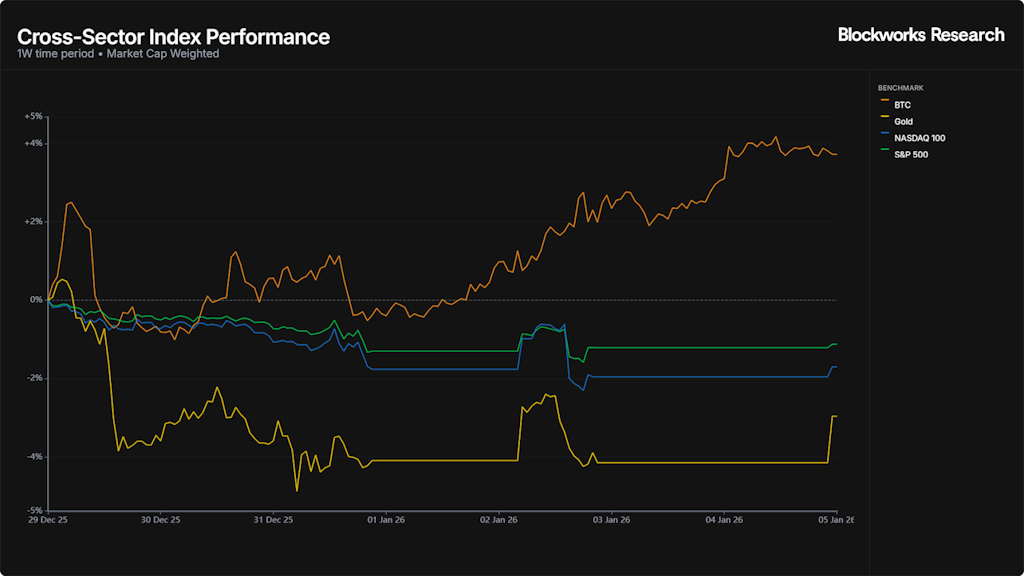
The crypto markets kicked off the year with subtle yet critical shifts in positioning, led by Bitcoin decoupling from traditional risk-on assets and demonstrating a rare negative correlation to both equities and gold. While traditional financial markets softened at the start of the year, higher-beta crypto narratives reawakened, and derivatives positioning across major digital assets pointed to a measured, careful rebuild of risk rather than an eruption of speculative excess.
As traders and analysts parse the early tape behavior of the year, index performances, underlying Ethereum derivatives metrics, and the accelerating narrative surrounding equity perpetuals are painting a detailed picture of an evolving market structure.
Market Indices and the Return of Bitcoin’s Diversification Role
Bitcoin quietly stole the spotlight, benefiting from a timely negative correlation to both equities and gold that has been largely absent for much of the past year. While traditional markets drifted lower—with the Nasdaq 100 sliding 1.7 percent and the S&P 500 dipping 1.1 percent—and gold experienced a sharp 3 percent sell-off, Bitcoin ground higher, posting a 3.7 percent gain.

This steady, low-drama upward move stood out precisely because of how infrequently crypto has outperformed across both risk and defensive asset classes within the same window over the past year, a period during which correlations repeatedly snapped back toward parity. Rather than feeling like a wave of unbridled speculative exuberance, the week’s price action served as a reminder of Bitcoin’s historical utility as a portfolio diversifier. Whether this decoupling can persist will ultimately depend on broader macroeconomic follow-through, but Bitcoin’s ability to outperform both stocks and gold simultaneously marks a noteworthy shift in tape behavior.
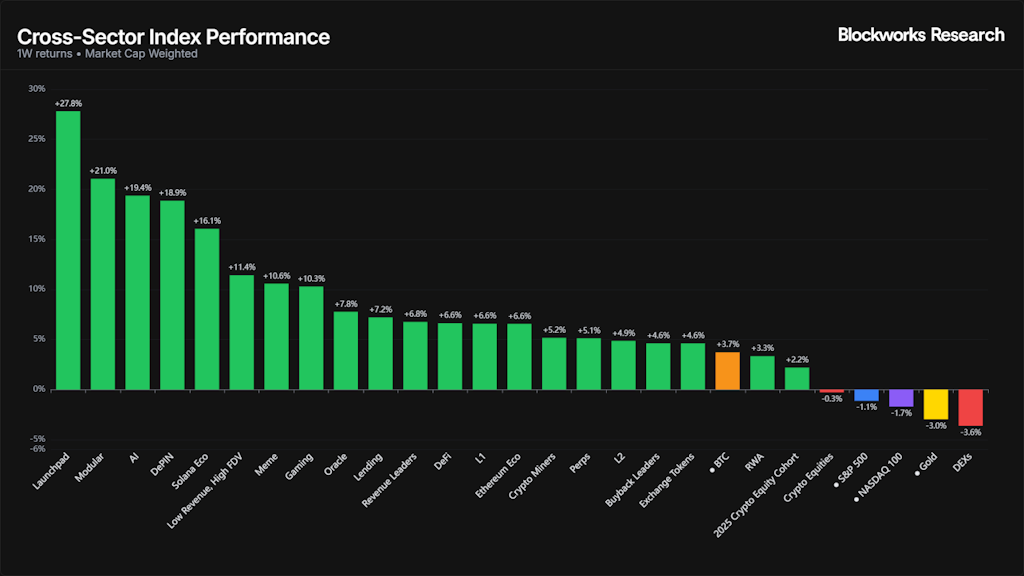
Beneath Bitcoin’s steady climb, last week’s sector-specific winners were concentrated almost entirely in the higher-beta, narrative-driven corners of the digital asset ecosystem, highlighting a distinct rotation toward speculative positioning. Launchpad tokens surged 27.8 percent to lead the market by a wide margin, fueled by renewed retail participation and a rapid resurgence in short-duration token launches as traders prioritized velocity over fundamental valuations.
Modular infrastructure tokens and artificial intelligence narratives followed closely behind, posting gains of 21 percent and 19.4 percent, respectively. Decentralized Physical Infrastructure Networks, commonly known as DePIN, and the broader Solana ecosystem also stood out, registering gains of 18.9 percent and 16.1 percent.
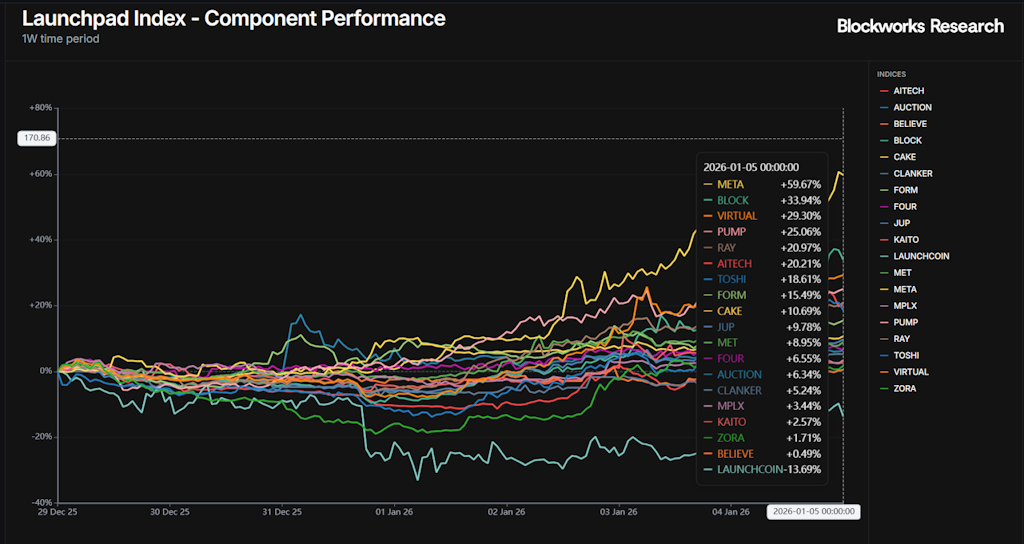
Within the launchpad sector specifically, leadership once again belonged to MetaDAO, which extended its streak of relative outperformance and cemented its status as the primary bellwether for the space. Sharp gains for its native token reflected a broader revival of interest in token issuance infrastructure, with active market participants gravitating toward platforms most directly exposed to new asset launches and velocity-driven capital flows.
The breadth of the move was equally striking. Nearly every single constituent within the launchpad index finished the week in positive territory, underscoring a synchronized sector-wide allocation trend rather than isolated, token-specific catalysts. The sole exception was Launchcoin, which lagged while the rest of the cohort captured the upside.
This near-universal participation is historically indicative of broader sector-level positioning. Looking ahead, the structural setup for launchpads remains compelling. With regulatory frameworks widely anticipated to crystallize, compliant launch infrastructure is poised to transition from a speculative niche into a permanent structural pillar of the broader crypto stack, forcing investors to engage with the sector systematically rather than opportunistically.
Ethereum Derivatives Signal a Measured Risk Reset
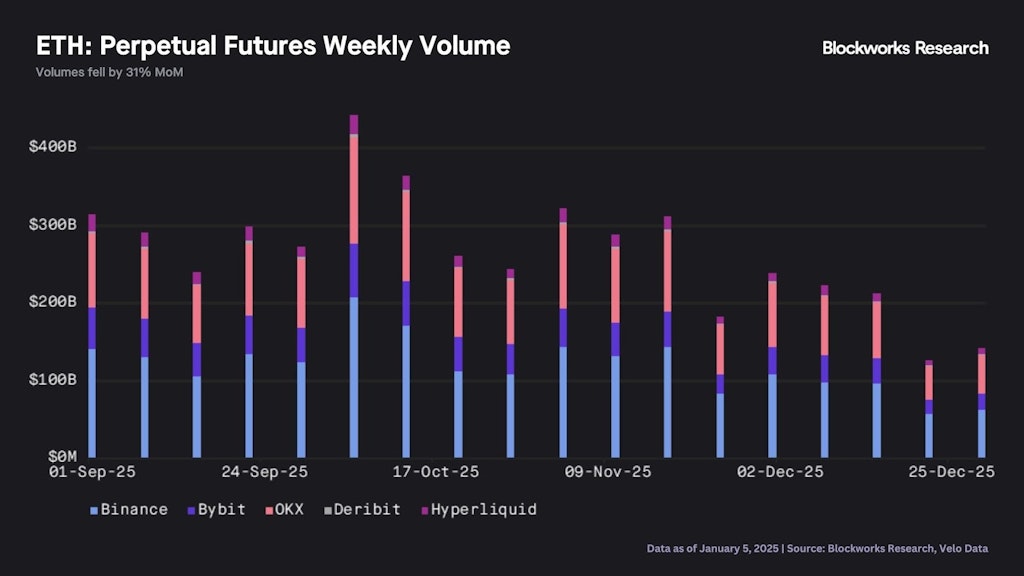
Shifting from spot markets to derivatives, December data for Ethereum revealed a fascinating divergence between participation and positioning. Perpetual futures trading volumes continued to cool significantly, with aggregate Ethereum perpetual futures volume falling roughly 31 percent month-over-month. This contraction extended the downward trend observed in November, reflecting a broader cooling of speculative intensity against a backdrop of price consolidation and compressed market volatility.
Trading activity tapered off broadly across major venue types, signaling a reduced appetite for short-term directional trading, a trend that was particularly pronounced amid the thinner liquidity conditions typical of the holiday season.
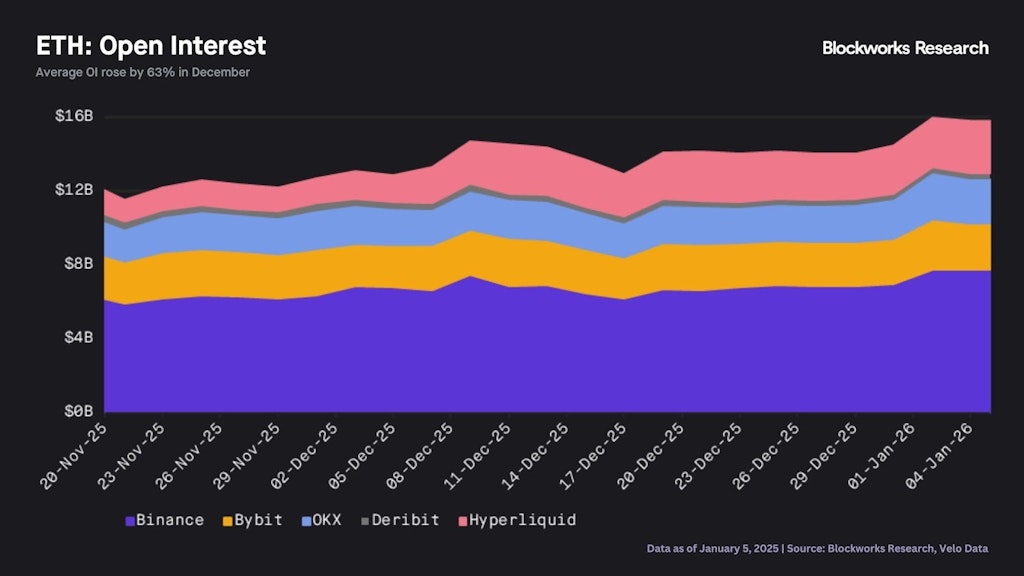
Despite this notable pullback in aggregate turnover and short-term speculative volume, open interest across Ethereum derivatives staged a robust rebound. Average Ethereum open interest rose approximately 63 percent over the course of the month, reversing the contraction seen in November and climbing steadily as underlying price action stabilized.
The simultaneous occurrence of falling trading volumes and rising open interest points to a very specific market dynamic: exposure was being rebuilt quietly and deliberately by longer-horizon traders or relative-value market participants, rather than accumulated through aggressive, short-term leverage chasing.
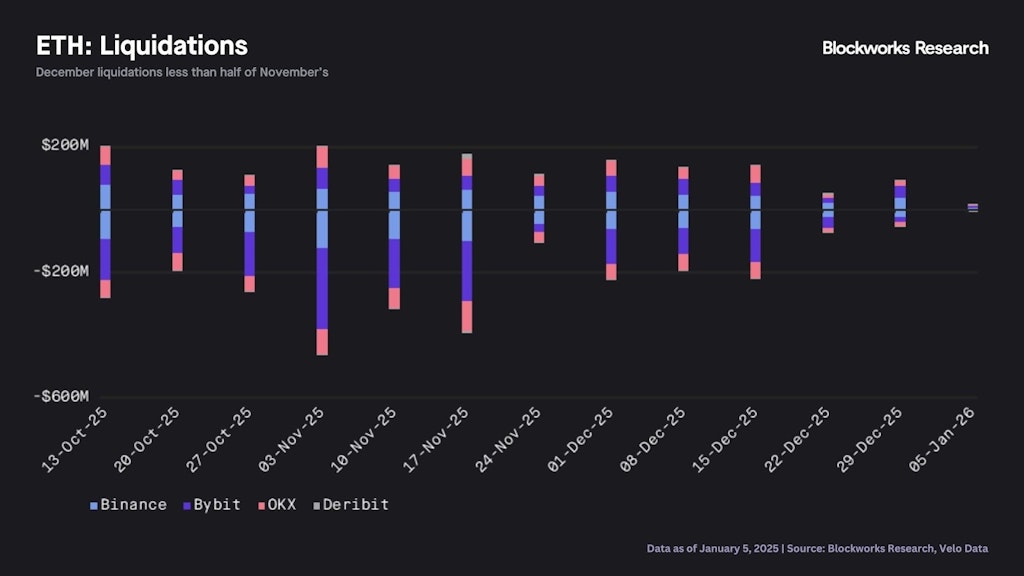
This measured, methodical approach to positioning was further corroborated by a steady decline in forced liquidation activity across the board. Ethereum liquidations remained remarkably subdued throughout the month, with weekly liquidation volumes plunging 56 percent compared to November levels and sitting far below the forced deleveraging extremes witnessed in October.
Both the long and short sides of the market remained relatively contained as prices consolidated. Although short liquidations continued to modestly exceed long liquidations, they did so at significantly lower absolute volumes. The complete absence of large-scale liquidation cascades, paired directly with rising open interest, underscores a considerably healthier structural leverage profile where market participants added positions gradually and managed their risk with greater discipline.
When viewed in totality, the combination of declining trading volumes, rising open interest, and falling liquidations characterizes the period as one of systemic risk reduction and a clean positioning reset, rather than a slide back into speculative excess.
The Emerging Bull Case for Equity Perpetuals
Beyond native digital assets, equity perpetuals have continued to attract attention as a product bridging traditional finance and onchain execution. While these instruments are frequently described merely as a crypto-native mechanism to bring traditional equities onchain, their true competitive landscape is not found in traditional options markets, but rather among leveraged exchange-traded funds, a product category that has already secured massive retail adoption.
The underlying appeal for retail investors is straightforward. Market participants increasingly demand leveraged exposure packaged within clean, intuitive wrappers. According to estimates from JPMorgan, retail equity flows surpassed previous levels by more than 50 percent compared to the prior year, exceeding even the frenzied meme stock peaks of 2021. Leveraged exchange-traded funds have absorbed a substantial share of this retail appetite, with total assets under management expanding dramatically from $41.6 billion in 2020 to reach $250 billion by late 2025, generating monthly trading volumes in excess of $800 billion.
However, leveraged exchange-traded funds suffer from a structural flaw: they rely heavily on underlying derivatives to reset their exposures on a daily basis, which introduces severe volatility drag. Even in market environments where the underlying index finishes flat over a given timeframe, leveraged exchange-traded funds can systematically bleed value over time.
Although these products are engineered explicitly for short-term, tactical trading, they are frequently misunderstood by retail participants and held for durations far longer than intended, often resulting in unintended capital erosion.
Equity perpetuals offer a technical solution to this structural flaw. By providing constant notional exposure without the necessity of daily resets, they eliminate the mechanical leverage decay inherent to traditional leveraged funds. Volatility does not compound against the trader in the same persistent manner, making equity perpetuals a cleaner instrument for anyone seeking straightforward leveraged directional exposure.
Early market traction offers empirical support for this thesis. Since mid-October, aggregate equity perpetual volume on Hyperliquid alone reached approximately $12.9 billion, with daily turnover frequently settling between $200 million and $300 million. Hyperliquid currently maintains a dominant market share in the space, followed closely by platforms such as Lighter. Accessibility remains a critical factor in this growth, with equity perpetual volume naturally congregating on the same onchain venues that already dominate native crypto perpetuals.
Nevertheless, friction points remain. When traditional equity markets close for the weekend or holidays, market makers lose the ability to effectively hedge their positions, causing liquidity to thin out and funding rates to occasionally experience sharp spikes. Platforms have attempted to manage these operational challenges through various means, including restricted trading hours or internal oracle adjustments. These lingering hurdles help explain why overall adoption has expanded at a steady, deliberate pace rather than exploding overnight.
Ultimately, the long-term winners in the equity perpetual space will not be determined purely by clever venue design, but rather by effective distribution networks. Just as centralized exchanges came to dominate native crypto perpetuals, equity perpetuals will likely scale through consumer-facing platforms that already command massive retail reach, with major fintech players and crypto exchanges best positioned to capitalize.

Several major industry entities have already taken preliminary steps toward tokenized equities, and fully compliant iterations of equity perpetuals could emerge broadly. The commercial opportunity is substantial, given that leveraged exchange-traded funds trade between $800 billion and $900 billion per month. Capturing even a fraction of those existing flows would translate to a meaningful expansion in trading activity for major retail platforms. In the end, equity perpetuals represent a natural evolution of a retail-focused product finding its way to the most efficient distribution channels available.





Comments (0)