



The cryptocurrency market closed out a turbulent year with a notably mixed performance, characterized by a resilient headline figure for Bitcoin contrasted against sharp, divergent movements across alternative sectors. While major tokens and specific verticals staged unexpected rallies, structural pressures, compressed asset valuations, and volatile capital flows continued to define the broader digital asset landscape as market participants navigated the holiday-shortened trading week.
Bitcoin managed to finish the week in positive territory, recording a modest 1.6% gain. However, this overarching stability masked deep underlying fragmentation throughout the broader token economy. Capital rotation proved unpredictable, leaving various sectors experiencing starkly contrasting fortunes as investors adjusted their portfolios ahead of the new calendar year.

Sector Performance Divergence
The most striking development of the week came from unexpected quarters. DePIN (Decentralized Physical Infrastructure Networks) and Gaming led all major market sectors, staging a surprising and aggressive rebound after enduring a brutal prior year. DePIN surged 13.1% on the week, while Gaming followed closely with a 12.6% gain.
These advances are particularly notable given how heavily battered both sectors were previously. Over the course of the preceding year, DePIN and Gaming indexes suffered steep drawdowns of approximately 79.5% and 81.3% respectively. The recent recovery injected a measure of optimism back into these heavily depressed verticals.
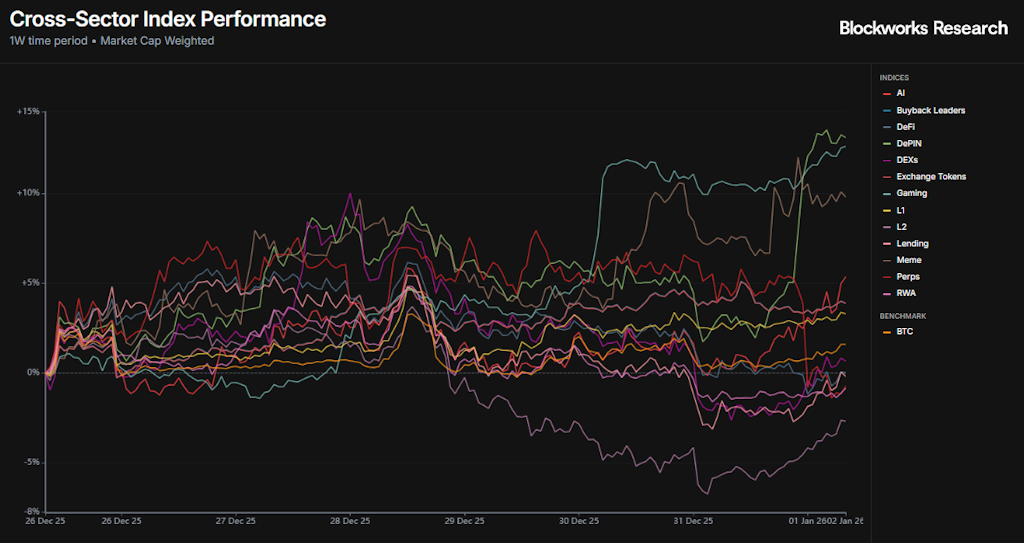
The strength within the DePIN sector was largely propelled by prominent tokens Filecoin (FIL) and Render (RENDER), which posted weekly gains of 22% and 13% respectively. Together, these two assets account for nearly half—specifically 49%—of the total index weighting. The Gaming sector demonstrated a similarly centralized momentum profile, with Immutable (IMX) leading the charge through an 11% increase that did the vast majority of the heavy lifting for the broader gaming index.
Conversely, other sectors struggled to find footing. Layer-2 scaling solutions (L2s) and Real World Assets (RWAs) lagged behind the broader market, dropping 2.67% and 0.84% respectively over the course of the week. Weakness within the L2 space was driven downward by tokens such as MNT and ZORA, which fell 5.7% and 6.4%.
At the same time, the L2 sector showcased its own internal polarization. Other prominent Layer-2 names—including Optimism (OP), Arbitrum (ARB), and ZK—posted substantial individual gains ranging between 10% and 20%. This sharp divergence highlights a market where investors are increasingly selective rather than engaging in blanket sector-wide accumulation.
Real World Assets faced downward pressure primarily due to a broader market pullback in gold following its stellar performance throughout the year. Tokenized gold products PAXG and XAUT both retreated by approximately 3.4% over the week.
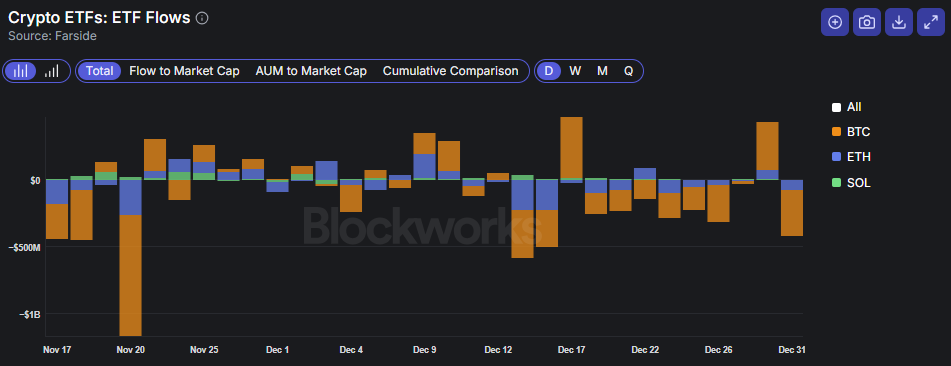
Overall capital flows mirrored this fragmented environment, remaining persistently choppy. Institutional fund flows painted a picture of indecision. On the final day of December, spot exchange-traded funds recorded $417.8 million in net outflows. This sizable exodus nearly wiped out the $428.2 million in net inflows that had been recorded just a day prior, illustrating a tug-of-war between institutional buyers and sellers.
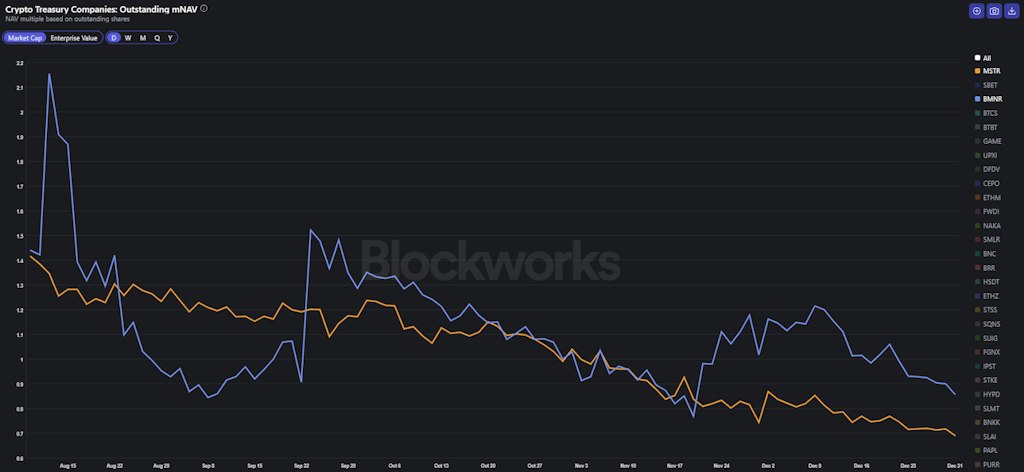
Meanwhile, digital asset corporate treasuries continued to experience significant strain. Modified net asset value (mNAV) multiples compressed further across major corporate holders. Entities such as MicroStrategy (MSTR) and Bitcoin Miner (BMNR) found themselves trading at mNAV levels of 0.69 and 0.85 respectively. This compression underscores the mounting valuation pressures facing the corporate treasury trade as participants step into the new year.
End-of-Year Analyses and Market Evolution
To contextualize the rapid shifts that defined the market, industry researchers released comprehensive retrospectives and forward-looking analyses over the weekend. These reports examine structural developments across stablecoin yields, payments infrastructure, cross-chain interoperability, and the psychological fatigue brought on by excessively rapid narrative cycles.
Among the notable institutional studies, Blockworks Research published an evaluation of Neutrl, a protocol aiming to bring institutional-grade over-the-counter (OTC) arbitrage into a stablecoin wrapper. The analysis points out that the protocol offers market-neutral yields designed to be less reliant on traditional funding rate cycles than existing synthetic dollar models. Early traction, characterized by double-digit sNUSD yields, indicates robust institutional demand supported by deep token unlock pipelines and privileged OTC execution access via STIX. While the upside potential rests on scalable deployment into hedged OTC deals, analysts note that the core risks center on execution quality, counterparty performance, and liquidity management. If these yields manage to hold up as total value locked scales, protocols of this nature could potentially mirror the trajectory of early Ethena dynamics while operating within a more structurally defensive framework.
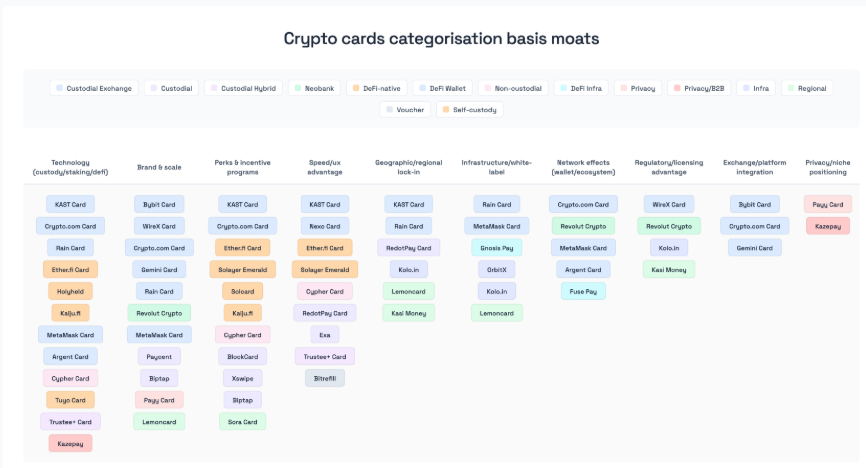
In the realm of consumer payments and retail adoption, an analysis by Polaris Fund explored the evolving moats surrounding crypto cards and neobanks. The research suggests that the sector has reached a critical inflection point, where long-term value is decisively shifting away from superficial marketing, rewards, and branding toward deep infrastructure, regulatory compliance, and liquidity control. According to the findings, durable competitive advantages stem from owning foundational primitives such as regulated access, programmable liquidity, and robust institutional integrations rather than relying on cash-back incentives. Infrastructure rail providers and decentralized-finance-native card models are increasingly capturing the most leverage through recurring fee structures and aligned token economics, while centralized finance distributors face ongoing margin compression. As regulatory frameworks tighten globally, market scale will increasingly favor entities that control licensing, settlement, and compliance workflows over those competing solely on consumer-facing perks.
Interoperability also took center stage in year-end reviews, highlighted by data from LayerZero examining how cross-chain technology accelerated the digital asset ecosystem. The findings indicate that 2025 marked the definitive transition of interoperability from theoretical infrastructure into the core operational backbone of crypto. Data demonstrates that tokenized assets and stablecoins are now routinely distributed across a multitude of disparate chains, with seamless interoperability acting as an accelerator for asset velocity, capital mobility, and global access. Rather than individual blockchains competing in isolation, the crypto economy increasingly functions as an interconnected network where liquidity flows freely to areas of genuine demand. The widespread adoption of message-based transfers and open primitives has successfully reduced transaction costs and structural friction, allowing cross-chain activity to increasingly resemble traditional software functionality rather than cumbersome financial plumbing. Consequently, interoperability is no longer viewed as a developmental bottleneck, but rather as the foundational default layer enabling true systemic scale.
Finally, Tiger Research released a retrospective examining a year defined by exceptionally rapid narrative cycles. The report notes that 2025 generated attention and speculation at a pace faster than the market could validate, leading to widespread user fatigue and analytical skepticism. While the vast majority of ephemeral narratives faded quickly into obscurity, a distinct subset successfully translated into tangible use cases that drove the market forward, particularly in areas where retail onboarding was simple and intuitive. Memecoins demonstrated how rapidly new users can be onboarded into the ecosystem, while simultaneously exposing the extreme fragility of user engagement in the absence of genuine retention mechanisms. Similarly, experiments involving incentivized growth models highlighted persistent quality and trust challenges. The clearest, most durable progress materialized where the industry definitively demonstrated authentic product-market fit—most notably across stablecoins, prediction markets, and streamlined payment rails. These developments reinforce the broader market lesson that enduring value emerges only when speculative narratives align directly with real-world economic utility.





Comments (0)