


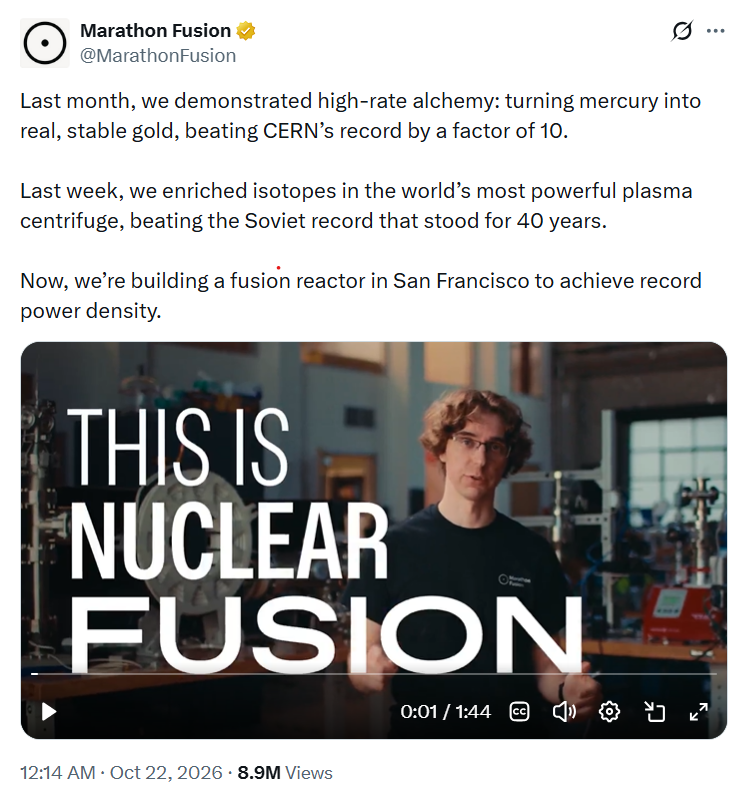
They say all that glitters is not gold, a classic idiom that took on a remarkably literal and modern meaning this month when a United States-based nuclear fusion startup asserted that it successfully produced genuine gold from mercury.
Rather than relying on ancient chemical trickery or the elusive ambitions of medieval alchemists, Marathon Fusion’s process is rooted in modern nuclear physics. The company’s newly released research paper details how high-energy neutrons generated from a deuterium-tritium fusion reaction can be used to irradiate mercury-198. This specific irradiation process produces a radioactive isotope that subsequently decays into stable gold-197.
The breakthrough immediately ignited lively discussions across financial and technology forums, with some observers jokingly referring to the scientific feat as an "infinite mint bug" in the physical world. This playful terminology quickly led to a broader economic question: if gold can theoretically be manufactured through nuclear manipulation, what might happen to the centuries-old precious metal that has derived its core value and historical reverence from its ultimate scarcity? Furthermore, what implications could this development hold for Bitcoin, the leading digital asset that has long been championed as digital gold due to its strict, hard-capped supply protocol?
Coinbase Chief Executive Officer Brian Armstrong was quick to weigh in on the unfolding debate, suggesting that the development ultimately plays directly into Bitcoin’s narrative. Comparing the creation of net-new gold through nuclear physics to the disruptions seen in the lab-grown diamond industry, Armstrong pointed out a fundamental difference in monetary design.
"You can’t invent anything that will increase Bitcoin supply," Armstrong noted in a public statement, emphasizing that there will only ever be 21 million bitcoins in existence.
Perhaps inspired by the massive commercial popularity and widespread acceptance of lab-grown diamonds in the consumer market, Marathon co-founder and Chief Executive Officer Kyle Schiller reveals that the company has already been fielding a surprising amount of attention from commercial sectors, particularly from jewelers.
"We have gotten a shocking amount of interest from people who want to do jewelry," Schiller says, though he adds a realistic caveat regarding its primary utility: "As with regular gold, I think it’ll be mostly used as a store of value."
Despite the headline-grabbing nature of the discovery, traditional precious metals experts note that gold bugs do not need to start quaking in their boots just yet. Marathon’s scientific achievement remains a very long way from proving that gold can be produced cheaply, efficiently, and at a massive industrial scale.
Nikos Kavalis, managing director at prominent precious metals research firm Metals Focus, explains that the industry is nowhere near a stage where this can be considered a threat to traditional mining operations. While allusions to alchemical dreams make for fantastic media headlines, Kavalis suggests that traditional gold miners will easily get to keep their jobs for the foreseeable future.
Can gold ever really be manufactured at scale?
The underlying nuclear process itself is scientifically plausible and well-understood within theoretical physics, but turning that concept into an economical, commercially viable industrial process is an entirely different challenge.
Marathon reported that it had produced stable gold at a rate ten times higher than the historical record set by CERN, the renowned European particle physics laboratory where researchers routinely use massive particle accelerators to study the fundamental building blocks of matter.
However, context is vital when examining those production rates. CERN’s historic ALICE experiment only produced an estimated 29 picograms of gold nuclei during its operational run between 2015 and 2018. Moreover, those specific nuclei existed for mere fractions of a second before they were destroyed in high-energy collisions.
While Marathon has not publicly disclosed the exact physical quantity produced in its own recent experiments, company research engineer Jake Harter notes that the quantities remain extremely small for now—describing them as "microscopic." Nevertheless, the company harbours ambitious goals to scale up production, aiming to reach "macroscopic milligram quantities in 2027."
Consequently, the much larger figures cited in Marathon’s research paper are mathematical projections modeled for a theoretical, future fusion power plant rather than actual physical output achieved today.
The research paper models the production of approximately two tonnes of gold per gigawatt of thermal fusion power annually. To put that ambitious projection into perspective, data from the World Gold Council shows that global mining operations produced a staggering 3,672 tonnes of gold in 2025 alone. Therefore, the theoretical output of a single future fusion plant would remain modest in comparison to global market demand.
Even to reach those future targets, Harter acknowledges that the company would first need to significantly scale up the production of the heavily enriched mercury required to initiate the process, alongside the monumental task of successfully building and operating a commercial fusion reactor itself.
"In the process of maturing this technology, we’ll also be working on studies demonstrating materials compatibility, mercury pumping, and gold extraction," Harter explains.
Could gold follow the lab-grown diamond playbook?
It is difficult for market observers to avoid drawing parallels between Marathon’s nuclear gold and the rise of lab-grown diamonds. Wholesale prices for lab-grown diamonds have plummeted by more than 90% since 2018 as manufacturing techniques scaled up globally. Unlike earlier diamond substitutes such as cubic zirconia, modern lab-grown diamonds are chemically identical to mined diamonds while costing only a fraction of the price. This historical precedent naturally leads many to wonder if gold could eventually suffer a similar fate.
According to Nagham Hassan, a market analyst at investment platform eToro, the comparison to lab-grown diamonds is entirely understandable from a consumer perspective, but the underlying economics are fundamentally different.
While diamond manufacturing became drastically cheaper as factory production scaled over the years, Hassan points out that producing gold through nuclear fusion would require extraordinarily complex infrastructure that does not currently exist in a commercial capacity.
Another immediate complication is the radioactive nature of the newly synthesized metal.
"The gold would need to be stored for a bit over a decade before dropping to banana-levels of radioactivity," Harter explains. However, because the vast majority of investment-grade gold is simply stored securely in vaults rather than handled daily, he does not view radioactivity as a permanent barrier to eventual commercialization.
A more pressing concern for economists and investors is whether the economics of nuclear gold will ever truly stack up against traditional extraction methods.
"There is no demonstration that the process is commercially viable," Kavalis emphasizes. "There are theoretical revenue projections, but nothing about what it will cost to run the reactors."
Would Bitcoin benefit if gold became less scarce?
Bitcoin is frequently described by its proponents as digital gold because its underlying software protocol enforces a hard-capped supply limit of 21 million coins. While critics have occasionally questioned whether a new technological breakthrough could theoretically replicate this scarcity, advocates like Armstrong argue that no amount of human ingenuity can invent a way to fabricate future bitcoins outside the protocol rules.
If an advanced technology like nuclear fusion were to successfully create an alternative, abundant source of gold supply in the distant future, economic theory suggests it could place downward pressure on the market price of the precious metal.
"For any asset, a substantial increase in available supply would, other things being equal, put downward pressure on its market price," Fabian Schär, a professor of distributed ledger technology and fintech at the University of Basel, notes. "Under the hypothetical assumption of inexpensive production at scale, gold would be no exception."
However, with the world’s first commercial fusion reactors still estimated to be at least a decade away, and with numerous unanswered questions surrounding the economic viability of this modern form of alchemy, the development is unlikely to alter Bitcoin market prices or disrupt the precious metals sector anytime soon.
For the time being, Marathon’s research stands primarily as a fascinating scientific experiment with potential industrial applications rather than an imminent threat to the global gold market. Traditionalists and lifelong gold advocates can rest easy, knowing their chosen store of value remains secure for the foreseeable future.





Comments (0)