



Global financial markets closed with a distinct risk-off tone, as caution rippled across technology equities, digital assets, and mining sectors. The retreat in risk assets was compounded by lingering jitters surrounding the artificial intelligence trade, prompting investors to pivot toward defensive positioning. Amid the broader market gloom, however, alternative segments continued to capture intense interest, underscored by major strategic maneuvers from retail brokerage giant Robinhood to cement its dominance in the burgeoning prediction markets sector.
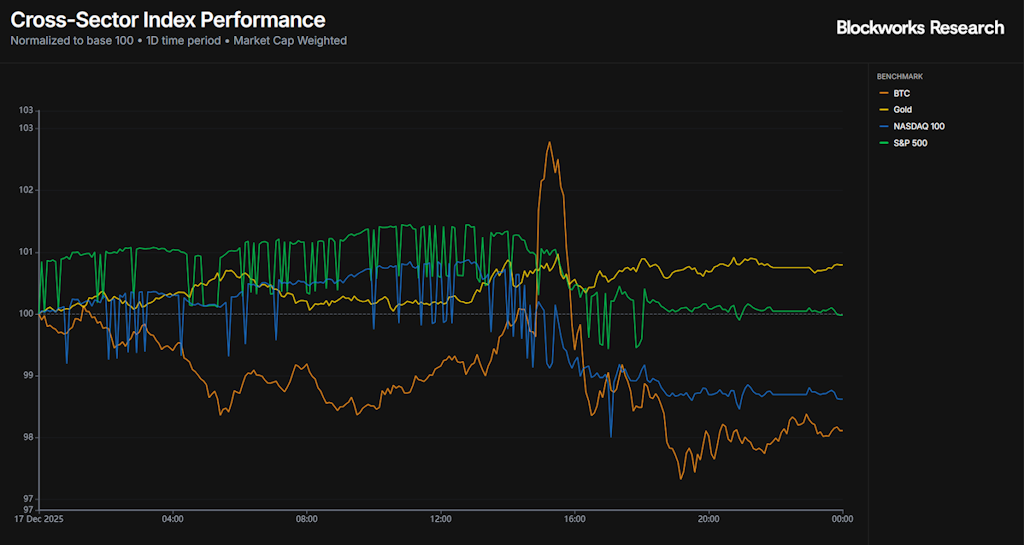
The trading session concluded with broad-based weakness across major indices, while traditional safe havens found localized support. Gold emerged as the lone bright spot of the day, managing to climb 0.8% by the closing bell. Meanwhile, the S&P 500 finished largely flat, but the tech-heavy Nasdaq composite suffered a 1.38% decline. The cryptocurrency market mirrored this downward pressure, with Bitcoin sliding 1.89% as macroeconomic headwinds and sector-specific anxieties weighed on sentiment.
Underlying drivers for the cautious environment remained largely unchanged from previous sessions, anchored by a persistent rotation away from the high-flying AI trade that has dominated market narratives for over a year. Investor nerves were frayed further after reports surfaced that a major investor had pulled out of a prominent Oracle data center project. Although Oracle subsequently disputed the accuracy of the claim, the headline proved potent enough to rattle an already jittery market, driving cautious capital further into defensive assets and prompting profit-taking across high-growth portfolios.

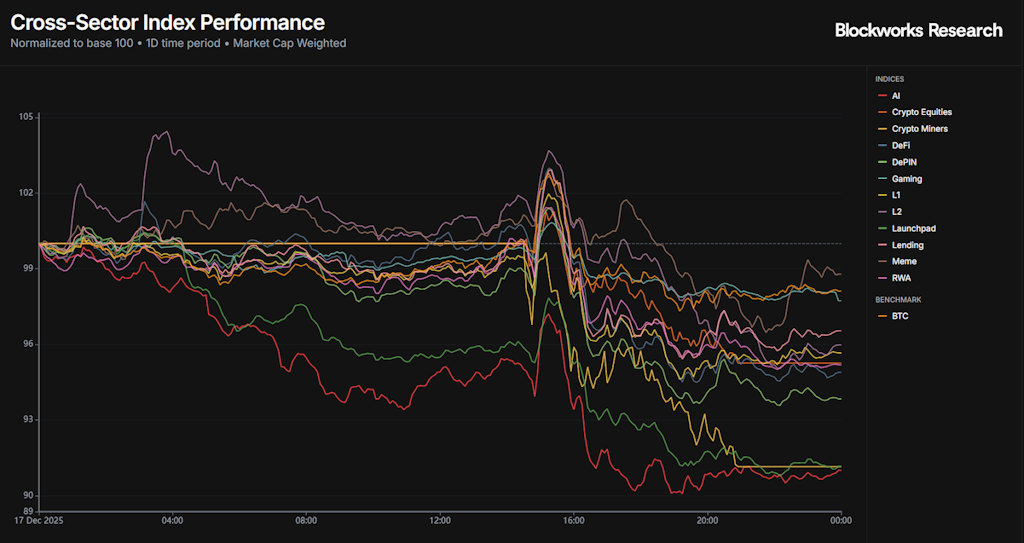
The resulting weakness quickly bled over into the digital asset ecosystem, where virtually every major crypto sector finished the day in negative territory. However, a notable exception emerged within the meme coin index. Despite typically ranking among the most sentiment-sensitive and volatile corners of the cryptocurrency market, the meme index held up relatively well, declining a modest 1.2%. Resilience in this segment was driven largely by MemeCore, which stood out as the sole index constituent to close in the green, posting a 1.96% gain on the day.
At the opposite end of the spectrum, the hardest-hit sectors within the digital asset landscape were crypto miners and artificial intelligence tokens, both of which plunged by close to 9%. Mining stocks continue to grapple with persistent fears that the broader AI boom is rolling over, dragging down infrastructure plays like IREN, which has now suffered a steep 31% correction over the past month. Within the AI-focused token index, TAO bore the brunt of the selling pressure, tumbling 9% despite having recently undergone its scheduled token halving event.
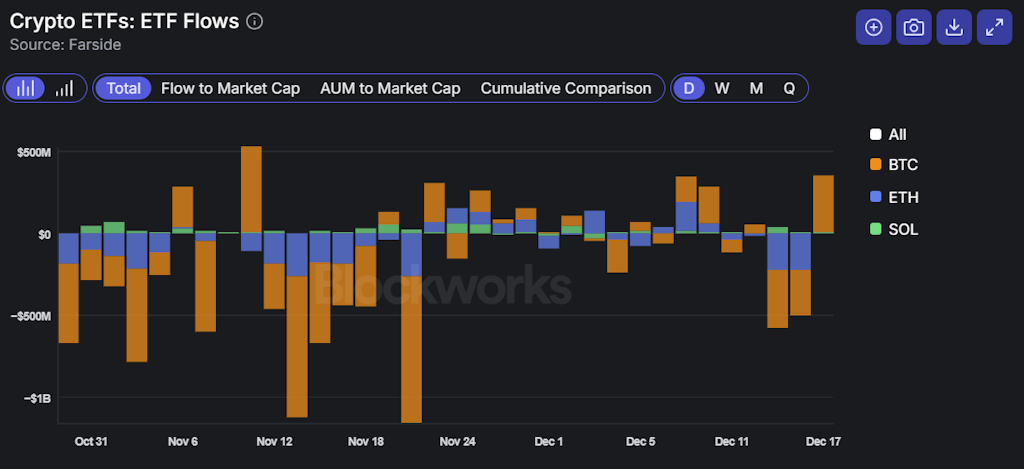
Despite the prevailing negative market sentiment and downward price action, market participants found a glimmer of hope in institutional flows. Bitcoin exchange-traded funds flipped positive once again, notiling a robust $346.1 million in net inflows. Analysts and traders alike are watching closely to see whether this renewed institutional demand can sustain itself over consecutive sessions, offering a potentially stabilizing catalyst to close out the year on a constructive note.
Robinhood Accelerates Its Prediction Market Roadmap
Beyond traditional equities and digital assets, the structural transformation of prediction markets continues to generate waves across the financial technology landscape. The latest catalyst came from retail brokerage giant Robinhood, which used its keynote event to unveil an ambitious roadmap for expanding its prediction market offerings. The strategic pivot is hardly surprising given the meteoric rise of the asset class; prediction markets have rapidly evolved into Robinhood’s fastest-growing product category by revenue, amassing a staggering 11 billion contracts traded by more than 1 million active users.
Sports-related contracts have emerged as the primary volume driver behind this exponential growth. Sports prediction markets currently account for roughly 35% of total trading volumes on platforms like Polymarket, and scale to an astonishing 90% on Kalshi. When annualizing the sports betting and prediction volumes generated across both platforms over the past four weeks, the aggregate figure reaches approximately $74.5 billion. To put that scale into perspective, leading traditional sportsbooks FanDuel and DraftKings reported total wagers of roughly $50.7 billion and $49.4 billion, respectively, over the course of 2024. These metrics underscore a fundamental shift: prediction markets are no longer a niche financial experiment, but are actively competing with established Web2 sports-gambling incumbents.
Despite this massive growth, one critical product category had largely remained missing from prediction market platforms until now: parlays. In the traditional sports betting industry, parlays account for approximately 30% of total handle in key markets and generate nearly 60% of total industry revenues. By bundling multiple individual wagers into a single cumulative bet, parlays offer significantly higher potential payouts alongside much lower statistical odds of winning—a dynamic that makes them exceptionally lucrative for platform operators.
Robinhood is now moving aggressively to capture this high-margin territory. The brokerage announced that users will soon gain the ability to trade complex combinations of outcomes, point totals, and point spreads for individual NFL games. Looking further ahead to early 2026, the company plans to introduce custom combination trading that will allow users to bundle up to 10 distinct outcomes for professional football matchups. Furthermore, Robinhood will introduce markets tied to individual player performance metrics, commonly known as prop bets.
This represents a meaningful evolutionary leap from the basic win-or-lose binary contracts that currently dominate prediction market platforms, opening the door to significantly deeper speculation and elevated trading volumes. Company leadership has confirmed plans to extend these advanced features beyond football, with an ultimate roadmap targeting expansion into non-sports event categories as well.
As competition intensifies, questions remain regarding the underlying infrastructure Robinhood will utilize to support this expansion. Industry observers are watching to see whether these sophisticated products will be developed in partnership with established regulated exchanges like Kalshi or brought entirely in-house. That speculation intensified following Robinhood’s recent announcement regarding plans to build proprietary prediction market infrastructure through a joint venture with Susquehanna International Group.
The competitive landscape heated up further as rival cryptocurrency exchange Coinbase entered the fray, announcing a strategic partnership with Kalshi to roll out integrated prediction market products to its own user base. The institutional and retail arms race for dominance in event-based trading is clearly underway. With sports-based prediction markets having firmly established product-market fit throughout the year, platforms combining massive retail distribution at scale with increasingly sophisticated financial instruments are well-positioned to capture the next wave of growth.





Comments (0)