



What began as a standard competitive battle within the Solana decentralized finance ecosystem has escalated into a public and contentious dispute between two of its most prominent protocols, Kamino and Jupiter. The friction highlights the growing pains of a maturing blockchain economy, where user acquisition, liquidity retention, and the boundaries of open-source composability are continually tested. As both platforms vie for dominance in the burgeoning Solana money market sector, the clash has sparked broader conversations about the true meaning of open-finance principles and the strategic necessity of expanding the overall market rather than cannibalizing existing local liquidity.
The public feud broke into the open on November 27, when Jup Lend—Jupiter’s lending arm—rolled out a dedicated refinancing tool on its frontend user interface. This feature was designed to allow users to migrate their looping positions from Kamino Multiply directly into Jup Lend using a single click. Behind the scenes, the one-click refinance operation triggered a complex atomic transaction involving a coordinated sequence of steps executed within a single transaction envelope to streamline what would otherwise be a tedious, multi-stage manual withdrawal and redeposit process.
This aggressive user-acquisition maneuver did not go unnoticed. Just days later, on December 2, Kamino moved swiftly to protect its user base and TVL by updating its smart contracts. The code update successfully blocked Jupiter’s specific program, effectively neutralizing the one-click refinancing pipeline and forcing users to revert to manual migration methods if they wished to move their capital.
The retaliation immediately drew sharp criticism. Both the Jupiter team and the developers behind Fluid—the backend liquidity protocol powering Jup Lend—condemned Kamino’s actions. They publicly framed the smart contract update as overtly anti-competitive and fundamentally opposed to the core ethos of open-finance principles, which traditionally champion seamless composability and permissionless interoperability across protocols.

As the rhetoric intensified across social media, Kamino’s co-founder stepped forward on December 6 to publicly clarify and defend the rationale behind the defensive block. The defense centered on a crucial point of transparency regarding risk management: Jupiter had repeatedly marketed and suggested to borrowers that their collateral remained entirely isolated within Jup Lend. Such marketing implied that user funds were neither rehypothecated nor exposed to underlying cross-contamination risks. However, Kamino’s team pointed out that this representation was inaccurate. Even Fluid’s co-founder eventually acknowledged that rehypothecation does indeed occur within Jup Lend, undermining the safety assumptions that Jupiter’s messaging had conveyed to everyday users.
Industry observers noted that while the debate over open-finance principles makes for compelling discourse, Kamino’s technical intervention was fundamentally a calculated business decision. Crucially, Kamino never placed any technical restrictions on users wishing to repay their loans manually, withdraw their collateral, and move their capital to Jup Lend or any other protocol of their choosing. The block targeted the automated migration wrapper, not user freedom of movement. This defensive posture mirrors the broader competitive realities of the sector, much like Jup Lend’s own strategic choice to keep its backend code proprietary—though the team has signaled future intentions to open-source it.
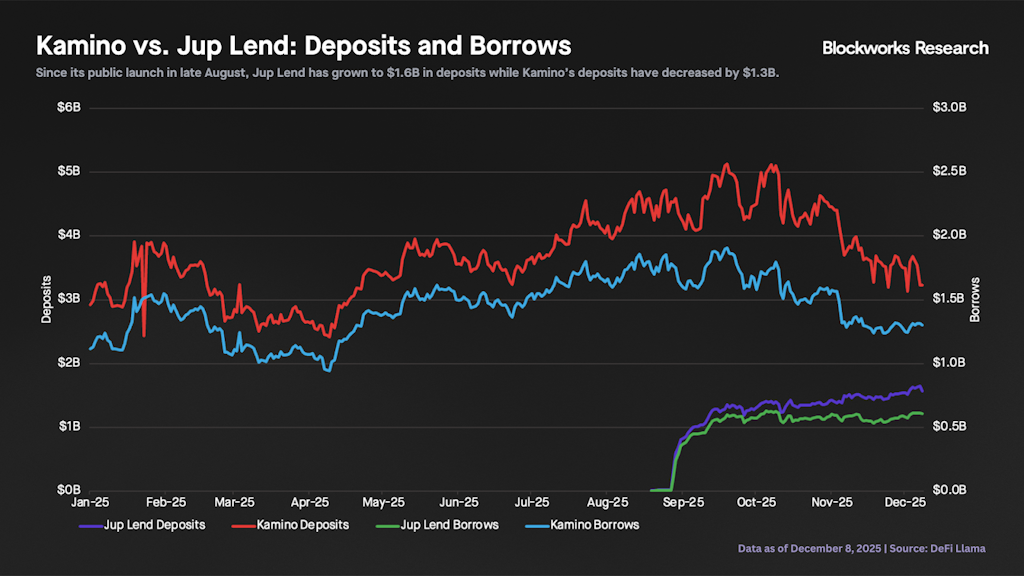
To understand the intensity of Kamino’s protective measures, one must examine the broader competitive dynamics that have played out between the two prominent money markets over the preceding months. Since its high-profile launch in late August, Jup Lend has experienced explosive growth, scaling its total deposits to an impressive $1.6 billion alongside $610 million in total borrows. During that exact same timeframe, Kamino has felt the squeeze of this aggressive newcomer. Kamino’s metrics reflect a notable contraction, with its deposits declining by $1.3 billion, representing a 28% drop, while its total borrows fell by $460 million, or 26%, over the course of the period.
A granular look at asset flows illustrates where the capital has moved. An analysis of the top five assets by deposit growth since the introduction of Jup Lend reveals substantial inflows into Jupiter’s ecosystem: USDC has attracted $485 million, JLP has brought in $225 million, native SOL has secured $206 million, syrupUSDC has added $174 million, and jupSOL has contributed $85 million. During this identical window, Kamino has suffered sizable capital outflows across almost all of these major assets, with syrupUSDC serving as the lone exception where Kamino managed to retain some traction. Even in the case of syrupUSDC, however, Jup Lend managed to attract roughly three times the volume of inflows compared to its competitor.
Kamino’s ability to sustain growth over the past few months has largely depended on onboarding and supporting niche assets that Jup Lend has not yet integrated into its platform. For instance, Kamino’s stablecoin inflows throughout the fourth quarter have been significantly bolstered by alternative assets such as PYUSD, which brought in $42 million, and Phantom’s CASH stablecoin, which contributed $125 million. Furthermore, Kamino has maintained an aggressive and proactive strategy regarding liquid staking tokens, successfully onboarding emerging DATCO LSTs, most notably dfdvSOL and more recently fwdSOL, to carve out specialized yield niches.
Looking ahead, Kamino is betting on innovative integrations to serve as a catalyst for net-new inflows that can revitalize its money market. A prime example of this strategy is its PRIME integration, which introduces a regulated credit pool backed by US real estate loans originated and serviced through Figure. By bridging traditional finance assets with decentralized infrastructure, this integration provides users with access to an institutional-grade source of yield that remains entirely uncorrelated from broader cryptocurrency market volatility. Such offerings are viewed as vital tools for attracting institutional liquidity and sophisticated borrowers who prioritize yield stability.
Ultimately, the friction between Kamino and Jup Lend underscores the reality that they are direct and fierce competitors. Healthy competition remains a foundational engine for innovation within decentralized finance, driving protocols to optimize user experiences, refine risk frameworks, and ultimately benefit the end consumer. Yet, as prominent voices in the broader ecosystem have pointed out, internecine warfare risks missing the forest for the trees. As Solana Foundation’s Lily Liu recently observed, rather than expending energy fighting over a localized share of the existing ecosystem, protocols like Kamino and Jupiter would achieve greater long-term success by focusing on expanding the aggregate pie and capturing larger market share from competing blockchain networks and traditional finance. Combined, both Solana money markets still account for a fraction of the liquidity managed by established multi-chain giants like Aave, holding less than 10% of Aave’s total deposits. Without aggressive structural expansion, novel institutional integrations, and continued ecosystem growth, closing that monumental gap will remain an uphill battle.





Comments (0)