


As the artificial intelligence boom matures, the primary bottleneck constraining the expansion of the compute market is shifting away from silicon manufacturing constraints and moving directly toward the availability of capital—specifically, credit. When the massive infrastructure buildout first began several years ago, the vast majority of capital expenditures were funded internally through cash reserves sitting directly on corporate balance sheets. This initial phase was clearly reflected in the way major hyperscalers burned through their cash reserves, drawing intense scrutiny from Wall Street as their free cash flow temporarily turned negative. Corporate leadership teams, however, largely pushed forward regardless, exercising total autonomy over how to deploy their own corporate treasuries.
That initial phase ultimately gave way to a second wave of financing driven primarily by public equity markets. Investors witnessed this dynamic unfold through multi-billion-dollar capital raises, such as Alphabet’s landmark $85 billion debt and equity maneuvers, alongside significant share dilution by Meta and other technology titans attempting to amass war chests large enough to fuel the ongoing machine learning revolution. Shareholders who maintained deep conviction in the long-term track records of these tech giants proved more than willing to fund aggressive, capital-intensive expansion plans. Yet, even these colossal equity raises ultimately proved insufficient to satisfy the insatiable appetite of the expanding digital infrastructure.
Consequently, the industry is now turning its attention toward the global credit markets. The implications of this transition are profound, given that the aggregate size of global credit markets vastly outweighs the amount of liquid equity capital currently circulating in the global economy. However, integrating traditional credit into the high-stakes compute buildout introduces entirely new operational and philosophical dynamics. Financing a project via cash on balance sheet demands virtually no external visibility or justification. Public equity offerings require investors to maintain faith in management’s overarching track record without necessarily requiring a granular understanding of underlying infrastructure mechanics. Credit markets, by contrast, demand rigorous accountability. Lenders need absolute certainty that their capital will be returned on strict, predetermined terms, backed by robust legal recourse should things go wrong.
For a lending counterparty to underwrite these transactions with confidence, they must rely on a specific set of foundational assumptions regarding demand, risk, and asset depreciation. Industry analysts point out that many of the prevailing beliefs held by traditional lenders are fundamentally contradictory, revealing a critical need for deeper financial education if the broader AI ecosystem is to unlock the next tier of capital liquidity. Critics who view the current artificial intelligence wave as an overhyped market bubble typically focus their skepticism on two core arguments: the belief that enterprise demand for compute is fundamentally finite, and the assumption that rapidly accelerating hardware advancements will render existing processing units obsolete within a matter of years.
Addressing the first criticism requires examining the core economic drivers of artificial intelligence demand. Agentic AI demand is currently scaling at an exponential rate, expanding roughly two-and-a-half to five times year-over-year, while total hardware supply is projected to grow by at most a factor of two through the end of the decade. This widening supply gap is compounding annually. Major memory suppliers report being entirely sold out years in advance, with prominent industry executives warning that chronic supply shortages are intensifying rather than easing. Aggregate compute commitment contracts now span into the trillions of dollars, with leading infrastructure providers sitting on backlogs worth hundreds of billions of dollars.
Physical supply cannot be scaled overnight, and the diffusion of artificial intelligence applications throughout the broader economy continues to accelerate. Entire industry verticals face scenarios where their demand for compute is virtually insatiable. This includes sectors operating far beyond traditional enterprise software deployments—industries where computational power functions directly as the primary means of production rather than an experimental line item. For these competitive enterprises, securing advanced compute provides an existential competitive advantage over market rivals. If one assumes that compute demand is not finite, the alternative requires believing in an improbable economic scenario where technological supply dramatically outpaces global demand across every sector simultaneously.
Furthermore, historical data regarding model efficiencies and algorithmic improvements demonstrates a consistent pattern: each time the cost of raw intelligence drops significantly, overall usage expands at a disproportionately higher baseline. This economic dynamic paradoxically unlocks entirely new commercial use cases rather than reducing the total volume of hardware required. With the risk of overbuilding minimized by this persistent, expanding demand, the conversation naturally shifts to the second major hurdle: the structural misunderstanding of how compute assets behave relative to traditional real estate or legacy IT hardware.
Many institutional lenders continue to analyze compute infrastructure through the lens of commercial real estate, an analogy that is superficially appealing but fundamentally flawed. In the housing market, the pool of potential tenants is strictly bounded by geographic constraints. Compute, by contrast, is an exceptionally fungible asset class. Despite this, many credit providers remain hyper-fixated on securing investment-grade off-take agreements, frequently demanding rigid two-to-three-year contracts accompanied by substantial upfront down payments ranging from twenty to fifty percent. In their pursuit of absolute security, these lenders frequently create self-defeating financial positions.
In a market environment where compute demand vastly outpaces available supply—a dynamic projected to persist for at least the next five years and potentially up to a decade—the loss of a single commitment is immediately absorbed by a line of prospective tenants waiting to take their place. Forcing rigid, long-term contracts and subjecting off-take partners to extreme scrutiny makes little strategic sense when demand remains robust. Furthermore, as market prices for compute continue to climb, locking in long-term contracts at deep discounts effectively positions the lender as net-short on compute—a counterproductive financial bet for institutions actively lending to technology startups. Given that compute rental prices have experienced steep upward adjustments over recent cycles, overly conservative security requirements can inadvertently lengthen payback periods and undermine optimal returns.
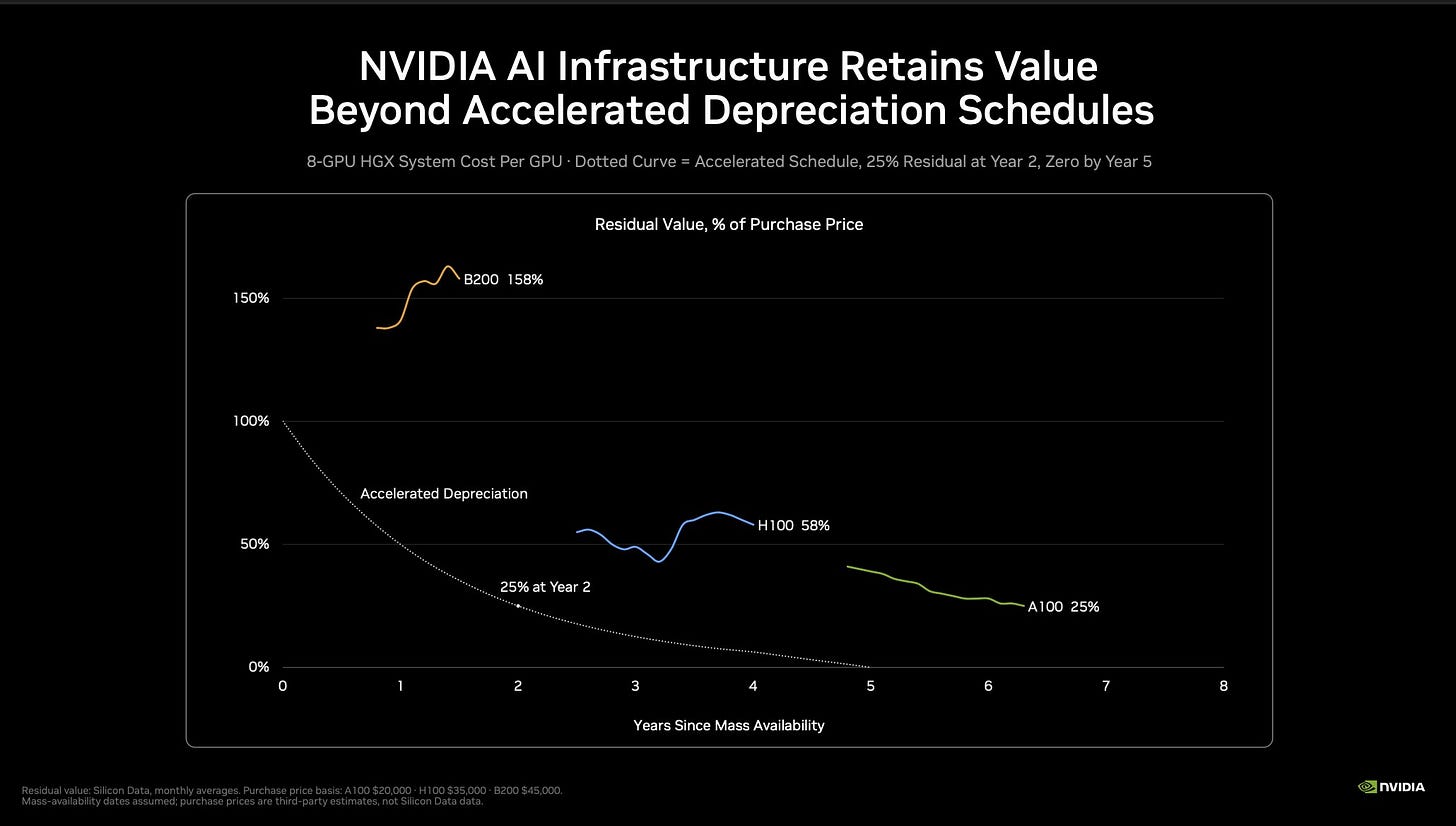
Another persistent concern among market skeptics involves hardware depreciation schedules, with bears arguing that specialized processors face rapid obsolescence that necessitates constant, costly replacements. Empirical evidence challenges this assumption. Older architectures, such as graphics processing units introduced years ago, continue to run active workloads in production environments, establishing a proven operational lifespan floor of nearly a decade for enterprise-grade hardware. More recent generations of processors are demonstrating even greater longevity and residual value retention, with market valuations for advanced chips frequently holding steady or appreciating well past their initial deployment dates.
The persistent evolution of software efficiencies does not diminish the need for hardware; rather, it fuels further adoption through classic economic principles like Jevons paradox, where increased efficiency drives down costs and ultimately sparks a massive expansion in total consumption. As this multi-decade shift continues to unfold, compute is steadily positioning itself to overtake traditional real estate as the single largest asset class on the planet. Navigating this emerging financial landscape requires an acute understanding of both advanced technology and sophisticated credit markets, signaling that credit-backed compute financing is only beginning to scratch the surface of its true economic potential.




Comments (0)