


As decentralized infrastructure continues to scale across the web3 landscape, gaining visibility into the foundational software powering various blockchains has historically remained an elusive task. With RouteMesh now tracking thousands of nodes within its system, the platform has reached a operational milestone that enables deep insights into the software client landscape of these decentralized networks. For the first time, comprehensive data regarding which client software runs across different chains is shedding light on an opaque segment of the blockchain ecosystem.
When RouteMesh integrates a new node into its system, it subjects that node to rigorous benchmarking and extracts as much operational information as possible. While future reports will delve into the specifics of these performance tests and the extensive data they yield, current efforts focus on node client type information. Operating a blockchain relies on distinct software implementations known as clients. For Ethereum, the most dominant and widely recognized client is "geth," short for go-ethereum. However, over the years, the client landscape has expanded significantly.

When a blockchain introduces differences in its consensus rules, operational workflows, or underlying mechanisms, development teams either adapt the core geth codebase or build an entirely new client software from scratch. Furthermore, for major networks, independent teams frequently author competing software clients. This practice introduces what the industry refers to as "client diversity," a crucial metric that enhances a blockchain’s overall resilience by ensuring that a single software bug or vulnerability cannot compromise the entire network.

Because RouteMesh manages thousands of nodes across its infrastructure, it possesses the capability to quantify client diversity in a manner previously unachieved in the broader blockchain ecosystem. Every few days, the system automatically rediscovers the state of its connected nodes to monitor vital metrics, including client version updates and configuration adjustments implemented by infrastructure providers. For context, observers can review the continuously updated client data directly through the RouteMesh portal. With more than thirty Remote Procedure Call (RPC) providers integrated into the system, RouteMesh maintains high confidence in its ecosystem coverage, serving as a robust proxy for industry-wide trends despite the impossibility of capturing every single node globally.

An analysis of the integrated RPC providers reveals that a substantial majority of their nodes run on geth. While analysts initially anticipated a more evenly distributed market share among various clients, the overwhelming dominance of geth came as a notable observation. Ranking in second place is reth, an emerging execution client developed by Paradigm. A subtle nuance in this dataset is that the measurements reflect absolute node counts rather than the volume of requests served by each client, though these two metrics remain closely linked in practice.

When rearranging the dataset to sort by individual chains rather than aggregate market share, distinct structural patterns emerge. Geth stands out as the most cross-chain dominant client, serving as the foundational backbone for hundreds of different networks across the crypto space. Trailing behind are a variety of specialized clients, alongside multi-chain solutions such as cdk-erigon, Nethermind, skaled, zkSync, erigon, go-opera, OpenEthereum, and bor.

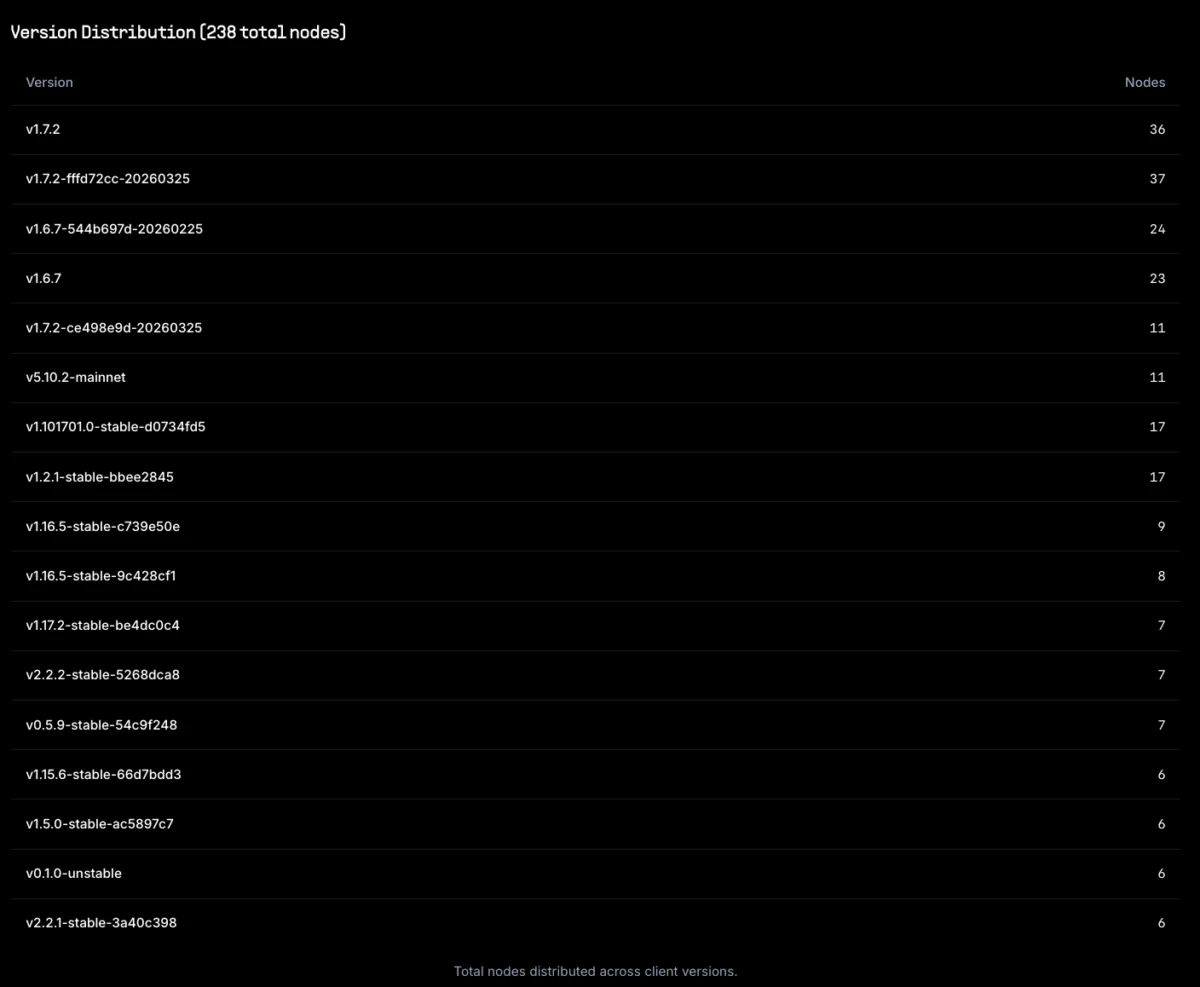
Examining these clients on an individual basis highlights the vast discrepancies in version adoption and infrastructure maintenance across providers. For instance, geth versions are notably fragmented across the board. The most recent major iterations, such as version 1.17, brought significant improvements tailored for extensive RPC queries. However, the data reveals that a large portion of active nodes still operate on older releases. Interestingly, the single most dominant version found in the dataset is 1.7.2, a release dating back to October 2017. If an independent provider relied on a single node running a legacy version of that vintage, the infrastructure would face severe vulnerability to unexpected downtime or exploits. In contrast, RouteMesh mitigates these operational risks by implementing robust fallback mechanisms across its network.

The slower pace of client upgrades highlights the inherent challenges of managing RPC infrastructure, where maintaining up-to-date node clients for dozens of supported chains requires continuous operational vigilance. Visibility into which providers operate specific client versions and network counts provides a clearer picture of how requests are handled. While major players like Alchemy and Quicknode maintain fleets that are partially captured by the system due to provider pricing models for auxiliary nodes, the available data still offers unprecedented transparency into fleet management.

A closer look at Paradigm’s reth client reveals a different operational dynamic. The primary chain supported by reth is Base, followed closely by Ethereum, Optimism, Base Sepolia, Ethereum Sepolia, and Binance Smart Chain. Unlike geth, reth installations display a much tighter version alignment. Infrastructure providers tend to keep their reth deployments significantly more up to date, providing a greater degree of confidence regarding network stability. While major releases such as reth 2.0 have recently entered the market, the most dominant versions in active use remain relatively recent iterations released earlier in the year, indicating that providers typically allow a brief stabilization window before rolling out major client upgrades.

A similar pattern emerges within the Arbitrum ecosystem when examining Nitro, the execution environment powering Arbitrum networks and various associated chains. Nitro runners demonstrate a strong tendency to maintain recent client versions. A review of release timelines shows that providers quickly adopt stable versions soon after their public deployment on GitHub, reflecting a high level of coordination between ecosystem developers and infrastructure providers within the Arbitrum community.

The pipeline from core protocol developers writing client software to RPC providers adopting and deploying those updates is an iterative, gradual process. Because RPC providers form the literal backbone of user-facing web3 applications, understanding their operational habits grants the entire ecosystem vital visibility into how transaction requests and data queries are processed. Investigating the lower-level mechanics of how blockchains function in practice uncovers valuable operational realities that are rarely captured in real time. Through this ongoing research, RouteMesh aims to foster greater transparency across the industry, with full datasets accessible to the public via the RouteMesh client portal.




Comments (0)