


As the landscape of artificial intelligence continues to shift toward centralized commercial offerings, heavy power users are beginning to feel the squeeze. For developers, researchers, and daily consumers of large language models (LLMs) who burn through tens or hundreds of millions of tokens a day, the golden age of cheap, virtually unlimited cloud-based compute is rapidly drawing to a close. Anthropic has already introduced strict session limits and watered-down fallback models, while companies like OpenAI adjust their feature lineups, signaling that the true, staggering cost of massive AI infrastructure is finally being passed down to the end user.
This looming economic and operational constraint has driven some privacy-conscious technologists down the rabbit hole of hardware sovereignty, arguing that relying exclusively on big tech labs carries long-term risks. Beyond rising subscription costs and tightening usage caps, critics of centralized cloud compute warn that major labs may eventually exploit user inputs and training data to sustain their enormous profit margins. These concerns have prompted a growing segment of power users to look past the major cloud providers and invest in independent local hardware, a movement that culminated for one developer in a high-stakes, $15,000 custom-built inference machine designed to run powerful models entirely on local power and electricity.
The journey toward local compute begins with a fundamental hardware truth: running artificial intelligence models requires a specialized type of memory known as VRAM, which is embedded directly onto the graphics processing unit. Unlike standard system RAM or DRAM, VRAM addresses the primary bottleneck of AI inference, which is memory bandwidth rather than mere memory capacity. As GPU cores execute complex intermediate mathematical calculations, they require an ultra-fast local repository to store and retrieve data instantaneously.
While alternative architectures such as Apple’s unified memory systems allow CPUs and graphics processors to share a single massive pool of RAM, they suffer from a significantly slower Time To First Token compared to dedicated hardware. This performance penalty led to the exclusion of standard or chained Mac setups in favor of a dedicated Windows or Linux-based inference rig.

Initial research pointed toward NVIDIA’s older RTX 3090 GPU as a popular entry point for hobbyists, praised for its generous 24GB of VRAM and the inclusion of NVLink, a high-speed networking bridge that allows two cards to communicate seamlessly. However, as the scope of modern experimentation expanded—especially when considering massive open-source models featuring hundreds of billions of parameters that require vast amounts of memory even after heavy quantization—a single 24GB card quickly proved too restrictive for running multiple concurrent models or maintaining large context windows.
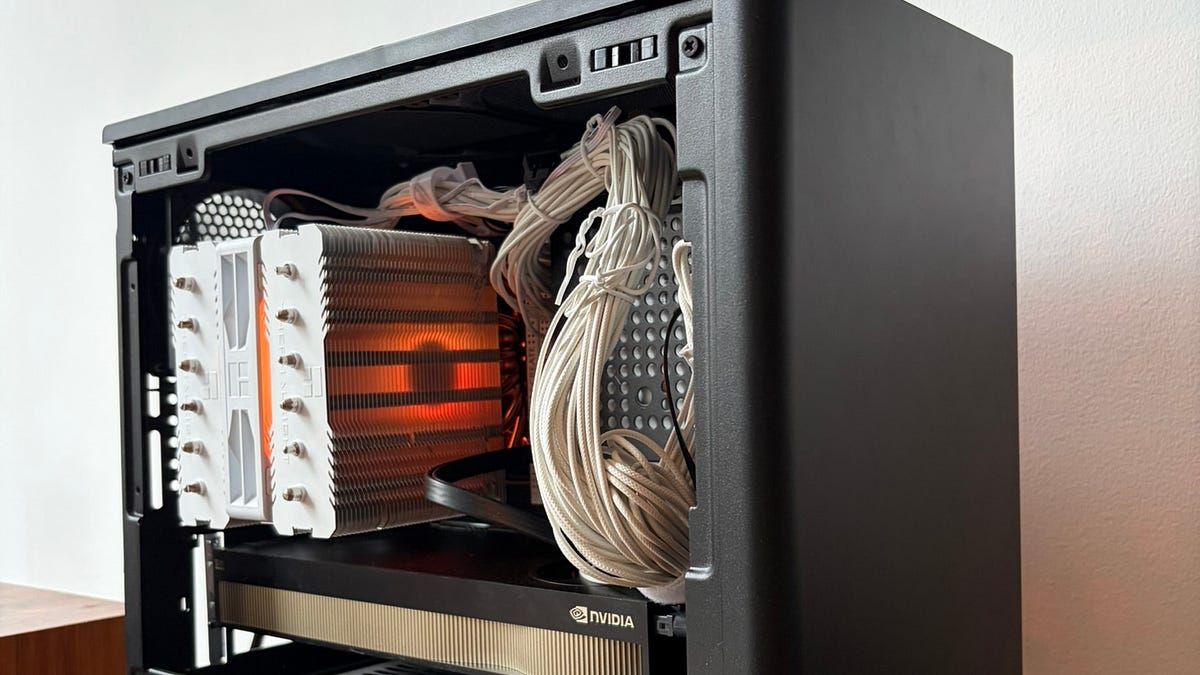
Faced with the choice of chaining multiple consumer cards or investing in top-tier professional hardware, the budget quickly scaled from a modest thousand-dollar experiment to a $10,000 investment centered around the NVIDIA RTX 6000 Pro. Released as a pinnacle of consumer-grade workstation technology, the card boasts an unprecedented 96GB of VRAM, delivering data-center-level performance in a form factor compact enough to fit inside a mini-ITX chassis. By opting for a Max-Q variant of the RTX 6000 Pro, which draws 300 watts instead of the full 600 watts while retaining roughly 85 to 90 percent of its native power, the builder successfully minimized heat generation and power supply requirements, creating a portable yet formidable local inference box.

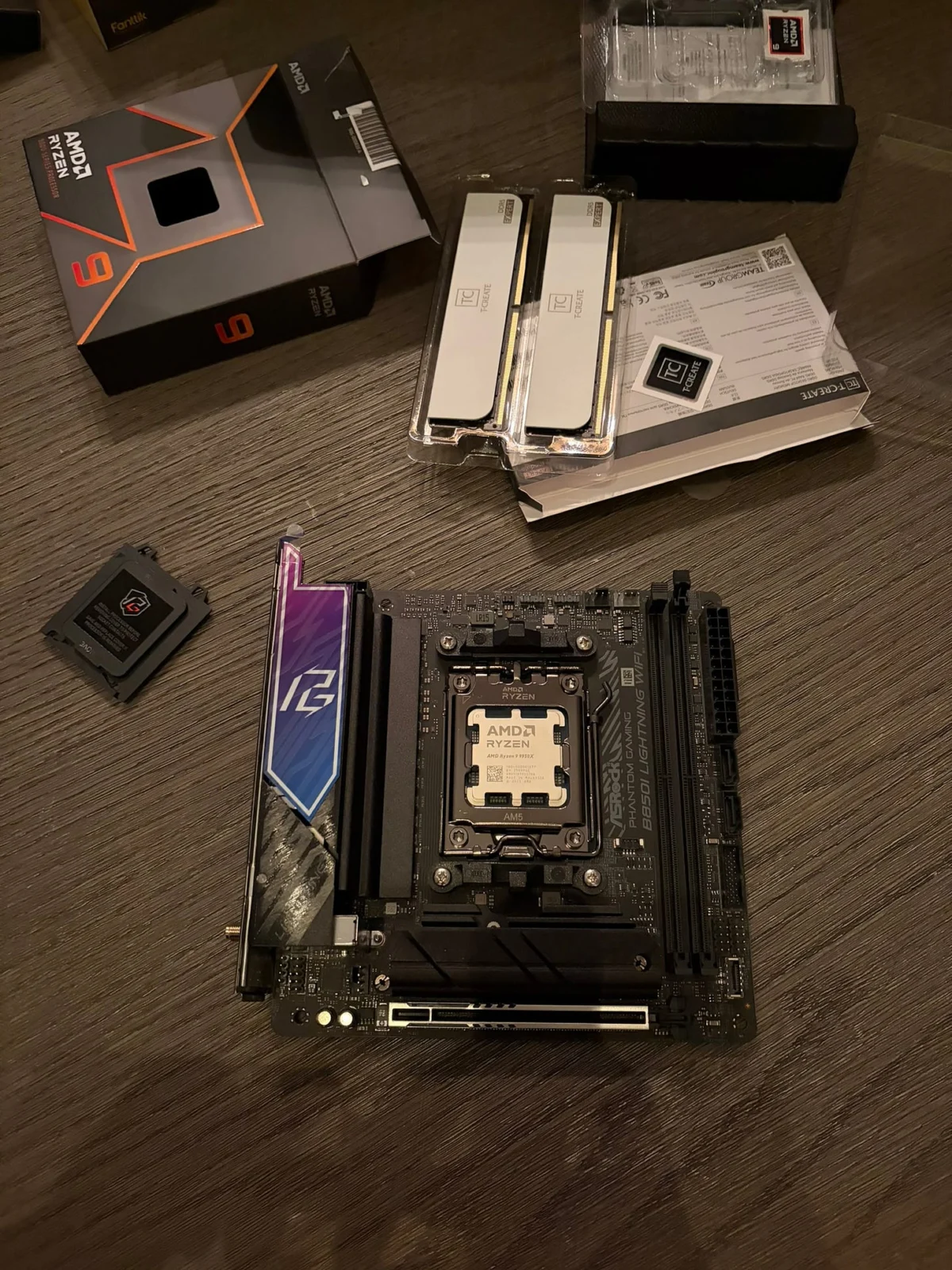
Building a compact, high-performance mini-ITX system around such an expensive and demanding component required careful coordination of complementary hardware. The foundation was built upon an ASRock AMD B850i motherboard, which supports up to 128GB of high-speed DDR5 RAM, alongside a powerful AMD Ryzen 9 950X processor, 4TB of high-speed NVMe.2 solid-state storage, a Corsair 850W power supply, and a Peerless Assassin CPU cooler. Navigating the complexities of memory specifications highlighted the vast divide between consumer-grade hardware and enterprise server infrastructure. While server racks utilize error-correcting code memory and registered DIMMs to stabilize massive capacities exceeding one terabyte, a mini-ITX build is constrained to non-ECC unregistered DIMMs due to motherboard limitations, emphasizing the compromises required to balance size, cost, and raw computing power.
Assembling a machine of this caliber from scratch over the course of a weekend proved to be a nerve-wracking exercise. Handling components worth thousands of dollars with no formal blueprint beyond online documentation, community forums, and manufacturer manuals meant that a single static discharge or misaligned connector could instantly destroy expensive hardware. The construction process involved methodically installing the processor, memory, and cooling systems before mounting the motherboard into the compact chassis, culminating in the high-pressure installation of the massive graphics card. A minor troubleshooting hurdle involving an initial lack of an HDMI display signal added to the tension, though isolating and resolving the issue ultimately led to a successful first boot.

With the physical assembly complete, the focus has shifted toward deploying software applications, autonomous agents, and everyday workloads onto the newly established local machine. While the system is still being fully configured and tested, the initial performance results have proven exceptionally encouraging, validating the steep financial investment. By breaking free from the subscription models and usage restrictions imposed by commercial AI labs, this custom-built inference station represents a step toward complete digital sovereignty, opening up new possibilities for individuals looking to control their own computational destiny in an increasingly constrained technological landscape.

Comments (0)