



As the cryptocurrency market steps into a new year, the collective mindshare of investors and builders has rotated meaningfully toward a fresh set of dominant narratives. Prediction markets, stablecoins, and real-world asset (RWA) tokenization have rapidly emerged as the clear winners of this sectoral shift, while former market favorites such as artificial intelligence, modular infrastructure, and memecoins have temporarily fallen out of favor. Amid this evolving landscape, one protocol has quietly commanded attention by bridging two of the three leading narratives while putting up remarkably robust onchain metrics: the Canton Network.
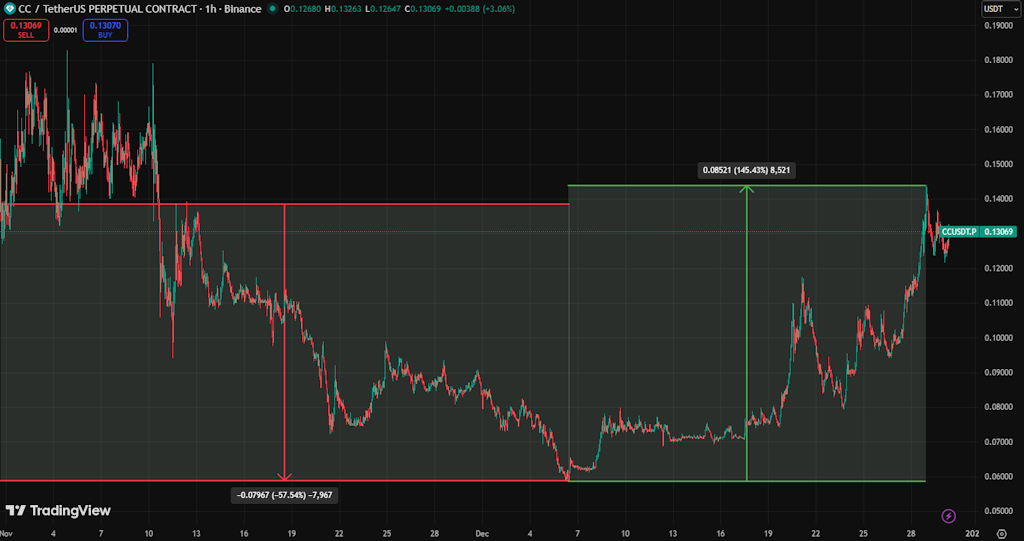
Canton is a specialized blockchain built explicitly to meet the rigorous demands of traditional financial institutions. It is engineered from the ground up to enable secure, interoperable, and privacy-preserving transactions across corporate and institutional boundaries. The network’s native token became fully transferable on November 10, and after suffering an initial market drawdown exceeding 50%, it has staged a complete recovery. The asset has surged impressively, climbing 47.6% over the past month as institutional engagement intensifies.

The sheer scale of real-world asset activity already running through the Canton Network is notable by any industry standard. Data from the fourth quarter of 2025 reveals that Canton has processed a staggering $6 trillion in real-world assets. Furthermore, the network currently handles approximately $350 billion per day in US Treasury activity alone. A substantial portion of this foundational traction stems from deep integration with major institutional partners, most notably Broadridge Financial Solutions, a global fintech leader specializing in trading and settlement infrastructure. Broadridge’s Distributed Ledger Repo platform runs directly on Canton, processing more than $8 trillion per month in repurchase agreement transactions. By leveraging blockchain rails, the platform dramatically improves operational efficiency in one of the largest and most critical markets within global finance.
Institutional momentum for Canton has continued to build through a series of strategic integrations and high-profile partnerships. A landmark collaboration with Nasdaq connects the Canton Network directly to Nasdaq Calypso. This integration enables automated margin and collateral management, giving institutional market participants the ability to move and reuse capital far more efficiently across both traditional asset classes and digital assets. More recently, the Depository Trust and Clearing Corporation (DTCC), which serves as the central clearing and settlement backbone of United States financial markets, selected Canton to support its RWA tokenization initiatives.
Under the planned rollout, a designated subset of US Treasury securities held within the DTCC depository will be issued on the Canton Network, pending final regulatory approval from the Securities and Exchange Commission. Given that the DTCC clears roughly $10 trillion worth of securities transactions every single day, the potential to shift traditional settlement timelines from the standard T+2 window to near real-time execution could fundamentally transform market efficiency and free up vast amounts of trapped capital within existing financial infrastructure.
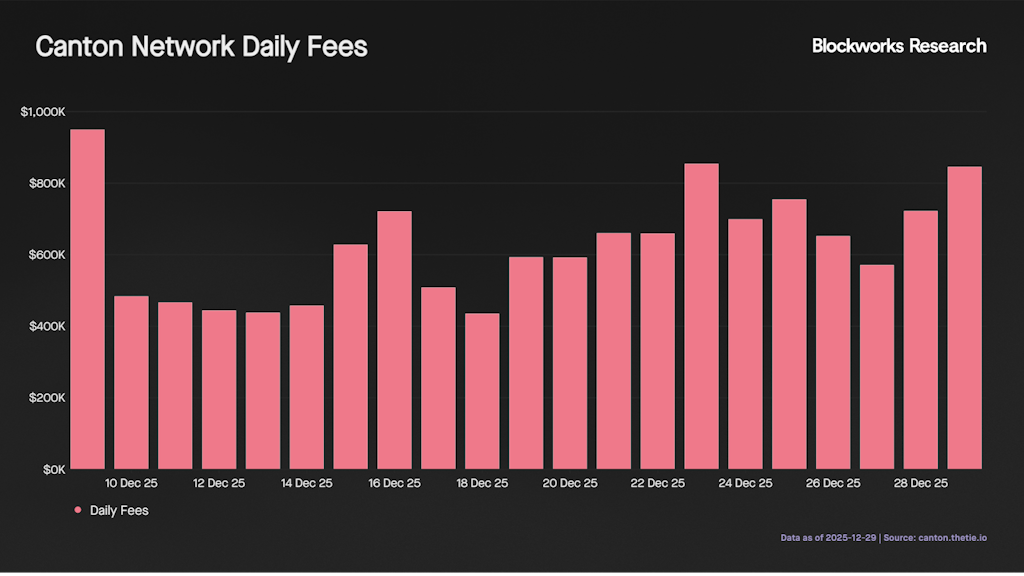
The robust usage of the network is closely tied to the economic design of its native token. Canton utilizes a mechanism called the Global Synchronizer to coordinate complex, multi-party transactions across various financial institutions. Transaction fees are predictable and paid in the native CC token, which are subsequently burned as overall network activity increases. Over a recent twenty-day observation period, the network burned a median of 6.71 million tokens daily, equating to roughly $627,000 worth of burned supply per day, with peak periods reaching between $750,000 and $850,000. To put these figures into perspective, Solana averaged approximately $670,700 in daily real economic value over a comparable seven-day window, yet commands a fully diluted valuation roughly sixteen times higher than that of Canton.
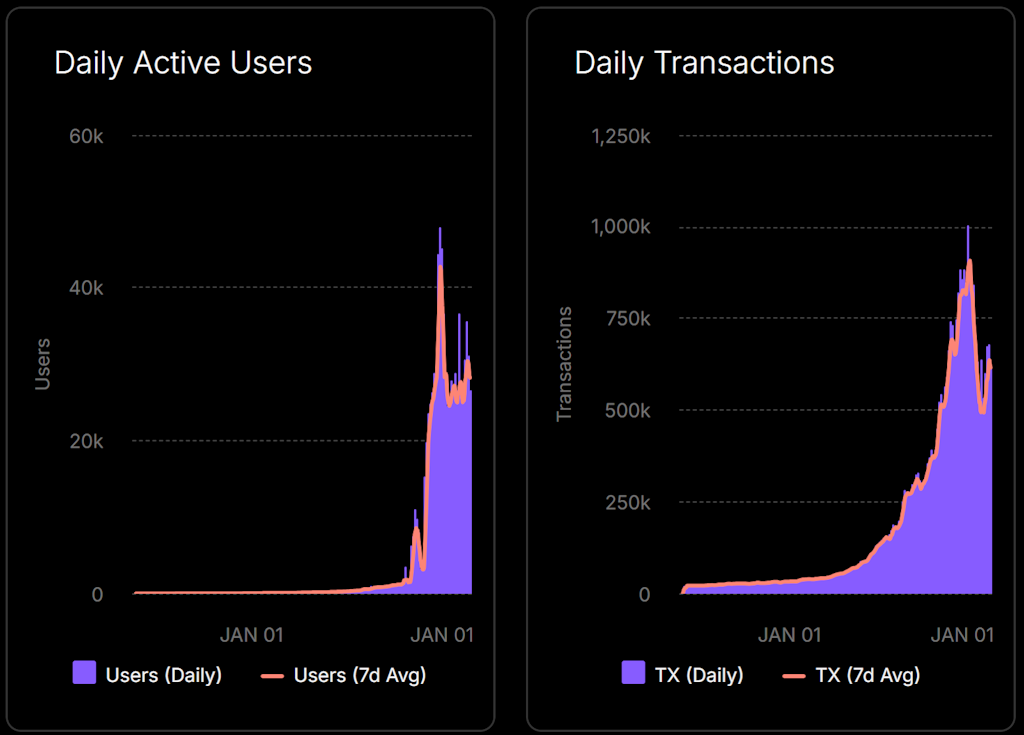
Core usage metrics further validate the network’s growing adoption. Since November, Canton has maintained an average of approximately 28,500 daily active users alongside 678,300 daily transactions. These figures place the institutional chain in direct alignment with high-profile public networks like Monad in terms of daily active users and Ton in terms of total transaction volume. While deeper technical evaluation regarding Canton’s underlying architecture, validator distribution, and long-term tokenomics remains ongoing, the early empirical signals are difficult for market observers to ignore. With deep exposure to vital institutional narratives including tokenization, stablecoins, and institutional-grade privacy, Canton is rapidly shaping up to be one of the most compelling protocols to watch as the broader market progresses through the year.
Lighter’s TGE
Parallel to the institutional advancements seen in tokenized finance, the decentralized derivatives sector marked a major milestone with the token generation event of Lighter. The protocol airdropped and launched its native LIT token, successfully concluding a multi-week timeline that speculative traders had been intensely stress-testing using a Polymarket prediction contract that effectively functioned as a pre-launch proxy. Market odds for the launch briefly slipped to approximately 60% intraday before the token generation event officially proceeded.
The newly launched LIT token features a maximum total supply of 1 billion tokens, with 250 million tokens circulating immediately at launch, representing a 25% day-one circulating float. The initial airdrop distribution was funded by accumulated points from Seasons 1 and 2 of the protocol’s user rewards program, with a total of 12.5 million points successfully converted into LIT tokens. This conversion rate implies a headline math of roughly 20 LIT tokens per accumulated point. The broader token allocation schedule splits the supply into 50% for the ecosystem—divided evenly between an immediate distribution and a future reserve—26% allocated to the core team, and 24% reserved for early investors. Both the core team and early investors are subject to a strict one-year lockup cliff followed by a three-year linear vesting schedule. Against this supply backdrop, premarket points pricing has repriced sharply in the post-launch environment, leaving points buyers down around 50% from peak valuation levels that had previously implied roughly $100 per point at the absolute top of the pre-market frenzy.
Beyond the mechanics of the airdrop itself, market participants have engaged in vigorous debate surrounding token holder value capture and protection. Lighter has leaned directly into the common industry critique concerning the structural equity mismatch between protocol operations and token valuations. The project argues that revenues generated by its core decentralized exchange and planned future products can be tracked transparently onchain in real time, allowing revenues to be dynamically allocated between protocol growth and token buybacks depending on prevailing market conditions.
Lighter goes a step further by asserting that the long-term value created by all of its products and services will fully accrue to LIT token holders, noting that the token is issued directly from its US C-Corp entity, which intends to operate the underlying protocol essentially "at cost." While directionally this represents a much stronger structural posture than the traditional separate labs model that captures private profits away from token holders, market analysts note that it does not provide an absolute financial guarantee, given that the definition of operating "at cost" can remain economically elastic, much like the operational expenditures of traditional decentralized foundations.
When evaluated against established market comparables, the broader crypto market is currently valuing Lighter in a manner strikingly similar to Hyperliquid. At a fully diluted valuation of $2.7 billion and a circulating market capitalization of $700 million, Lighter boasts a circulating float of approximately 25.9%, which sits nearly identical to Hyperliquid’s 25.4% float based on a $24 billion fully diluted valuation and $6.1 billion in circulation. More importantly, Lighter is currently trading on a fees multiple that places it directly within Hyperliquid’s valuation range. Lighter commands a multiple of 26.6x based on fully diluted valuation relative to annualized fees, and 6.9x based on circulating market capitalization to annualized fees. By comparison, Hyperliquid trades at a multiple of 29.9x on fully diluted valuation and 7.6x on circulating capitalization. This valuation parity exists despite a substantial gap in absolute financial scale between the two protocols, as Lighter printed $8.5 million in 30-day fees compared to Hyperliquid’s $66.8 million, and Lighter’s current open interest stands at $1.45 billion against Hyperliquid’s $7.44 billion.





Comments (0)