



The cryptocurrency market experienced a week of stark contrasts as the new year got underway, characterized by a modest upward finish for Bitcoin alongside a sharp divergence in performance across various crypto sectors. While flagship assets managed to stay afloat, capital flows remained notably volatile, reflecting broader macroeconomic hesitation and a shifting landscape for institutional digital asset products.

Bitcoin managed to finish the holiday-shortened trading week up 1.6%, offering a steady anchor while altcoins experienced highly fragmented price action. Rather than following a unified market trend, different sectors carved out entirely distinct trajectories, highlighting changing investor appetites and a rotation into previously overlooked corners of the digital asset ecosystem.
Perhaps the most unexpected development of the week was a powerful rebound led by Decentralized Physical Infrastructure Networks (DePIN) and the Gaming sector. Both groups posted strong gains, surging 13.1% and 12.6% respectively. This recovery comes on the heels of a bruising prior year for both sectors, which had suffered steep declines of 79.5% and 81.3% throughout the previous twelve months. The sudden reversal caught many market participants by surprise, breathing new life into tokens that had spent much of the year facing sustained downward pressure.
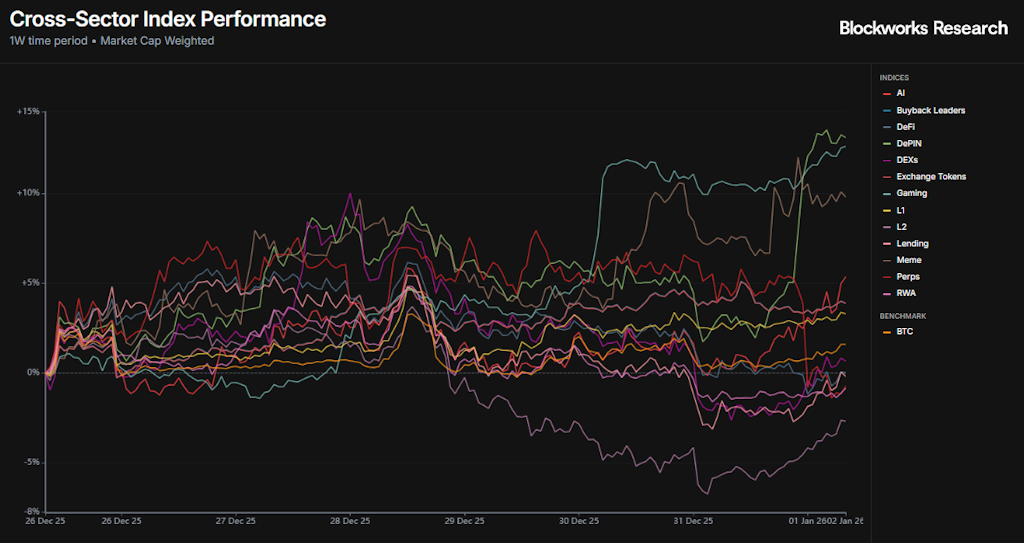
Underpinning the DePIN sector’s strength were major tokens like FIL and RENDER, which posted weekly gains of 22% and 13% respectively. Together, these two assets account for nearly half of the sector’s total index weighting, carrying the broader group upward. The Gaming sector followed a remarkably similar script, anchored largely by IMX, which climbed 11% and provided the primary catalyst for the sector’s recovery.
In contrast, other historically favored segments of the market faced ongoing headwinds. Layer-2 scaling solutions and Real-World Asset (RWA) tokens lagged behind the broader market, slipping 2.67% and 0.84% over the course of the week. The weakness in Layer-2 networks was spearheaded by tokens such as MNT and ZORA, which dropped 5.7% and 6.4%. At the same time, however, intra-sector divergence was clearly visible; other prominent Layer-2 assets including OP, ARB, and ZK managed to buck the trend entirely, posting double-digit gains ranging between 10% and 20%.
Meanwhile, Real-World Asset tokens felt the pressure of a broader pullback in gold following its stellar performance earlier in the year. Tokenized gold products such as PAXG and XAUT both retreated by approximately 3.4%, dragging down the broader RWA index as macro conditions shifted.
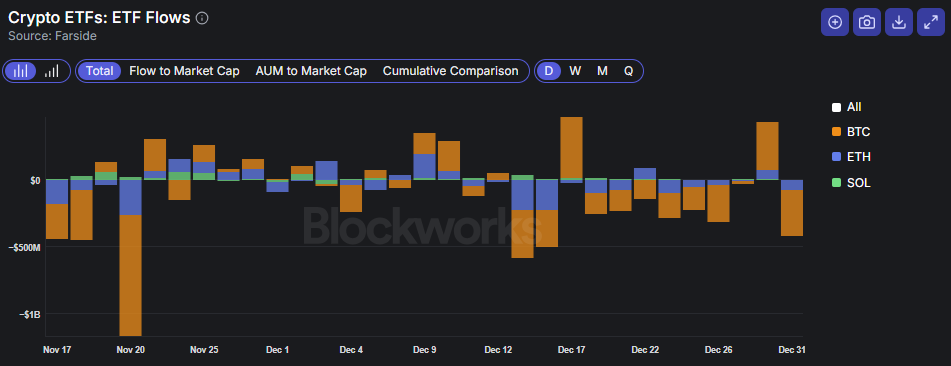
Underpinning these sectoral shifts were persistently choppy capital flows. Market participants watched exchange-traded funds experience a volatile end to the month. On December 31 alone, spot ETFs recorded $417.8 million in net outflows, almost completely erasing the $428.2 million in inflows registered just a day prior. This back-and-forth movement underscores a cautious institutional stance as allocators rebalance portfolios for the start of the year.
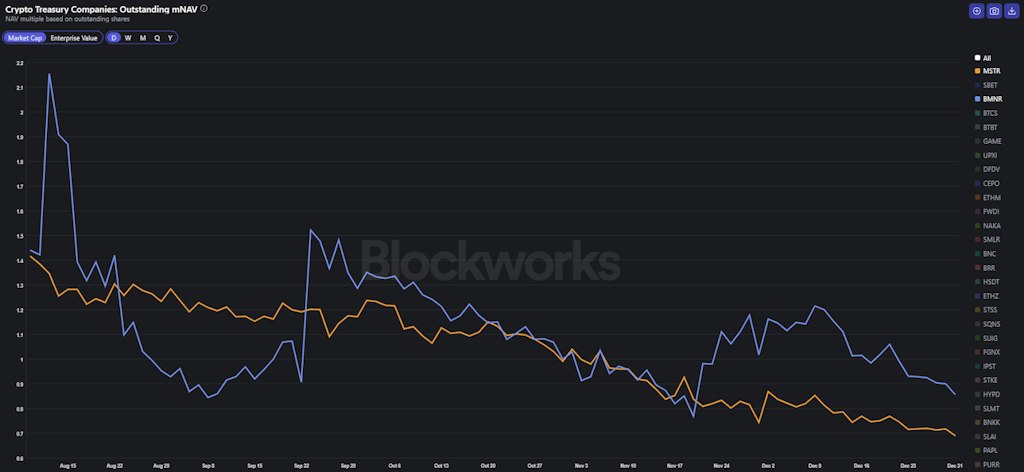
Corporate digital asset treasuries also continued to show signs of strain. Modified Net Asset Value (mNAV) multiples compressed further across major corporate holders, with firms like MicroStrategy and Bitcoin Miner holding companies trading at mNAV levels of 0.69 and 0.85, respectively. These compressed multiples highlight the ongoing financial pressures facing the corporate treasury trade as the market navigates a changing interest rate and liquidity environment.
As investors and analysts look for direction following the year-end transition, a series of comprehensive year-end reviews and thematic analyses have surfaced, examining the structural shifts that shaped the industry and the trends poised to define the months ahead.
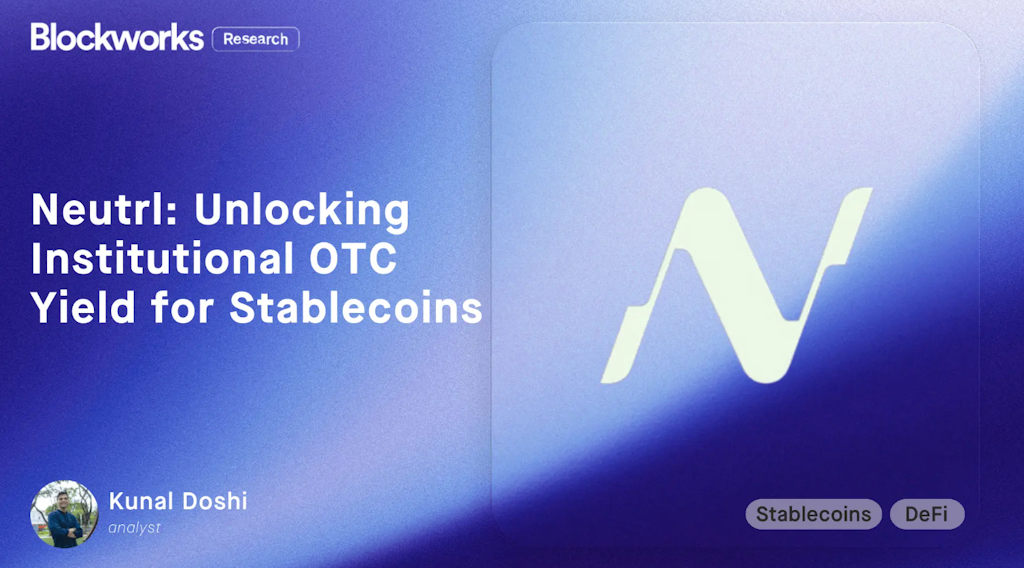
Among the key institutional focal points is the evolving landscape of stablecoin yield generation. Recent research from Blockworks Research sheds light on emerging protocols like Neutrl, which aim to package institutional-grade over-the-counter arbitrage strategies into a stablecoin-friendly wrapper. By offering market-neutral yields designed to be less dependent on traditional funding rate cycles than existing synthetic dollar models, such protocols are capturing early market traction. Backed by deep token unlock pipelines and specialized OTC execution access, these platforms represent an attempt to scale hedged yield generation while managing strict counterparty and liquidity risks. If these yields can remain stable as total value locked scales, analysts suggest they could mirror the rapid adoption curves seen in earlier synthetic dollar designs while introducing a more structurally defensive framework.
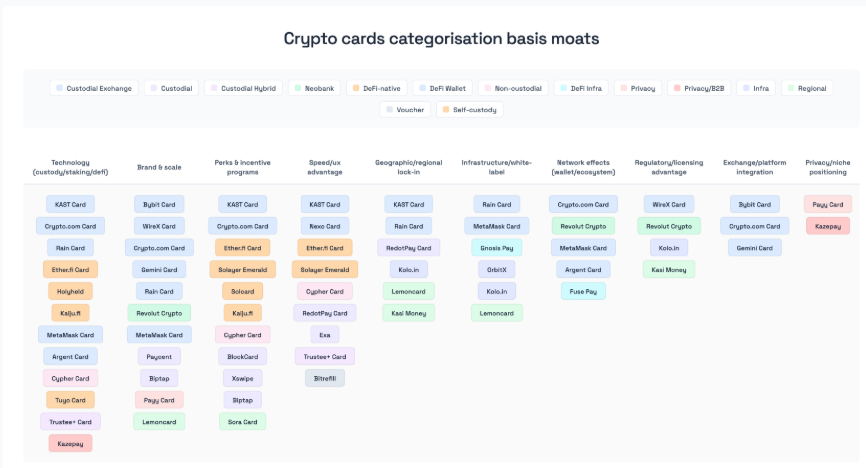
Simultaneously, the infrastructure powering digital asset payments and consumer applications is undergoing a profound structural evolution. An analysis by Polaris Fund points toward a critical inflection point for crypto-enabled neobanks and payment cards. The research indicates that long-term competitive moats are shifting decisively away from flashy consumer rewards, cashback incentives, and branding toward foundational infrastructure, regulatory compliance, and direct liquidity control. Sustainable market leaders are increasingly those that control core primitives such as regulated licensing, programmable settlement, and deep backend integrations, leaving purely consumer-facing distributors vulnerable to margin compression as regulatory frameworks tighten globally.
The maturation of crypto’s underlying architecture was also a defining theme of the past year, particularly concerning cross-chain interoperability. Data compiled by LayerZero highlights how interoperability transitioned in 2025 from a theoretical scaling solution into the foundational backbone of the crypto economy. As tokenized assets and stablecoins become increasingly distributed across an expanding multitude of distinct blockchain networks, cross-chain messaging primitives have accelerated asset velocity and capital mobility. Rather than operating as isolated ecosystems competing in a vacuum, blockchain networks increasingly function as an interconnected fabric where liquidity moves frictionlessly toward areas of highest demand. By reducing transaction friction and making multi-chain activity resemble standard software execution, interoperability has ceased to be a network bottleneck and has instead emerged as the default layer for modern blockchain scalability.
These technological leaps occurred against the backdrop of a remarkably fast-moving narrative cycle throughout the year, a dynamic explored in depth by Tiger Research. The report notes that 2025 was characterized by rapid-fire market narratives that generated speculative attention faster than the underlying ecosystems could validate, frequently breeding widespread market fatigue and skepticism. While many short-lived narratives faded quickly, a distinct subset successfully transitioned into tangible, real-world utility that propelled the broader market forward.
Memecoins demonstrated the sheer speed at which retail users could be onboarded, while simultaneously exposing the fragility of user retention in the absence of lasting product utility. Experimental models focused on information finance highlighted the potential of incentive-driven growth but underscored persistent trust and quality issues. The most enduring progress throughout the year consistently emerged in sectors where crypto demonstrated undeniable product-market fit—most notably in stablecoins, decentralized prediction markets, and global payment rails. These segments reinforced the fundamental reality that durable market value ultimately crystallizes only when speculative narratives align with concrete, functional utility.





Comments (0)