


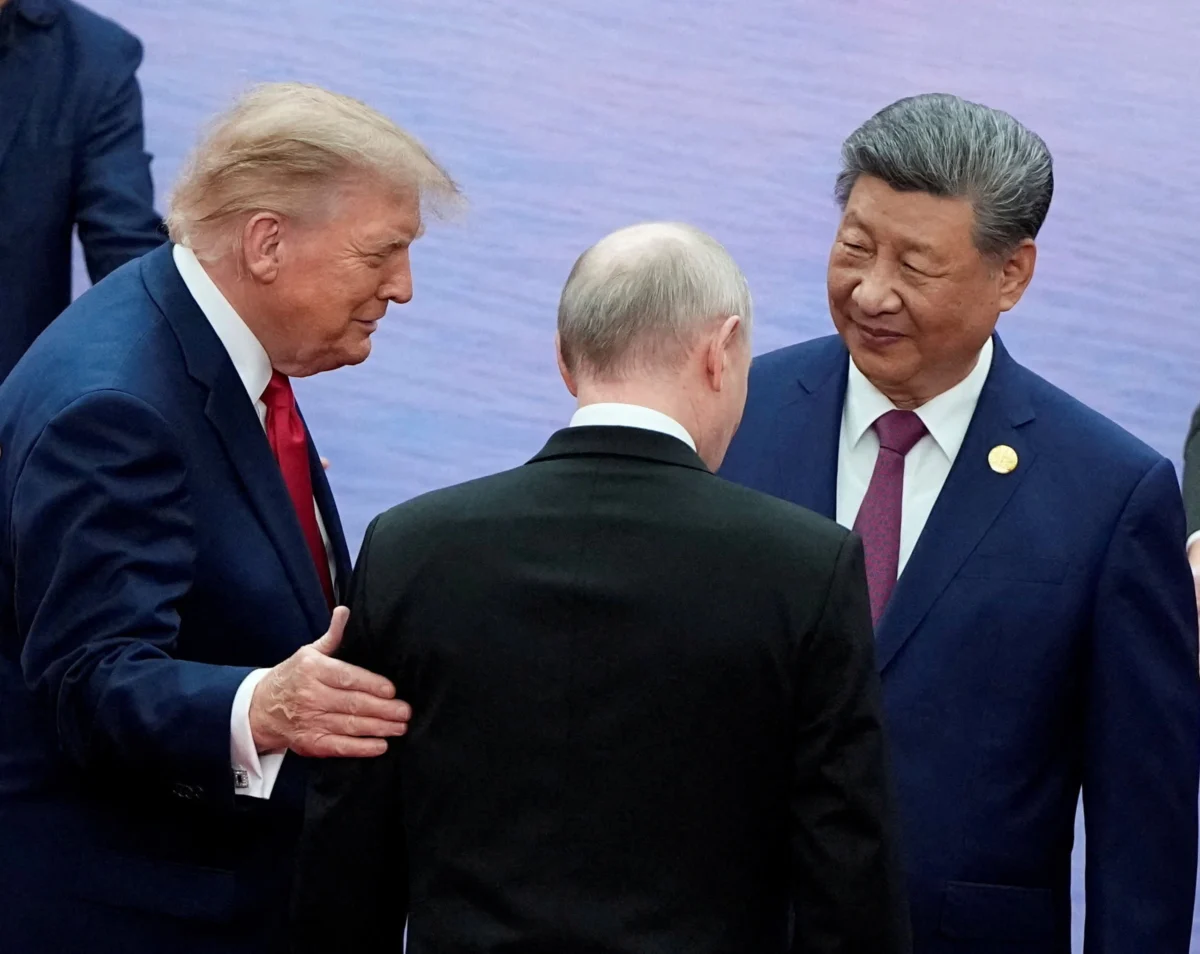
SHENZHEN, China — For the second consecutive year, Chinese President Xi Jinping has successfully orchestrated a high-profile diplomatic convergence on mainland Chinese shores, bringing together leaders of rival global superpowers in an unprecedented display of summit diplomacy.
U.S. President Donald Trump and Russian President Vladimir Putin participated in a high-stakes trilateral meeting with Xi on Thursday, following an initial gathering the previous evening during a grand welcome banquet for the Asia-Pacific Economic Leaders’ Meeting in the bustling southern Chinese technology hub of Shenzhen, Guangdong province. The meeting marked a watershed moment in contemporary geopolitics, representing the first time the three leaders have ever met together in person.
The landmark gathering in Shenzhen echoes a similar diplomatic milestone orchestrated by Beijing in September 2025. During an annual meeting of the Shanghai Cooperation Organization in Tianjin, China, Xi, Putin, and Indian Prime Minister Narendra Modi briefly smiled and laughed together for a friendly photo-op. That gathering followed a noticeable easing of diplomatic tensions between Beijing and New Delhi, signaling China’s growing knack for hosting major multilateral engagements.
The juxtaposition of these high-level meetings underscores a broader strategic effort by Beijing to position itself as a central pillar of international diplomacy, bridging divides across Eurasia and the Global South.
Summit Diplomacy
China’s remarkable "ability to engage directly with the world’s major powers" reflects the country’s expanding geopolitical influence across the Global South and the Eurasian landmass, noted Jodie Wen, a postdoctoral fellow at the Center for International Security and Strategy at Tsinghua University.
"China hopes to play a more constructive role in this conflict-ridden, unstable world," Wen said, pointing out that looking toward the future, "China will hope to provide more platforms" within its domestic borders for international actors to address pressing global friction points and negotiate shared concerns.
This convening power is not entirely new for Beijing, which has increasingly stepped into the role of diplomatic broker on the world stage. Most notably, China provided the crucial neutral forum that successfully brokered the restoration of diplomatic ties between regional adversaries Saudi Arabia and Iran in 2023.
By actively participating in and hosting a diverse array of multilateral organizations, Beijing has maintained its footing within the traditional Western-dominated international orbit while aggressively cultivating deep, independent relations with non-Western nations. The carefully orchestrated photo-ops from last year in Tianjin and this week in Shenzhen represent only a fraction of an exceptionally busy diplomatic calendar managed by the Chinese leadership.
According to a comprehensive CNBC analysis of official Chinese readouts, Xi has personally hosted more than 40 heads of state so far this year alone. This includes at least eight major foreign leaders who converged around the APEC meetings in Shenzhen this week. This intense diplomatic pace builds directly on a massive diplomatic push in 2025, which saw Xi receive well over 60 state visits.
Throughout the week, domestic Chinese media outlets have heavily emphasized the sheer volume and strategic significance of Xi’s foreign engagements on the sidelines of these China-hosted international events.
"Beijing sees these multilateral platforms as opportunities to expand its international influence and demonstrate its commitment to multilateralism, while bilateral diplomacy remains equally important," explained Yue Su, principal economist for China at the Economist Intelligence Unit (EIU).
However, Su also pointed out the inherent complexities of contemporary international relations, noting that different nations increasingly pursue diverging geopolitical and economic priorities. This fragmentation makes achieving genuine consensus through multilateral organizations an uphill battle.
"Against this backdrop, China’s diplomatic priorities are increasingly focused on delivering tangible economic benefits through trade, investment, financial connectivity, and technology cooperation," Su added, highlighting Beijing’s pragmatic pivot toward economic statecraft.
APEC Outcomes
Beyond the diplomatic theater of the trilateral talks, the broader Asia-Pacific Economic Cooperation summit yielded concrete policy discussions and financial commitments. During the official APEC Economic Leaders’ Meeting on Thursday, President Xi announced that China would provide $20 million in direct financial support aimed at fostering development across the wider Asia-Pacific region.
In his address, Xi also passionately advocated for the development of an "Asia-Pacific community with a shared future," presenting the concept as a regional iteration of his frequently invoked political slogan championing a "shared future" for all of humanity.
Tsinghua University’s Wen emphasized that summits like the one in Shenzhen can create highly meaningful outcomes for global crisis management, while simultaneously carving out essential diplomatic space for future negotiations. She stressed that physical, face-to-face interactions among top leaders remain vital for preventing dangerous misunderstandings and de-escalating simmering geopolitical tensions.
The urgency of direct communication was underscored on Thursday when President Trump remarked during the trilateral meeting that the United States, China, and Russia are "uniquely positioned" to discuss the critical issue of reducing nuclear weapons during their historic encounter.
Following the conclusion of the talks, an official Chinese readout confirmed that the three global leaders engaged in substantive discussions regarding several of the world’s most intractable geopolitical flashpoints, including the ongoing conflict in Ukraine, the volatile security situation in the Middle East, and the enduring tensions on the Korean Peninsula.
— CNBC’s Matthew Tan contributed to this report.


Comments (0)