


As the artificial intelligence boom continues to reshape the global technology landscape, a new and critical bottleneck is rapidly emerging in the compute markets: access to capital, specifically through credit. When the massive infrastructure buildout first commenced a few years ago, the vast majority of capital expenditures were comfortably funded directly from corporate cash reserves. This was vividly demonstrated as major hyperscalers systematically burned through their cash reserves, drawing sharp criticism and scrutiny from Wall Street as their free cash flow temporarily turned negative. Corporate leadership teams had absolute autonomy during this initial phase, deploying their own balance sheets exactly as they saw fit to secure early dominance in the artificial intelligence race.
However, that initial phase represented merely the end of the beginning. As cash reserves dwindled, the industry naturally looked for the next wave of financing, which materialized primarily through equity markets. This transition became glaringly apparent through massive capital raises, such as Alphabet’s $85 billion offering, alongside significant shareholder dilution by Meta and various other industry titans aiming to secure more dry powder. Although these equity raises were substantial, and investors who firmly believed in the long-term track record of these technological giants were initially willing and happy to fund their capital-intensive roadmaps, it still proved insufficient to feed the insatiable machine god of artificial intelligence infrastructure.
Consequently, the industry has had to turn its attention toward the global credit markets. This pivot introduces an entirely new dynamic, given that the sheer size of the global credit market vastly outweighs the amount of liquid equity capital available in the world. Yet, this transition brings complex structural challenges regarding how the compute buildout is financed. Cash on balance sheet required virtually no external visibility or justification. Standard equity offerings required existing investors to maintain faith in management without necessarily understanding the granular underlying market dynamics. Credit markets, however, operate under an entirely different set of rules.
Lending institutions require a reliable counterparty that can guarantee the return of borrowed funds on strictly promised terms, backed by robust legal recourse if those financial obligations are not met. For a lender to gain the necessary confidence to deploy capital on such a massive scale, they must subscribe to a specific set of foundational economic and technological beliefs. Currently, lenders hold a variety of assumptions regarding compute demand, off-take security, and hardware depreciation schedules. While these assumptions may appear logical and prudent on the surface, industry analysts argue that they are often fundamentally incompatible with one another, suggesting that better financial education and market alignment are urgently required to unlock the full potential of capital in the ecosystem.
Critics who view the current artificial intelligence expansion as an unsustainable financial bubble typically base their arguments on two primary reservations: concerns over terminal demand and fears of rapid hardware obsolescence. Addressing the first of these concerns requires examining the fundamental trajectory of compute consumption. Current data indicates that demand for agentic artificial intelligence is scaling at an exponential rate, increasing between two-and-a-half to five times every single year. Meanwhile, hardware supply is projected to grow at most twofold annually through the end of the decade, based on all currently observable manufacturing metrics.
This widening supply gap compounds year after year. Global memory manufacturing capacity is reportedly fully booked out through 2027, with major technology executives warning that supply chain shortages are steadily intensifying rather than abating. Aggregate compute commitment contracts now span into the trillions of dollars, with every major compute provider boasting multi-billion-dollar backlogs. Supply cannot be manufactured instantaneously through sheer force of will, and the diffusion of artificial intelligence applications throughout the broader economy continues to accelerate. Certain industries demonstrate an essentially limitless appetite for compute power.
Sectors such as autonomous driving, biotechnology and drug discovery, defense systems, and large-scale enterprise simulation models operate with fundamentally different economic models than traditional software users. These are not enterprises working within rigid token budgets trying to optimize minor administrative workflows. For these industries, compute power has transformed into a primary means of production, offering critical competitive advantages that dictate market survival.
Furthermore, historical data regarding model efficiencies and algorithmic improvements demonstrates a consistent paradox: every time the cost of artificial intelligence intelligence drops by ninety percent, overall usage expands at a disproportionately higher rate, easily surpassing a tenfold increase at a baseline level. Each iteration of cost reduction paradoxically unlocks entirely new categories of use cases, driving perpetual consumption.
Once the risk of an overbuild is contextualized against this backdrop of expanding demand, attention naturally shifts to the structural frameworks governing credit and collateral. Many credit institutions historically approach compute infrastructure through the analytical lens of commercial real estate. While this analogy holds superficial similarities, it is fundamentally flawed. In traditional real estate markets, the pool of potential tenants is strictly limited by geography. Compute infrastructure, by contrast, is vastly more fungible, movable, and globally accessible.
Despite this fungibility, many credit parties remain hyper-fixated on the investment-grade status of the off-take, frequently demanding rigid two-to-three-year contracts accompanied by steep twenty to thirty percent down payments, and occasionally requiring up to fifty percent upfront. Lenders implement these stringent terms in an attempt to guarantee that counterparties can service their contractual obligations. Paradoxically, in their pursuit of absolute security, lenders frequently engineer a worse financial position for themselves.
In a market environment where compute demand significantly outstrips supply and is projected to remain constrained for at least another five to ten years, a customer defaulting on a commitment is instantly replaced by a queue of numerous eager buyers. B300 hardware availability remains severely constrained, and upcoming GPU generations are expected to experience identical market pressures. Forcing long-term contracts and heavily scrutinizing off-take creditworthiness makes little economic sense when a multitude of solvent parties are waiting to secure access to scarce compute.
Furthermore, as market rental prices for compute steadily climb, locking in long-term contracts at a steep thirty to fifty percent discount effectively positions the lender as net-short on compute. For lenders already extending credit to artificial intelligence infrastructure startups, betting against the underlying appreciation of compute is a counterproductive financial strategy. With compute rental prices having surged significantly over the past year, payback periods could have been drastically shorter, meaning that an excessive desire for rigid security actually backfired against the lenders’ own economic interests.
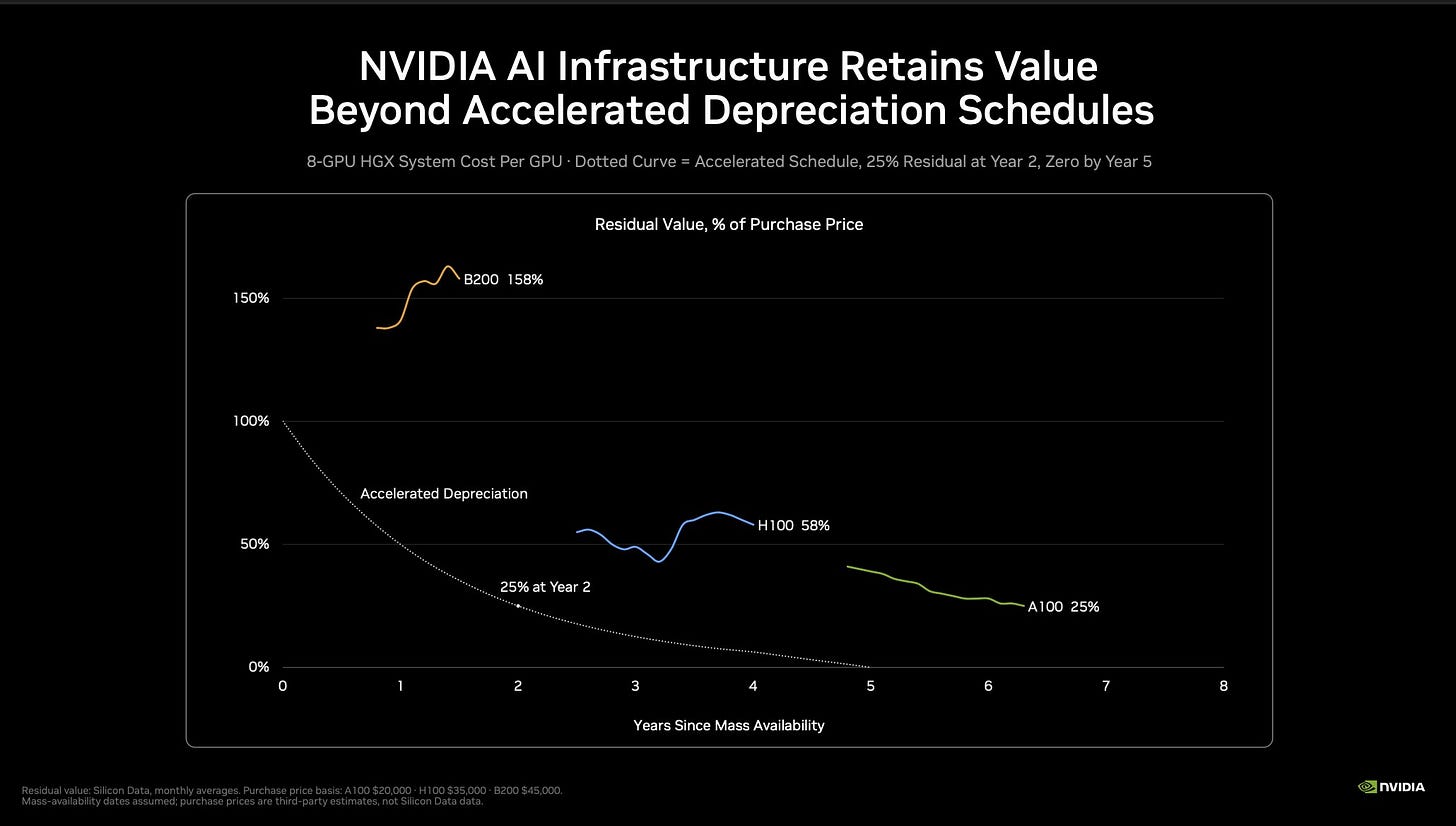
The debate surrounding hardware depreciation schedules represents another major friction point in credit markets. Artificial intelligence skeptics frequently argue that advanced processors feature rapid depreciation schedules that render them technologically obsolete within a few years, necessitating continuous, capital-intensive replacements. Empirical market evidence challenges this assumption. Older generation hardware, such as the A100 GPUs introduced in 2020, remains actively deployed and commercially rented out, establishing a proven operational floor of nearly a decade of useful economic value. Industry experts anticipate that newer architectures, including Blackwell and subsequent generations, will similarly maintain commercial viability well north of ten years.
Moreover, actual hardware market dynamics frequently defy standard depreciation models, with certain advanced chips maintaining or even appreciating in value relative to their initial release prices. For instance, specific high-performance chips have traded at premiums years after launch due to acute industry-wide shortages. While newer chips undoubtedly offer greater energy efficiency and raw processing power, this technological evolution overlooks three critical real-world factors: the overwhelming backlog of global demand, the ongoing scarcity of fabrication and packaging capacity, and the reality that older hardware remains fully capable of handling a vast array of inference and specialized training workloads.
Consequently, financial institutions must adopt an entirely new analytical framework when evaluating the useful economic life and collateral value of graphics processing units. This represents a distinct asset class operating under unprecedented financial and technological dynamics. As software efficiencies advance and drive further adoption, Jevons paradox continues to play out in real time across the global economy. Compute infrastructure is steadily positioning itself to surpass traditional real estate as the largest asset class on the planet, marking the beginning of a multi-decade structural transformation that requires a sophisticated synthesis of deep technological literacy and advanced financial market expertise.



Comments (0)