


CoreWeave, the specialized cloud provider backed by artificial intelligence giant Nvidia, posted a massive 24.7% surge in its stock price on Wednesday, injecting a vital wave of renewed enthusiasm into the broader AI trade following weeks of persistent selling pressure. The dramatic market rebound was fueled by the company’s latest financial report, which revealed soaring demand for the expensive, highly specialized computing hardware that serves as the absolute backbone of the global artificial intelligence boom.
For investors closely watching the trajectory of Nvidia and the entire technology sector, CoreWeave provides a remarkably clear window into what actually happens downstream after the chipmaker sells its advanced processors. The cloud computing firm operates by purchasing Nvidia graphics processing units (GPUs), installing them in massive, power-hungry data centers, and subsequently renting out that immense computing horsepower to companies that are actively developing or running cutting-edge artificial intelligence models. Among CoreWeave’s prominent customers are industry heavyweights like OpenAI, Cohere, and Perplexity, all of which rely heavily on outsourced infrastructure to train and deploy their large language models.
During the third quarter, the cloud provider posted an impressive $3.66 billion in revenue, representing a staggering 168% increase compared to the same period a year prior. Building on this momentum, the company significantly raised its sales forecast for 2026, telling investors it now anticipates generating between $13 billion and $13.3 billion for the full year. These better-than-expected results did not just benefit CoreWeave alone; they acted as a powerful rising tide that lifted Nvidia itself, along with a broad array of related AI infrastructure and neocloud stocks, including Nebius, IREN, Oracle, and Applied Digital. The wider technology sector also caught a tailwind, with the Nasdaq index climbing 1.6% during the trading session.
The strong earnings report arrived at a critical juncture for financial markets, as investors had spent recent weeks wrestling with deep uncertainty over whether falling technology stock prices reflected genuinely weakening demand for artificial intelligence capabilities or merely heightened anxiety regarding the massive capital expenditures required to build out the necessary infrastructure. CoreWeave’s numbers offered definitive proof that businesses and developers are still more than willing to pay top dollar for dedicated AI computing capacity. However, financial analysts note that while the revenue growth demonstrates robust near-term demand, it does not by itself guarantee that the astronomical spending required to supply that capacity will ultimately translate into sustainable, long-term profits.

Why Nvidia Has So Much Riding on CoreWeave
The commercial connection between Nvidia and CoreWeave extends far beyond a standard, arms-length supplier relationship, crossing into deep strategic entanglement. In January, Nvidia reinforced this alliance by injecting another $2 billion into CoreWeave shares at a price of $87.20 each. This transaction further expanded a collaborative business arrangement explicitly designed to accelerate the buildout of more than five gigawatts of AI-optimized data center capacity by the year 2030.
Under the terms of their broader agreements, the two companies also committed to integrating cutting-edge Nvidia technology directly into CoreWeave’s infrastructure as soon as it becomes available. This pipeline includes next-generation hardware platforms such as Nvidia’s Rubin architecture and Vera central processing units. Consequently, CoreWeave functions not merely as a high-volume customer purchasing off-the-shelf chips, but as a crucial showcase and testing ground for future iterations of Nvidia hardware.
When that expanded partnership was officially announced in January, Nvidia Chief Executive Officer Jensen Huang highlighted the urgency of the initiative, stating that the two firms were racing together to meet extraordinary, unprecedented demand for what he termed Nvidia AI factories.
Adding another layer to this intricate corporate web, Nvidia also maintains an initial $6.3 billion agreement to purchase CoreWeave’s unused or excess computing capacity through April 2032, subject to specific contractual conditions. For CoreWeave, this arrangement provides a valuable financial safety net by guaranteeing a buyer for cloud capacity that it might not be able to immediately lease out on the open market. For Nvidia, the contract ensures guaranteed access to specialized cloud computing infrastructure built entirely around its own proprietary silicon.

This web of interconnected financial dealings has naturally drawn intense scrutiny from market watchers, sparking both immense market excitement and sharp criticism. Critics on social media and financial forums have pointed out that Nvidia sells hardware to CoreWeave, invests heavily in CoreWeave’s equity, and simultaneously agrees to purchase the cloud services generated by those very same chips. Skeptics and financial commentators have colloquially dubbed this arrangement circular finance, viewing the overlapping capital flows as a potential warning sign that makes it difficult to accurately measure true, independent market demand for AI services. Despite these structural complexities, both companies maintain that these are entirely legitimate, binding commercial agreements rooted in real-world infrastructure needs.
What the Earnings Say About the AI Boom
Beneath the headline-grabbing revenue figures, CoreWeave’s financial disclosures offered a deeper look into the mechanics of the neocloud industry. The company reported a massive revenue backlog of $132.5 billion. In corporate finance terms, a backlog represents contracted business and future orders that the company expects to deliver over an extended period, rather than immediate cash sitting in the bank. At the close of September, CoreWeave reported that it had more than 1.7 gigawatts of active power capacity operational across its facilities.
During the company’s earnings call with analysts, Chief Executive Officer Michael Intrator described the period as a breakout quarter for the business, emphasizing that revenue had expanded by more than $1 billion on a sequential basis compared to the previous quarter. Furthermore, CoreWeave revealed that it expects to pull in approximately $9 billion in customer prepayments and cash deposits over the subsequent three-month window. Securing substantial capital upfront before delivering all the associated services could significantly reduce the firm’s immediate need to tap debt markets for funding—a crucial advantage at a time when traditional investors have grown increasingly uneasy about the heavy debt loads required to finance the construction of power-intensive AI data centers.
These specialized GPU-rental businesses are frequently referred to in financial circles as neoclouds. Notably, several prominent players in this niche—most notably CoreWeave itself, which originally launched years ago as an Ethereum cryptocurrency mining operation—trace their institutional roots back to crypto infrastructure. Operators originating from the crypto mining sector arrived with pre-existing expertise in sourcing massive amounts of cheap electricity and managing dense concentrations of intensely power-hungry computing hardware, giving them a head start when the generative AI boom triggered an unprecedented scramble for data center space.
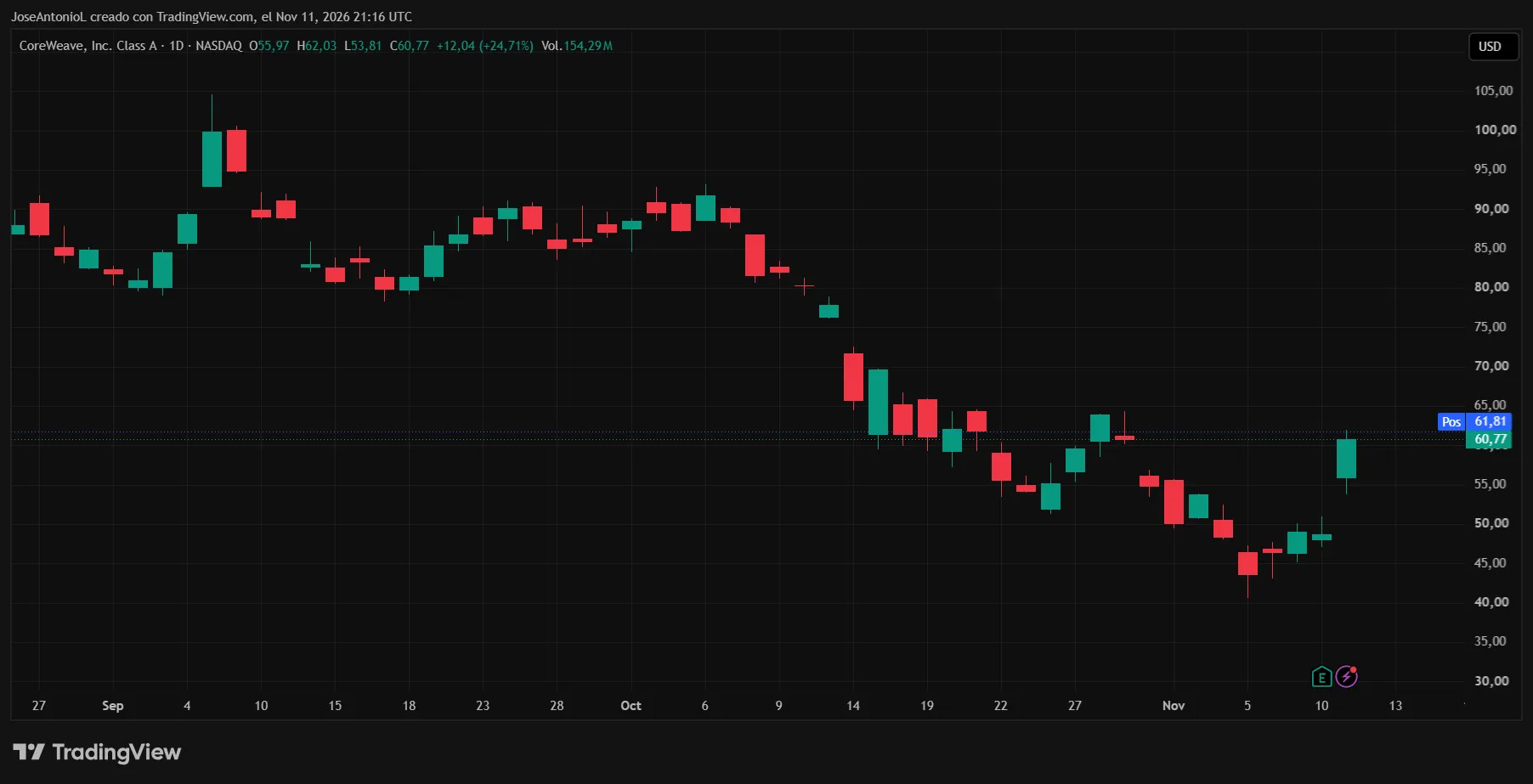
Wall Street analysts responded enthusiastically to the latest corporate update. According to reports from Reuters, analysts at Bernstein characterized the period as about the best quarter anyone could have reasonably asked for. However, even the most optimistic observers offered words of caution, warning that CoreWeave would likely be among the firms hit hardest if the acute, industry-wide shortage of available AI computing capacity eventually begins to ease.
The deep strategic partnership with Nvidia does not completely insulate CoreWeave from these underlying market risks. As technological advancement presses forward, the introduction of newer, faster processors can rapidly render older GPU models less competitive, potentially compressing profit margins. Furthermore, external constraints such as regional electricity shortages, long construction delays for new data center real estate, and elevated borrowing costs can severely squeeze financial returns. An oversupply of AI computing power across the broader market would also exert immediate downward pressure on the rental prices that CoreWeave can charge its corporate clientele, testing the long-term viability of the neocloud business model.




Comments (0)