


The decentralized finance landscape has long wrestled with one of its most persistent and costly architectural flaws: impermanent loss. For years, automated market makers have forced liquidity providers to accept the inherent risk of asset price divergence, often resulting in losses that outweigh trading fee rewards unless aggressively offset by token emissions or complex hedging strategies. Now, a novel protocol known as Yield Basis is attempting to rewrite the rules of liquidity provision by introducing a specialized mechanism that uses leverage to completely eliminate impermanent loss from automated market makers, signaling what many analysts believe could be a structural turning point for decentralized liquidity.

The protocol carries significant pedigree within the decentralized finance sector, having been developed by the same founder behind Curve DAO, the foundational stablecoin and pegged-asset exchange. This shared lineage creates natural technical and operational synergies between the two protocols, positioning Yield Basis not as an isolated experiment, but as an extension of proven liquidity architecture. The complex mathematical and economic mechanics underpinning the protocol’s approach to leveraged liquidity are detailed in the official research documentation published by the team, outlining how leverage can be strategically deployed to neutralize the divergent risks traditionally borne by liquidity providers.
Despite a history marked by countless failed attempts from various projects aiming to solve the impermanent loss dilemma, Yield Basis appears to have secured immediate traction where its predecessors stumbled. Market adoption has materialized at a rapid pace, with the protocol already capturing the three largest Bitcoin decentralized exchange pools across the entire decentralized finance ecosystem, representing a combined total of over $400 million in total value locked. This substantial early accumulation of capital suggests that institutional and sophisticated retail liquidity providers are increasingly willing to test the protocol’s innovative mechanics in exchange for safer, more predictable yield generation avenues.

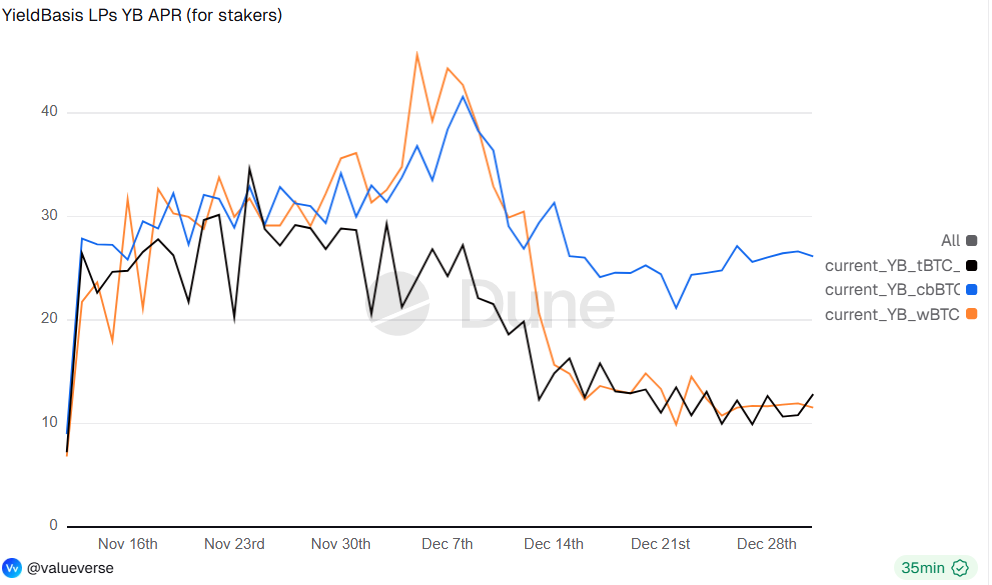
Crucially, this rapid expansion means that holders of wrapped native Bitcoin tokens can now generate consistent yield while supplying liquidity without the constant threat of capital erosion via price divergence. Historical data covering the seven-day moving average for this supply yield demonstrates a compelling return profile, with rates typically fluctuating between 4% and 40% depending on market volatility and pool utilization. Because many participants typically avoid providing liquidity to automated market makers unless driven by aggressive liquidity mining incentives, it is easy to overlook a vital structural feature of the protocol: yields are distributed directly in the underlying pool tokens. For Bitcoin holders, this translates directly into native Bitcoin yields rather than speculative or diluted governance tokens.
Beyond the baseline mechanics of liquidity provision and yield generation, the governance and utility framework of the native YB token has been designed to capture genuine economic value rather than relying on purely speculative sentiment. The protocol officially activated its fee switch earlier this month, establishing a tangible link between platform activity and tokenholder value. Under the current structure, Yield Basis liquidity providers face a clear choice regarding how they generate returns from their deposited capital. Providers can choose to hold the ybBTC liquidity provider token and receive trading fees denominated directly in Bitcoin, or they can opt to stake their ybBTC tokens, foregoing the Bitcoin-denominated trading fees in exchange for participation in native YB token emissions.

This dual-pathway approach aligns closely with traditional corporate finance principles regarding shareholder returns versus reinvestment, favoring direct earnings distribution over superficial token buyback programs. As financial theory suggests, providing direct earnings gives participants crucial optionality, allowing them to independently decide whether, when, and how to acquire the underlying protocol token based on their own market assessments. To put the scale of this distribution into perspective, roughly $450,000 was distributed to participants for the week ending December 25 alone, and this impressive figure was achieved despite existing caps restricting the maximum capacity of the liquidity pools.
While the immediate application centers heavily on eliminating impermanent loss and offering a reliable mechanism to earn native yield on Bitcoin without the traditional risks, complexities, and ongoing costs associated with manual hedging, the broader ambitions of Yield Basis extend considerably further. The project is strategically positioned as a comprehensive yield and liquidity infrastructure layer designed to transform historically non-productive assets into yield-bearing instruments while simultaneously establishing robust secondary markets. By focusing heavily on wrapped native assets and tokenized real-world assets, Yield Basis aims to theoretically make any sufficiently liquid and volatile asset productive. This architecture allows asset issuers to derive organic earnings from liquidity rather than perpetually subsidizing market-making activities, while simultaneously granting asset holders access to sustainable yield and downstream decentralized finance use cases, such as utilizing their productive assets as collateral for borrowing.
This expansive model holds the potential to extend far beyond primary crypto majors like Bitcoin and Ethereum, reaching into tokenized commodities and equities such as gold, silver, and major technology stocks like NVIDIA. Currently, the onchain adoption of these traditional financial instruments remains severely constrained by the persistent threat of impermanent loss, shallow market liquidity, and a noticeable absence of organic yield generation or efficient liquidation pathways. By offering a unique, superior yield alternative characterized by an attractive risk-reward profile, deep liquidity pools, and powerful network effects, Yield Basis could successfully unlock these dormant markets and bridge the gap between traditional asset classes and decentralized finance infrastructure.
At the same time, market participants and analysts emphasize that Yield Basis is not entirely without risk, and careful evaluation of the protocol’s underlying mechanics remains essential for anyone interacting with the system. Observers and prospective users are encouraged to examine the technical research papers, leveraging available analytical tools to fully comprehend both the potential systemic downsides and the profound structural unlocks that the protocol has to offer as it continues to scale its operations across the broader decentralized finance ecosystem.





Comments (0)