


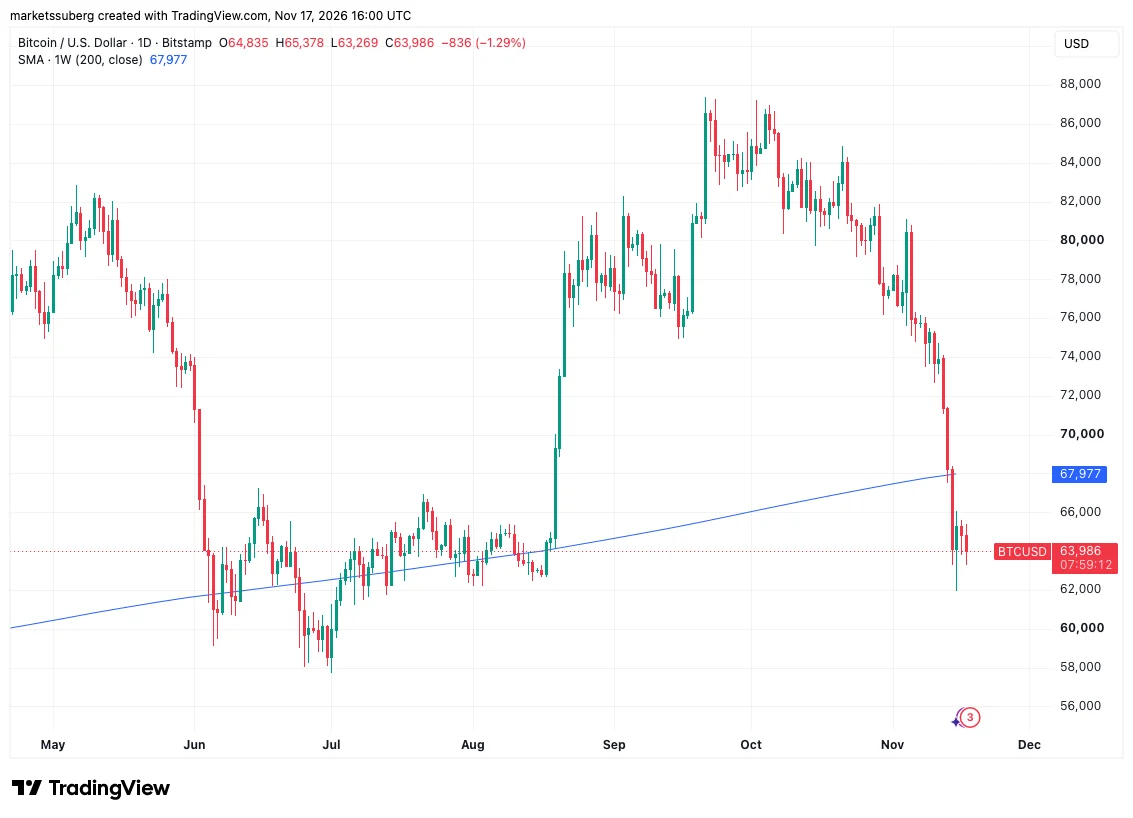
Bitcoin faced renewed selling pressure following Tuesday’s Wall Street opening bell, as traditional stock markets remained on edge in anticipation of Nvidia’s upcoming third-quarter earnings report and forward-looking guidance. The broader financial landscape showed signs of acute fragility, with investors grappling not only with shifting sentiment surrounding the artificial intelligence sector but also with intense corporate governance drama at one of the world’s most influential technology firms.
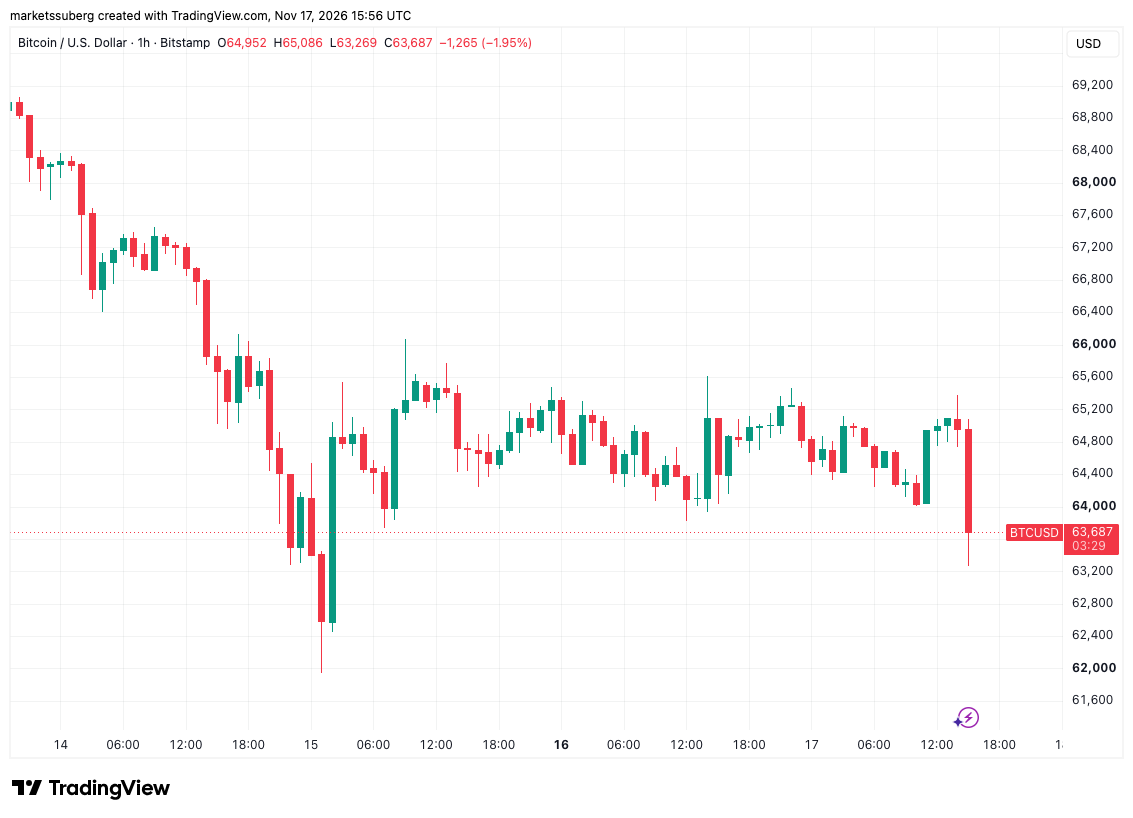
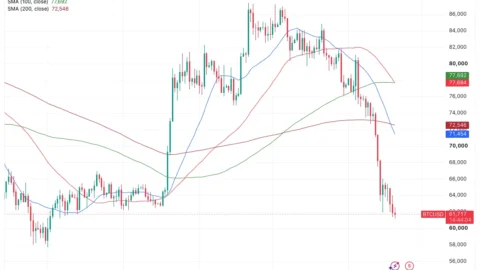
Data captured from TradingView illustrated a notable downward move for the bellwether cryptocurrency. The BTC/USD trading pair dipped to an intraday low of $63,269 on the Bitstamp exchange, registering losses of up to 2.5% on the day. This downward correction broke Bitcoin out of the tight, narrow consolidation range between $64,000 and $66,000 that had largely defined its price action since mid-November. As traders awaited concrete signals from the broader macro environment, digital asset markets once again demonstrated a high sensitivity to traditional equity volatility.
Bitcoin and Global Equities Face Nvidia Headwinds
US equities kicked off the trading session with minor losses, heavily weighted by apprehension over Nvidia’s financial disclosures. Beyond the standard earnings metrics and revenue forecasts for the AI hardware giant, market participants sought clarity on how the company intended to navigate the ongoing controversy surrounding its former Chief Executive Officer, Jensen Huang.

Mounting pressure has been placed on Nvidia’s leadership to reinstate Huang, a push that has notably encountered stern resistance from key political figures, including US Treasury Secretary Scott Bessent. Industry commentators and analysts have suggested there is currently little chance of Nvidia’s board reversing its previous decision to dismiss him. Amid these tensions, the board moved to institutionalize its risk management framework on Tuesday by announcing the creation of a National Security and Export Control Oversight Committee. According to the company’s official press release, the newly formed committee is dedicated to the oversight of national security policies, export control compliance, and global trade risk management.
Harvey Jones, the chairman of the board, commented on the formation of the committee, stating that the organization remains committed to working constructively with government and industry partners. He emphasized that the goal is to help establish and advance a robust framework utilizing every available tool to safeguard national security while simultaneously supporting continued technological innovation.
Compounding the corporate uncertainty, Jensen Huang is scheduled to appear before Congress to testify on December 1. In its latest market analysis, prominent trading resource The Kobeissi Letter estimated the odds of Huang returning to his former post at less than 20% given the weight of recent developments. Nevertheless, analysts noted that any unexpected indication of a higher probability of his return would likely act as a strongly bullish catalyst for the stock.
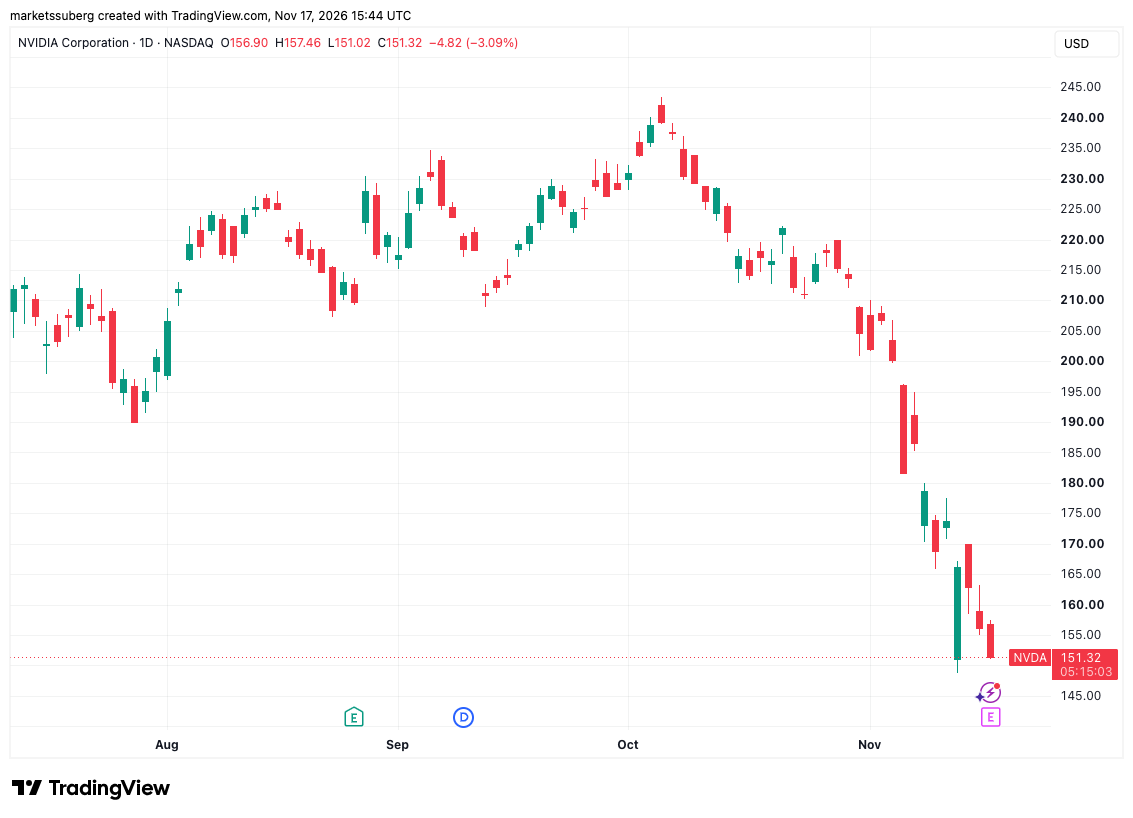
The Kobeissi Letter also raised questions regarding whether Huang’s departure could fully justify the staggering $750 billion loss in market capitalization that Nvidia has suffered during the ordeal. Nvidia shares (NVDA) dipped to $150.35, trading down over 3% on the session and hovering near levels not seen since late June, when the stock touched $148.80 on November 12.
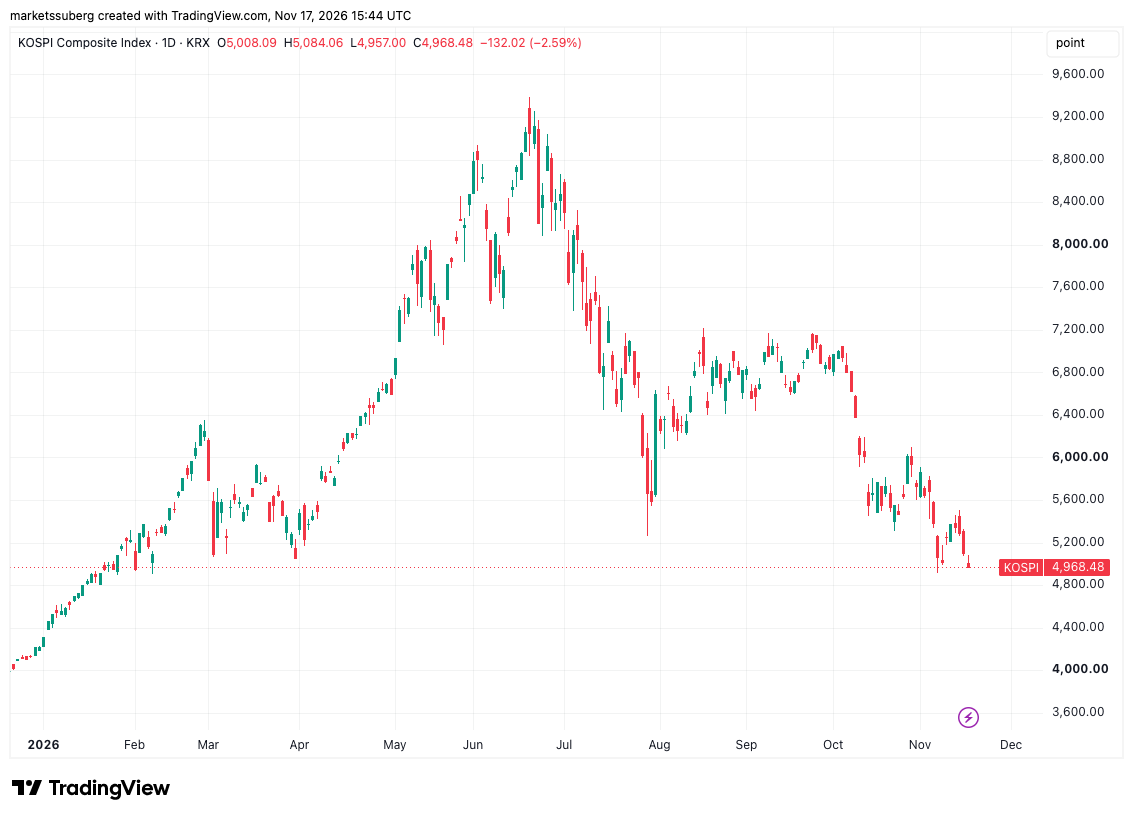
Nerves across the financial markets extended far beyond the borders of the United States, reflecting a broader anxiety ahead of a pivotal moment for the global artificial intelligence sector. In South Korea, the technology-heavy KOSPI Composite Index finished Tuesday’s trading session down 2.6%, closing at 4,968 points. This marked the index’s lowest daily close since February 2, highlighting how international markets are acutely vulnerable to shifts in tech sentiment.
Market analysts pointed to a broader unwinding of speculative excess. Ben Emons, the founder of FedWatch Advisors, observed in a note to clients that the market tape feels increasingly fragile as Nvidia’s AI premium continues to unwind. He noted that investors are actively reassessing the long-term durability of the entire corporate ecosystem that has been built around the company’s historic market dominance.
This cautious stance was further corroborated by institutional survey data. Major financial outlets, including CNBC, referenced findings from Bank of America’s latest monthly fund manager survey. The data revealed that institutional investors slashed their technology stock exposure last month, dropping from a 37% overweight position down to just 12%. This drastic reduction represented the largest single monthly shift in tech-stock allocations recorded since June 2006.
Analyst Warns BTC Price Must Avoid Rebound "Trap"
As Bitcoin attempted to digest the macroeconomic pressure and break out of its recent multi-day trading range, market technicians warned traders against prematurely buying the dip. Keith Alan, co-founder of the crypto trading platform Material Indicators, took to social media to outline several strict technical conditions that the market must fulfill before any sustainable and durable market rebound can be confirmed.
In an update shared on X, Alan argued that while reclaiming key long-term moving averages is essential, it is far from sufficient on its own. Specifically, he noted that the BTC/USD pair needs to decisively reclaim its 200-week simple moving average, which sat at $67,977. However, simply touching or briefly piercing this moving average would not guarantee a trend reversal.
According to Alan, lower time frames must also produce a clear, sustained series of higher swing lows and higher swing highs. Furthermore, any organic breakouts through local overhead resistance levels must be accompanied by high, verifiable buyer volume to prove institutional commitment. Without these foundational technical elements falling into place, Alan warned that any sudden price bounce carries a statistically higher probability of being a bull trap rather than a legitimate recovery effort.
This analysis aligns with ongoing market commentary regarding the critical importance of the 200-week simple moving average. Market observers have repeatedly highlighted this specific multi-year trend line as a foundational support level that must be defended by the bull camp to maintain a broader macro recovery narrative, especially as metrics measuring realized losses and open interest signal significant shifts in market positioning across the digital asset ecosystem.




Comments (0)