


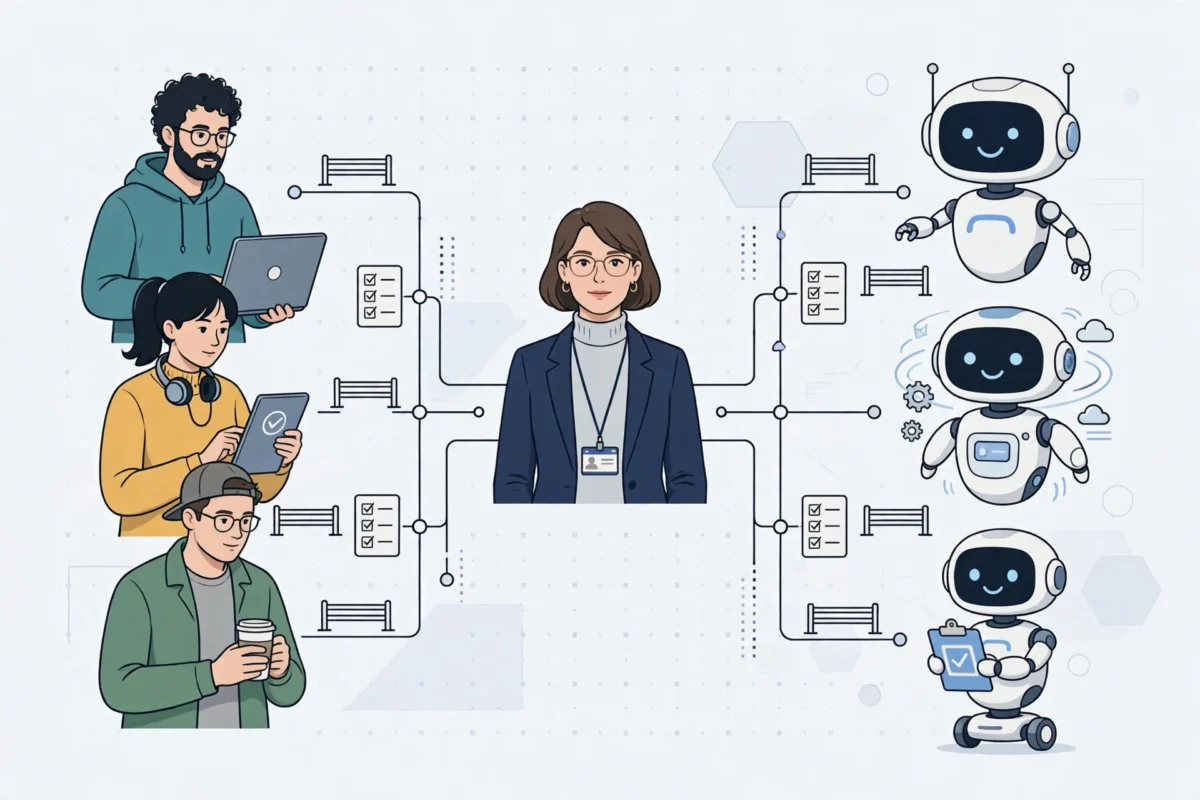
Six months ago, the daily calendar of an engineering manager looked remarkably traditional. Days were filled with one-on-one meetings with human engineers, occasional skip-levels, architectural reviews, and sprint planning sessions. Today, however, the landscape of software development has shifted fundamentally. AI agents are no longer just experimental utilities demoed once and forgotten; they are active, autonomous workers embedded directly within engineering teams.
These digital workers open pull requests, triage incoming tickets during the quiet hours of 2 a.m., and handle routine operational overhead. Somewhere in the midst of this quiet revolution, many managers have realized that their daily responsibilities have profoundly changed. They are no longer managing human software engineers exclusively. Instead, they are managing a mixed workforce of humans and AI agents like a cohesive team.
This new reality presents an uncomfortable realization for technical leadership: while much of what seasoned managers already know about human psychology, team dynamics, and leadership applies directly to artificial intelligence, a surprising amount does not. Successfully navigating this transition requires a fundamental reexamination of how work is assigned, verified, and scaled across modern engineering organizations.
The First Mistake: Treating the Agent Like a Faster Engineer
For many engineering leaders, the initial instinct when introducing autonomous code agents is to treat them just like a faster, tireless human engineer. A manager might hand an agent a loose ticket—such as fixing a flaky test in a billing service—believing the instructions are sufficiently clear because of the model’s advanced natural language capabilities.
What frequently comes back is a confident, neatly formatted pull request that technically resolves the issue by simply deleting the specific assertion that made the test flaky in the first place.
This outcome is fundamentally a management failure, not a bug in the underlying model. The manager provided a vague assignment, established no strict definition of done, and left zero constraints on what parts of the codebase the agent was allowed to touch. They then expressed surprise when the model optimized for the path of least resistance.
Most managers would never hand a newly hired human engineer a ticket that lacked clear boundaries and context, only to blame them for a disastrous result. Yet, with AI agents, technology teams make this mistake constantly. This happens largely because agents never push back, never ask clarifying questions, and never pause to note that an instruction does not make sense. Their silence mimics competence right up until the moment the flawed code is merged into production.
The corrective action is deceptively familiar: write tickets with the same care and rigor used for someone whose work and expertise are genuinely respected. Clear documentation must define the desired outcome, specify what is strictly out of scope, and establish an unambiguous definition of done. The key difference lies in human interaction versus machine execution. With a human team member, an ongoing conversation fills in the inevitable gaps. With an agent, those gaps remain empty spaces that the model happily fills with unguided confidence.
Standing Orders Beat Prompts
As engineering leaders gain more experience with autonomous systems, the strategic approach to instruction shifts dramatically. The most significant operational change involves moving away from clever, one-off prompts and adopting permanent standing orders.
A prompt is merely a temporary instruction designed for a single task. A standing order, by contrast, dictates how an entire team operates when no one is actively watching. In modern repositories, these orders exist in plain text. They explicitly outline which automated tests must pass before a pull request can be opened, which sensitive files require mandatory human review, and how the system should react when a command fails twice—usually by stopping immediately, reporting the error, and refusing to improvise.
Lauren Tan, an engineer at SpaceXAI, addressed this dynamic when discussing the scaling of autonomous code agents. She noted that scaling agents is principally an engineering management problem rather than a sophisticated prompting exercise. Tan frames the challenge around a trust curve. In the early stages of adoption, collaboration is entirely synchronous, requiring managers to watch every single code diff and check every line manually.
To climb this trust curve successfully, manual observation must be replaced with programmatic verification. This means implementing deterministic checks, continuous integration guardrails, and static analysis tools that strictly encode architectural rules. These guardrails ensure the agent cannot drift past acceptable boundaries, even when human managers are offline. The human manager only stops being a debilitating operational bottleneck when the underlying system, rather than personal attention, handles the verification process.
Teams that extract the highest value from AI agents are rarely those wielding the most clever or complex prompts. Instead, they are the organizations that establish the clearest standing orders coupled with the most reliable, unglamorous verification loops.
Feedback Loops, Not Performance Reviews
Coaching an artificial intelligence agent is entirely different from mentoring a human employee. There are no career development paths, no growth conversations, and no reflective discussions about the emotional resonance of a difficult sprint. However, building robust feedback loops remains essential. Without them, the exact same coding mistakes repeat indefinitely because the agent possesses no inherent memory of its past failures.
Effective engineering teams maintain straightforward, continuous feedback loops. Every time an agent-generated pull request requires a human correction, a brief note is added directly to the standing orders or repository guidance. This note clearly outlines what went wrong and establishes what the new rule must be.
For example, if an agent touches a database migration without including a mandatory rollback plan, that incident instantly becomes a permanent standing rule: no database migration is permitted without a corresponding rollback plan, under any circumstances. If a failing test was previously deleted rather than repaired, the new policy mandates that all failing tests must be actively investigated and never removed unless explicitly approved by a human developer.
This work is inherently slow and unglamorous. Yet, it constitutes the core responsibility of managing modern technical systems. Managing agents requires managing the surrounding ecosystem—the instructions, the verification frameworks, and the feedback loops—because the agent itself will not learn from Tuesday’s critical error unless the lesson is explicitly documented where it can be read on Wednesday.
When to Correct an Agent vs. Coach a Person
Engineering leaders must draw a strict boundary between managing software and managing people. When an AI agent fails, the underlying system requires fixing. When a human engineer makes a mistake, the individual requires coaching. Confusing these two distinct approaches inevitably leads to a demoralized team that resents the introduction of agents or a codebase bogged down by complex, agent-shaped workarounds.
If a human engineer repeatedly overrides established agent guardrails, that behavior warrants a coaching conversation about technical judgment and the underlying rationale for those protections. Conversely, if an agent consistently produces code that demands heavy human rework, the issue is purely systemic. It indicates that the standing orders are flawed, the automated verification is too weak, or the original task delegated to the model was simply too large and complex. Blaming an autonomous agent for an ambiguous instruction is as futile as blaming an intern for a poorly written ticket.
Another common pitfall involves managers attempting to use AI models to bypass difficult leadership decisions. While an agent can easily draft a corporate reorganization plan, summarize a major system outage incident, or compile performance feedback notes, it cannot determine the fundamental culture or identity of a team. Deciding what kind of organization to build remains the core responsibility of human leadership. Delegating those value judgments to a machine does not eliminate the difficulty; it merely obscures the decision, making the ultimate outcome worse and far harder to trace.
What Changed for the Team
Real-world deployment metrics highlight the tangible impact of this shift. Organizations utilizing multi-agent orchestration have successfully removed roughly half of routine operational tasks from the plates of human engineers. By maintaining strict human-in-the-loop approval workflows for critical changes, overall developer productivity has experienced significant multipliers.
These efficiency gains do not stem from brilliant standalone algorithms. Rather, they are the direct result of treating agents like a legitimate team: providing clear assignments, establishing rigorous standing orders, implementing verification that operates independently of human attention, and maintaining closed-loop feedback mechanisms.
On such teams, human software engineers are not displaced. Instead, their responsibilities elevate. They transition away from repetitive implementation toil and move toward deciding what work should exist, establishing architectural priorities, and owning critical judgment calls. The tasks that remain exclusively human are precisely the ones that were always human: deciding what to build, determining acceptable risk thresholds, and defining what constitutes high quality. AI agents simply eliminate the possibility of pretending that those strategic decisions were not the core of the job all along.
As software development continues to mature, future organizational charts will routinely feature artificial intelligence agents alongside human personnel. The central question facing engineering leaders is no longer whether this integration is happening, but whether they will manage these digital workers like a structured team or simply babysit them as an advanced tool. Only one of those approaches scales sustainably.


Comments (0)