



As another year comes to a close, a curious paradox defines the modern human experience. By nearly every measurable statistical standard, global living standards continue to rise at an unprecedented pace, yet the prevailing emotional atmosphere remains stubbornly pessimistic. In the memorable framing of historian Johan Norberg, "Despite what we hear on the news… the great story of our era is that we are witnessing the greatest improvement in global living standards ever to take place."
Looking back, 2025 offered a surprisingly resilient canvas for human progress. Commentators and analysts examining the data have pointed to an exceptional period of domestic renewal, particularly in the United States. Writing on social media, policy analyst Derek Thompson went so far as to label 2025 "an exceptional year for America," drawing attention to significant, simultaneous declines across multiple categories of hardship. According to Thompson, the year brought staggering reductions in traffic fatalities, drug overdoses, and suicides, alongside what may be the largest single-year drop in murder rates in modern history, paired with dramatic, forward-looking advances in healthcare delivery and therapeutics.

"This seems to be the first period on record when every major cause of premature death — overdose, auto accident, homicide, obesity — is falling at the same time," Thompson observed.
Economist Noah Smith echoed these observations, outlining ten distinct indicators suggesting that the United States is quietly putting itself back together. Among these structural improvements are a rebounding life expectancy rate, a stabilization or peak in hyper-addictive social media usage among youth, and a powerful resurgence in business dynamism and entrepreneurial formation. On a global scale, the data repository Human Progress cataloged more than 1,000 distinct positive developments over the course of the year. These ranged from the astonishing and rapid decline of extreme poverty across India to environmental restoration success stories, such as the return of puffins to the Isle of Muck in the United Kingdom after an absence of at least a quarter-century.
For the average media consumer, however, encountering these milestones relies almost entirely on intentional searching. If one were to rely solely on the daily churn of mainstream news feeds, the impression of the world would be drastically different. This discrepancy highlights a fundamental structural issue in modern journalism: good news rarely commands attention, and in the relentless battle for shrinking human attention spans, media outlets have increasingly doubled down on a strategy of emotional provocation through negative framing.
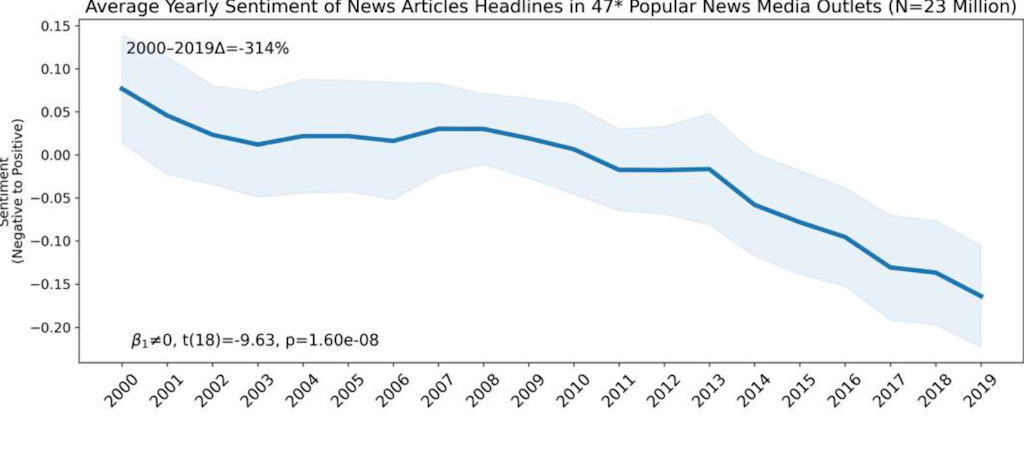
The mechanics of this phenomenon are deeply entrenched in media culture, driven by the timeless newsroom adage, "If it leads, it bleeds." Yet, empirical evidence suggests this strategy has accelerated dramatically in the digital age. A comprehensive academic study published in 2022 documented a distinct pattern of escalating negative sentiment within headline writing over the prior two decades. Researchers discovered that news headlines from 2019 were a staggering 314 percent more likely to convey emotions of anger, disgust, fear, or sadness compared to headlines sampled from the year 2000. In the years since that study was published, cultural observers argue that the baseline has only deteriorated further.
Mariana Tupy of Human Progress recently warned of a broader societal contagion. "We are experiencing a contagion of negativity," Tupy noted, explaining that this pessimistic outlook is actively fueled by a hypercompetitive media environment where newspapers, television networks, radio stations, and digital websites project a profoundly skewed and distorted picture of the global reality.
This is not to suggest that 2025 was a utopian era devoid of suffering or systemic challenges. Serious geopolitical conflicts continued to rage across multiple continents, global temperatures continued an upward trajectory, sovereign governments wrestled with deepening debt burdens, and displaced migrants around the world faced ongoing persecution and hardship. But alongside these enduring trials, the world remains demonstrably safer, healthier, and more prosperous than public perception allows.
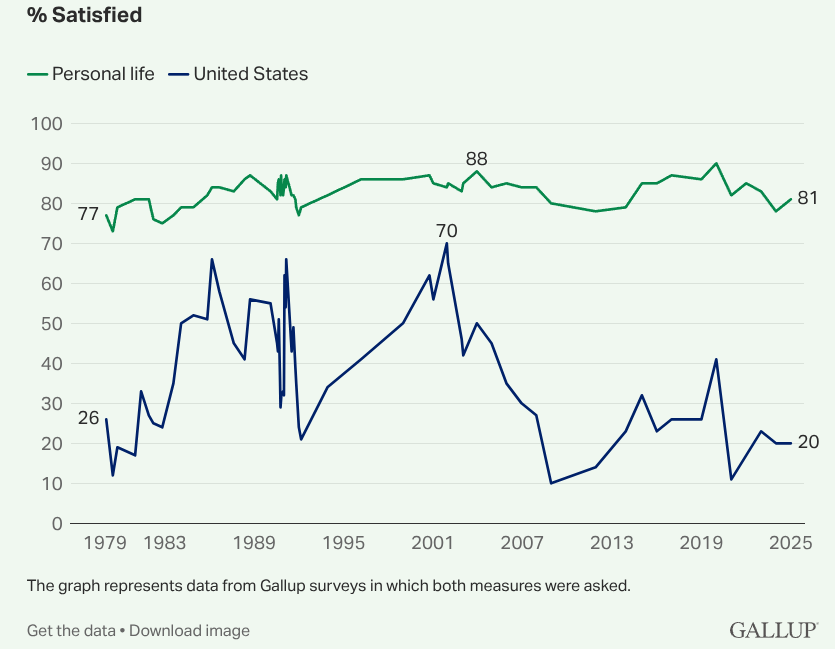
A glaring manifestation of this disconnect can be found in long-running public opinion surveys. A Gallup poll conducted recently revealed a striking perceptual chasm: 81 percent of Americans reported being satisfied with the way things were going in their personal lives, yet only 20 percent expressed satisfaction with the broader trajectory of the country. This gulf between individual contentment and societal despair prompts a fundamental question about how citizens evaluate their world. As Malcolm Cochran noted in a commentary for Human Progress, a country cannot genuinely be failing or collapsing if a supermajority of its citizens report experiencing an excellent quality of life on a personal level.
A similar paradox surrounds the persistent cultural anxiety over an "affordability crisis," which has dominated economic headlines for years. Following a rigorous examination of underlying economic indicators, The Economist concluded that, contrary to popular panic, life in America has arguably never been so broadly affordable for so many people. For the past decade, wage growth has outpaced consumer price inflation, even when accounting for the volatile housing market.
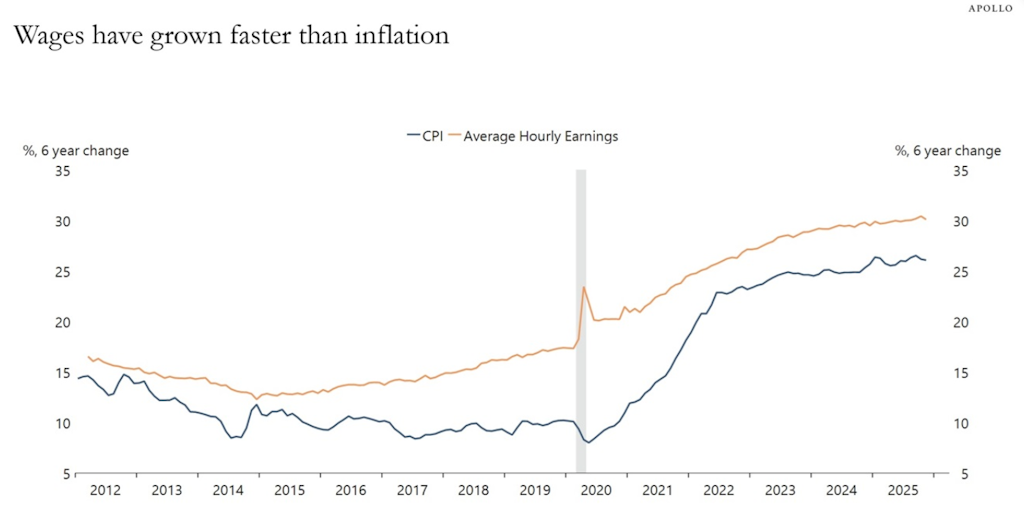
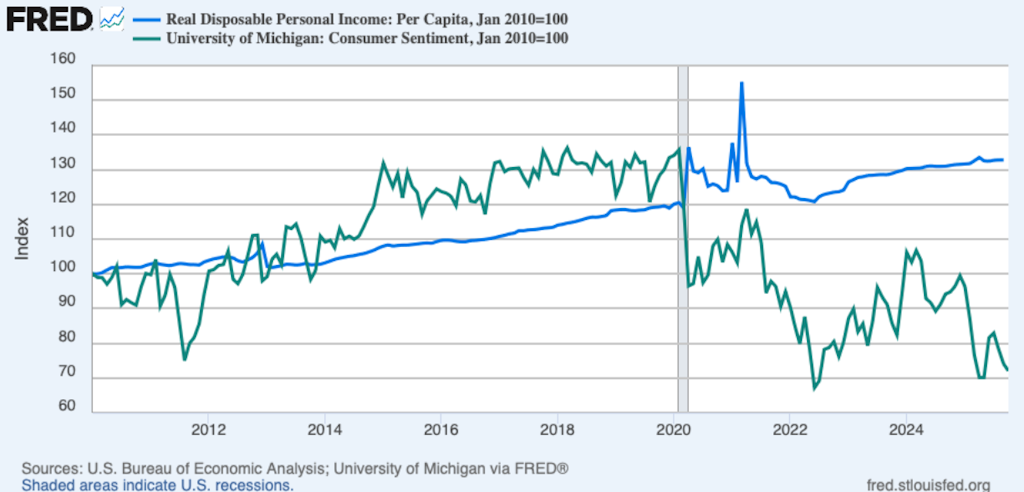
Despite such encouraging economic fundamentals, consumer sentiment has remained stubbornly decoupled from reality. Beginning with the economic disruptions of the pandemic era, consumer confidence indices—tracked by various financial institutions—diverged sharply from real disposable income metrics and have never fully recovered. People continue to feel significantly more pessimistic than hard economic data justifies.
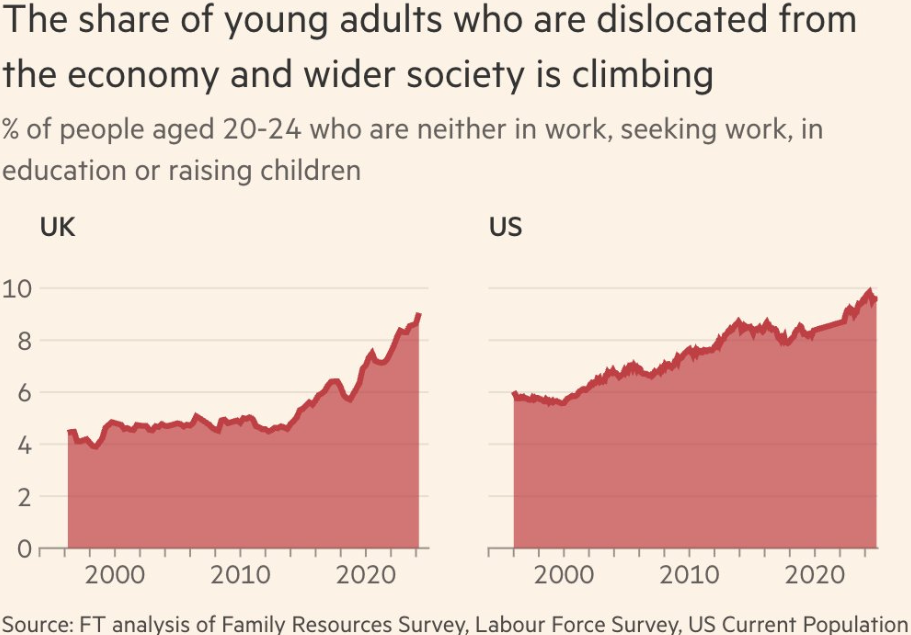
This psychological hangover is visible across multiple sectors of society. While certain lifestyle sectors, such as restaurant dining and commercial air travel, have completely rebounded from pandemic-era lows, others, such as the traditional film industry and mass public transit systems, continue to struggle with structural shifts. Meanwhile, younger demographics exhibit changing patterns of engagement. Financial Times reports examining youth metrics around employment and parenthood indicate that young adults are becoming increasingly disengaged from traditional societal milestones, a trend that analysts suspect is at least partially fueled by the constant drumbeat of pessimistic cultural narratives.
At the same time, global demographic shifts continue to reshape the planet in ways that escape everyday notice. Birth rates have shifted dramatically across continents, with Nigeria now recording more annual births than the entirety of Europe, Ethiopia outpacing the United States, and Afghanistan surpassing Japan. These profound structural evolutions happen largely out of sight, overshadowed by the immediate crises of the daily news cycle.
As society moves forward, the challenge for consumers and institutions alike lies in reconciling emotional perception with empirical reality. Whether the coming year will see a shift toward greater cultural optimism remains an open question. If history is any guide, a more balanced outlook is unlikely to dominate the front pages, but for those willing to look beyond the headlines, the underlying trajectory of human progress continues unabated.





Comments (0)