


The digital asset ecosystem finds itself at a fascinating crossroads as the year progresses, caught in a tug-of-war between short-term price stabilization and a broader, lingering macroeconomic correction. While major cryptocurrency prices have mounted a modest recovery following a bruising market selloff, underlying market indicators suggest that caution remains the order of the day. Negative market breadth and continued underperformance relative to traditional financial benchmarks over a monthly horizon indicate that a prevailing bearish environment still dominates the sentiment of institutional and retail participants alike.
Yet, stepping back from the day-to-day volatility reveals a much more resilient narrative. Secular growth trends across foundational sectors such as stablecoins and decentralized finance lending continue to demonstrate robust, multi-year expansion. Even as spot prices fluctuate and traders grapple with rangebound conditions, the fundamental plumbing of the decentralized economy is maturing at a pace that commands attention far beyond native crypto circles.
Indices and Short-Term Market Dynamics
Digital asset markets continue to trade within a defined range following the severe market contraction witnessed during November. The past week has offered a welcome, albeit modest, recovery across major tokens. Bitcoin (BTC) has managed to reclaim ground, trading near $90,400, which places it roughly 12% above its recent correction low of $80,700.

Looking at performance over a tight 24-hour window, the artificial intelligence and modular blockchain sectors emerged as the top gainers. Tokens such as Bittensor (TAO), which climbed 6.4%, and Celestia (TIA), up 6.2%, served as notable contributors to this short-term upside momentum. Conversely, the perpetual swaps index lagged behind, experiencing mild weakness led by assets such as DYDX, which dropped 3.1%, and HYPE, which slipped 0.6%.
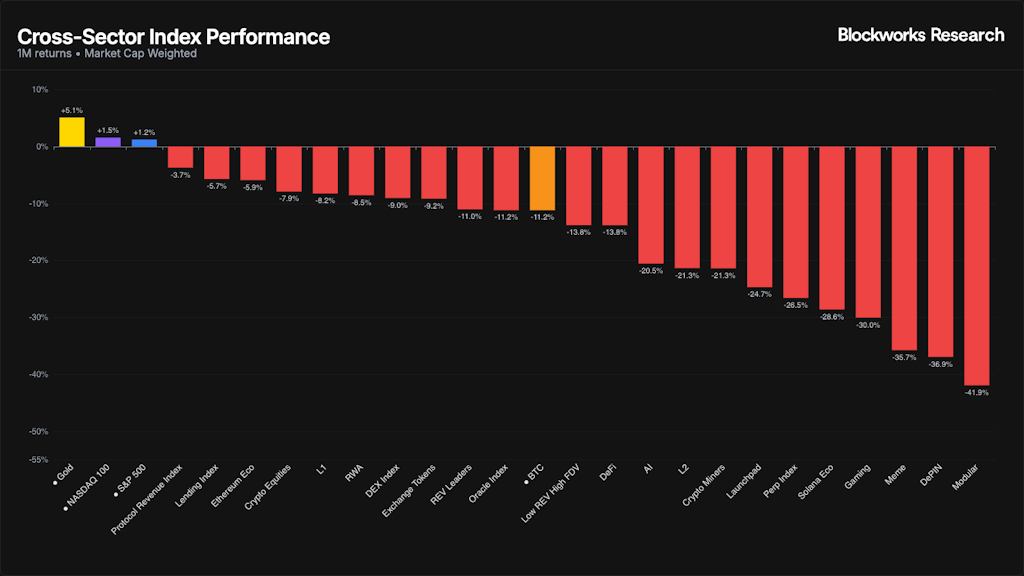
However, shifting the lens to a broader monthly timeframe reveals a distinctly unfavorable picture for digital assets. Traditional finance benchmarks, including gold, the Nasdaq, and the S&P 500, all boast positive returns over the past month. In stark contrast, nearly every crypto index tracked by analysts measures negative returns for the same period. Market breadth remains decisively negative across all crypto indices on a monthly basis, offering investors virtually no safe haven from the downward pressure.
Amid this broader weakness, the Protocol Revenue index has emerged as the relative outperformer among crypto sectors. This resilience points to underlying strength within protocols that boast robust fundamental positioning and genuine utility, rather than pure speculative momentum. Despite these pockets of relative strength, market participants remain divided on whether the current relief rally represents a temporary countertrend move within a prolonged downtrend, or if the ultimate market low for the cycle has already been established.
Market Update and Secular DeFi Expansion
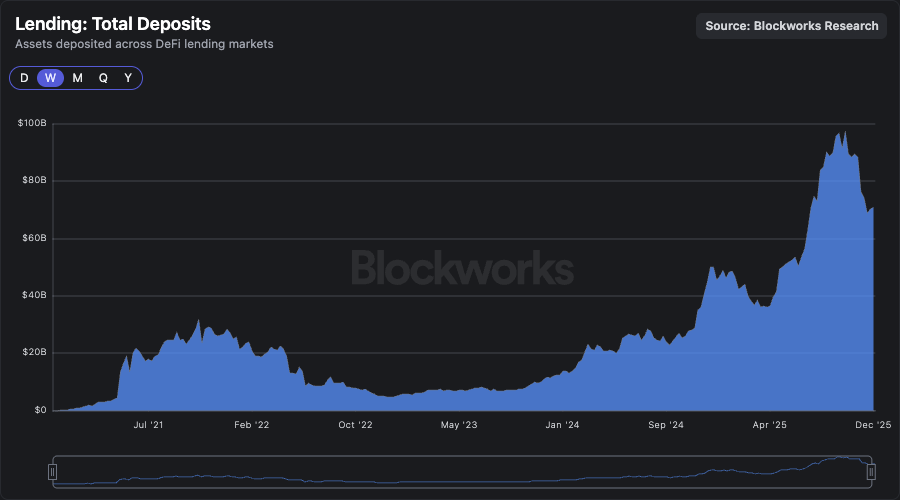
Amid the turbulence of falling spot prices, market observers emphasize the importance of maintaining a macro perspective and appreciating the monumental distance the decentralized finance ecosystem has traveled over market cycles. At the depth of the previous bear market, lending applications within DeFi accounted for a mere $5 billion in total deposits—a veritable rounding error when measured against the scale of the broader global financial system.
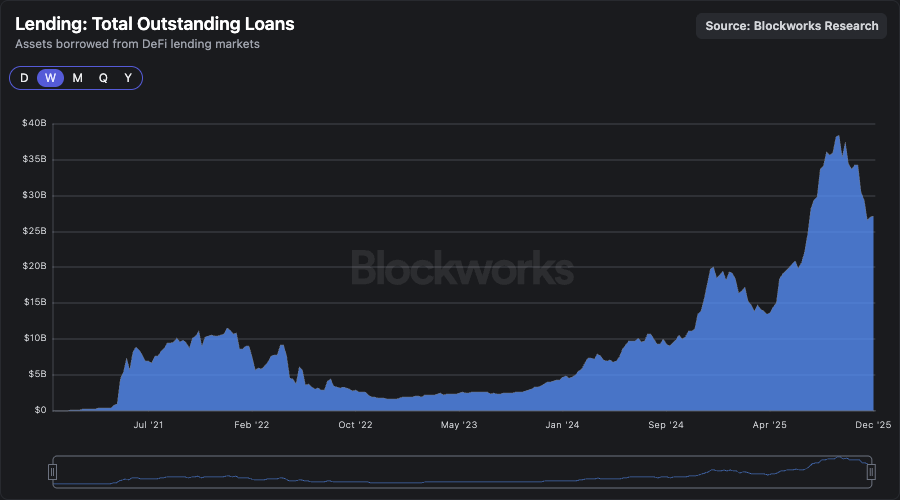
In the years since that trough, that figure has experienced exponential expansion, surging to $71 billion in aggregate deposits after recently flirting with the $100 billion threshold. A similar trajectory is visible in active loan volumes. Outstanding loans on these decentralized lending applications stood at a modest $1.6 billion during the bear market lows. Since then, active loans have climbed to over $27 billion, having recently peaked above the $38 billion mark.
These multi-fold increases have elevated decentralized lending to a scale that warrants serious evaluation by traditional financial institutions and macroeconomic analysts alike. While financial markets are inherently cyclical and variance cuts in both directions—impacting key protocol metrics and spot prices with equal ferocity—a twentyfold growth in top-line metrics over the span of just a few years strongly indicates that the sector is still a long way from reaching its terminal growth rate.
Concurrently, the aggregate stablecoin supply has demonstrated remarkable resilience, retracing all the way back up to its all-time high of $310 billion following a brief period characterized by roughly $10 billion in net capital outflows. This sustained accumulation of stablecoins is a secular trend that highlights the enduring demand for digital cash equivalents onchain.
Onchain money markets stand as the primary beneficiaries of this expanding stablecoin supply, serving as the core applications for deployment and utilization. Stablecoin lenders actively seek sustainable yield opportunities, while borrowers leverage these assets to execute various trading and investment strategies. While underlying spot crypto assets will inevitably remain volatile, this structural trend is expected to provide a persistent and durable tailwind for decentralized finance applications for the foreseeable future.
Nevertheless, this growth occurs against a backdrop of tightening economic margins within the ecosystem. The continued expansion of the stablecoin supply is currently taking place amid relatively modest onchain yields. Benchmark supply rates across major lending applications are hovering around 3.6%, representing a notable discount compared to the Secured Overnight Financing Rate (SOFR), which sits at 3.9%.
This compression highlights a structural challenge for the sector. The growing depth and liquidity of onchain stablecoin capital may continue to dampen the upside potential for lending supply rates. Absent a material risk premium that can compete favorably with legacy financial rates, the pace of future growth in stablecoin utilization across decentralized money markets could potentially face headwinds as capital seeks the most attractive risk-adjusted returns across the global financial landscape.




Comments (0)