


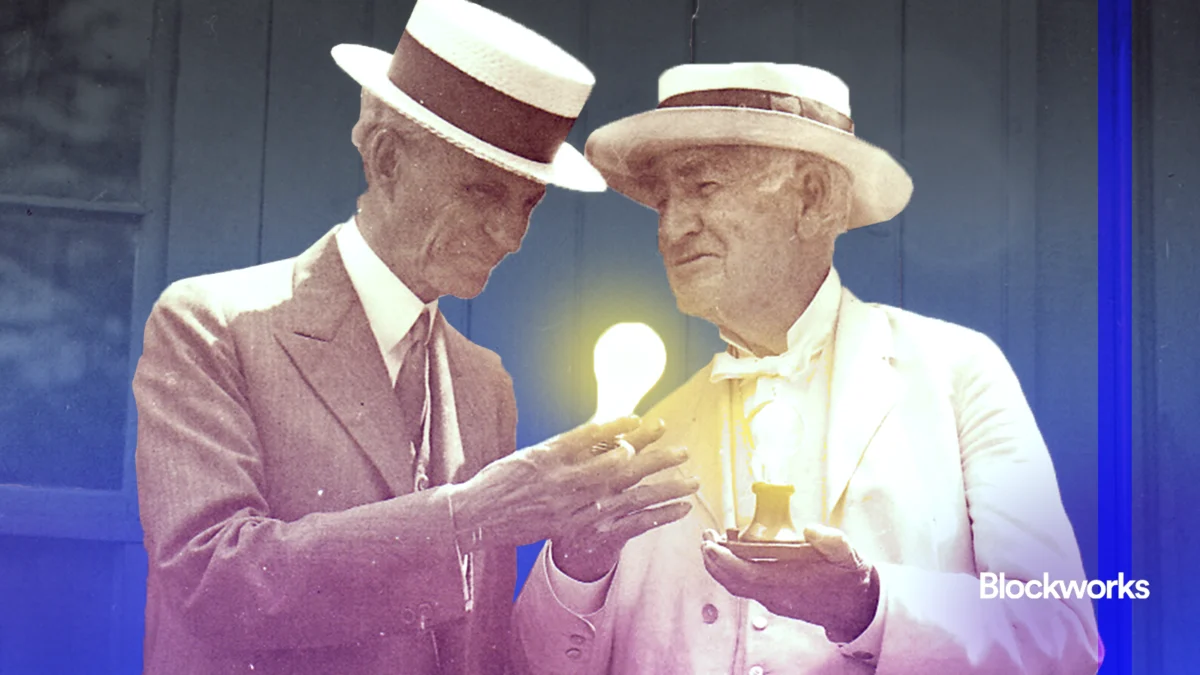
"There was no lightbulb moment in the story of the lightbulb."
That observation, written by Steven Johnson in his acclaimed book How We Got to Now, cuts straight to the heart of how human technological progress actually happens. For generations, popular culture has associated breakthroughs with serendipitous flashes of inspiration—the dramatic moment when a fully formed idea suddenly materializes inside a lone inventor’s head, prompting an immediate, triumphant shout of "Eureka!"
Yet, that is not how the lightbulb itself came into existence, nor is it how most transformative technologies are truly built. While the invention is popularly and persistently credited to Thomas Edison, the incandescent lightbulb was actually the cumulative product of nearly an entire century of relentless trial, error, and collaboration by dozens of different inventors scattered across the globe.
Electric light was first successfully demonstrated in a laboratory setting by Humphry Davy as early as 1802. Decades later, the enclosed bulb mechanism essential to prolonging the life of the element was developed by Warren de la Rue in 1840. Thomas Edison himself was not even born until 1847.
Many more minds contributed both before and after 1847, weaving a complex web of technological evolution. In his seminal historical research, historian Arthur Bright lists approximately two dozen individuals who can rightly be considered co-inventors of the lightbulb. In this light, Edison’s celebrated work represented the ultimate culmination of a long journey, not its solitary origin.
"The Edison lightbulb was not so much a single invention as a bricolage of small improvements," Johnson writes in How We Got to Now.
Edison’s primary and undeniable contribution to that sprawling bricolage was his invention in the late 1870s of the carbonized bamboo filament. This crucial refinement was what ultimately made lightbulbs longer-lasting, safe for indoor residential use, and economically viable for the mass market.
Even then, the path to commercial dominance was far from straightforward. Edison was eventually forced by the patent courts to share historical and legal credit with Sir Joseph Wilson Swan, a British physicist whose own parallel version of the incandescent lightbulb was notably historic for being the first to successfully illuminate both a private home—Swan’s own residence—and a major public venue, the Savoy Theatre in London.
This shared legacy gave rise to the portmanteau brand name of the "Ediswan incandescent lamp," which consumers were offered in the marketplace starting around 1880.
Recognizing this joint custody of the lightbulb takes nothing away from Edison’s monumental achievements as an inventor and entrepreneur. In fact, it highlights an accomplishment of an entirely different order. Edison did something far bigger than simply bring artificial lighting to the masses: He effectively industrialized the act of inventing itself.
"Edison didn’t just invent technology," Johnson explains. "He invented an entire system for inventing, a system that would come to dominate 20th-century industry."
That pioneering corporate system directly inspired a massive proliferation of corporate research and development laboratories. These environments brought together teams of diverse specialists collaborating intensively on complex problems, sharing the financial upside, absorbing outside ideas, and freely building upon each other’s ongoing work. It established a form of "networked innovation" that proved to be infinitely more powerful and productive than the enduring popular myth of the solitary genius working in isolation.
That, Johnson argues, is the true and most profound lesson to learn from the history of the lightbulb.
"If we think that innovation comes from a lone genius inventing a new technology from scratch, that model naturally steers us toward certain policy decisions, like stronger patent protection," Johnson notes. "लेकिन if we think that innovation comes out of collaborative networks, then we want to support different policies and organizational forms: less-rigid patent laws, open standards, employee participation in stock plans, cross-disciplinary connections."
And perhaps, looking forward into the modern technological landscape, that same lesson applies directly to cryptocurrency and blockchain technology.
At its core, crypto is first and foremost a mechanism designed to incentivize the kind of open, composable innovation that builds powerful, resilient networks.
Edison definitively proved that collaboration beats isolation, but his groundbreaking corporate model still ultimately relied heavily on traditional legal patents to retain proprietary control and commercial dominance.
By contrast, some of the most transformative and enduring networks in human history—such as Roman roads, standardized shipping containers, the internet, and GPS—operated on an entirely different architectural philosophy. They were built as open, permissionless infrastructure that anyone could access, build upon, and integrate into their own systems without needing centralized approval.
Economist Christian Catalini recently highlighted this historical lineage when discussing the trajectory of open-source networks. "Money," Catalini observes, "is the last closed network."
Crypto, proponents argue, is the definitive way to open that network up to everyone’s mutual benefit. "Permissionless innovation will always create exponentially more value than a closed system," Catalini concludes.
At the end of what has proven to be a somewhat disappointing and volatile year for open-source crypto markets and development, it remains crucial to remember just how immensely powerful these decentralized networks can ultimately become when allowed to mature.
Just as there was no singular "lightbulb moment" in the historical narrative of the lightbulb, there may well be no single, cinematic moment when crypto "arrives" into mainstream daily life either.
Both technologies are classic products of networked innovation that only truly realize their full societal and economic potential when they evolve into foundational networks themselves. A lightbulb, after all, is merely a fragile glass ornament until it is plugged into a vast, functioning electrical grid.
In much the same way, the broader crypto ecosystem is currently building that exact kind of grid for the modern digital economy—open, permissionless infrastructure patiently waiting for the next great idea to plug in, draw power, and light up the world.
Let us hope that illumination begins to take hold in the year ahead.





Comments (0)