


As the artificial intelligence boom matures beyond its initial phases, the technology sector is encountering a critical new bottleneck: access to capital, specifically through the credit markets. While the early days of the artificial intelligence buildout were funded directly from corporate balance sheets and subsequent waves relied on massive equity raises, industry experts note that these traditional avenues are no longer sufficient to sustain the relentless expansion of the machine infrastructure.
When the modern artificial intelligence buildout commenced several years ago, the vast majority of capital expenditures were covered directly by cash reserves. This was clearly demonstrated as major hyperscalers burned through their cash reserves, drawing intense scrutiny from Wall Street analysts as their free cash flow temporarily turned negative. Tech giants deployed their balance sheets as they saw fit, largely because the spending originated from their own accumulated funds. However, that phase was merely the prologue.
As balance sheet cash proved finite, the next wave of financing naturally shifted toward equity. Major technology firms turned to public and private markets to sustain their operations, highlighted by massive capital raises and shareholder dilution across industry leaders like Alphabet and Meta. Investors who firmly believed in the long-term track records of these corporate titans were initially more than willing to fund their capital-intensive visions. Yet, even these multi-billion-dollar equity injections ultimately fell short of satisfying the insatiable appetite for computational power required to train and run modern advanced models.
Consequently, the industry has turned its focus toward the global credit markets. This transition introduces a radically different dynamic, largely because the sheer size of the global credit market dwarfs traditional pools of equity capital. However, securing credit involves a fundamentally different set of mechanics than equity or internal cash deployment.
While cash on balance sheet requires zero external visibility and equity offerings rely primarily on broad investor confidence without necessitating a deep dive into underlying operational dynamics, credit demands absolute certainty. Lenders must be thoroughly convinced that they will recover their principal on strictly promised terms, backed by robust legal and financial recourse if obligations are not met. To underwrite these transactions, creditors must establish a concrete set of underlying assumptions regarding compute demand, off-take security, and asset depreciation schedules. Industry analysts suggest that many current lender assumptions are not only mutually incompatible but also reflect a fundamental misunderstanding of the modern hardware economy, creating unnecessary barriers to unlocking vital capital.
Skeptics of the current artificial intelligence landscape frequently voice two primary concerns regarding the sustainability of the infrastructure buildout: doubts surrounding the long-term, organic demand for compute, and assumptions regarding the rapid obsolescence of specialized hardware. Addressing the first concern requires examining the trajectory of technological adoption. Current market data indicates that agentic artificial intelligence demand is scaling at a staggering rate of 2.5 to 5 times annually, whereas hardware supply is projected to grow at a maximum of roughly two times by the end of 2030 based on foreseeable manufacturing capacities.
This widening supply gap is compounded by the fact that crucial components like high-performance memory are completely sold out for years in advance, with major industry executives warning that supply constraints are intensifying rather than easing. Aggregate compute commitment contracts currently sit in the trillions of dollars, with leading providers holding backlogs worth hundreds of billions. Because supply cannot be expanded overnight and the diffusion of artificial intelligence across the broader economy continues to accelerate, entire industries are emerging where compute has transformed into a fundamental means of production rather than an optional discretionary expense.
Sectors requiring relentless computational power view advanced hardware as an indispensable source of long-term competitive advantage. These are not enterprises operating under rigid token budgets or attempting to micro-manage marginal productivity gains; rather, they are organizations for which compute capacity directly equates to market survival and leadership. Furthermore, historical data demonstrates that every time the cost of intelligence decreases significantly through software efficiencies and algorithmic improvements, usage expands exponentially, ultimately unlocking entirely new use cases rather than reducing the total volume of required hardware.
Despite these realities, many credit providers continue to approach compute financing through the traditional lens of real estate, a comparison that market analysts argue is fundamentally flawed. In conventional real estate markets, the pool of potential tenants is strictly limited by geography, making long-term lease commitments a primary mechanism for risk mitigation. Compute, by contrast, is an inherently fungible asset class.
Many lenders remain hyper-fixated on securing investment-grade off-take agreements, frequently demanding rigid multi-year contracts paired with steep down payments ranging from twenty to fifty percent. In their pursuit of absolute security, lenders often inadvertently engineer positions that undermine their own financial standing. In a market where compute demand vastly outstrips supply and is projected to remain severely constrained for years, the loss of a single commitment is immediately absorbed by a line of prospective clients waiting to secure access. Forcing long-term contracts and subjecting off-take partners to disproportionate scrutiny makes little practical sense when the underlying asset is in such high demand.
Additionally, as rental prices for advanced processing units continue to climb—with market rates showing substantial appreciation over the past year—locking borrowers into long-term contracts at steep discounts effectively positions the lender as net-short compute. This dynamic directly contradicts the intended risk profile of financing technology startups, especially when rapid price appreciation could otherwise result in significantly compressed payback periods.
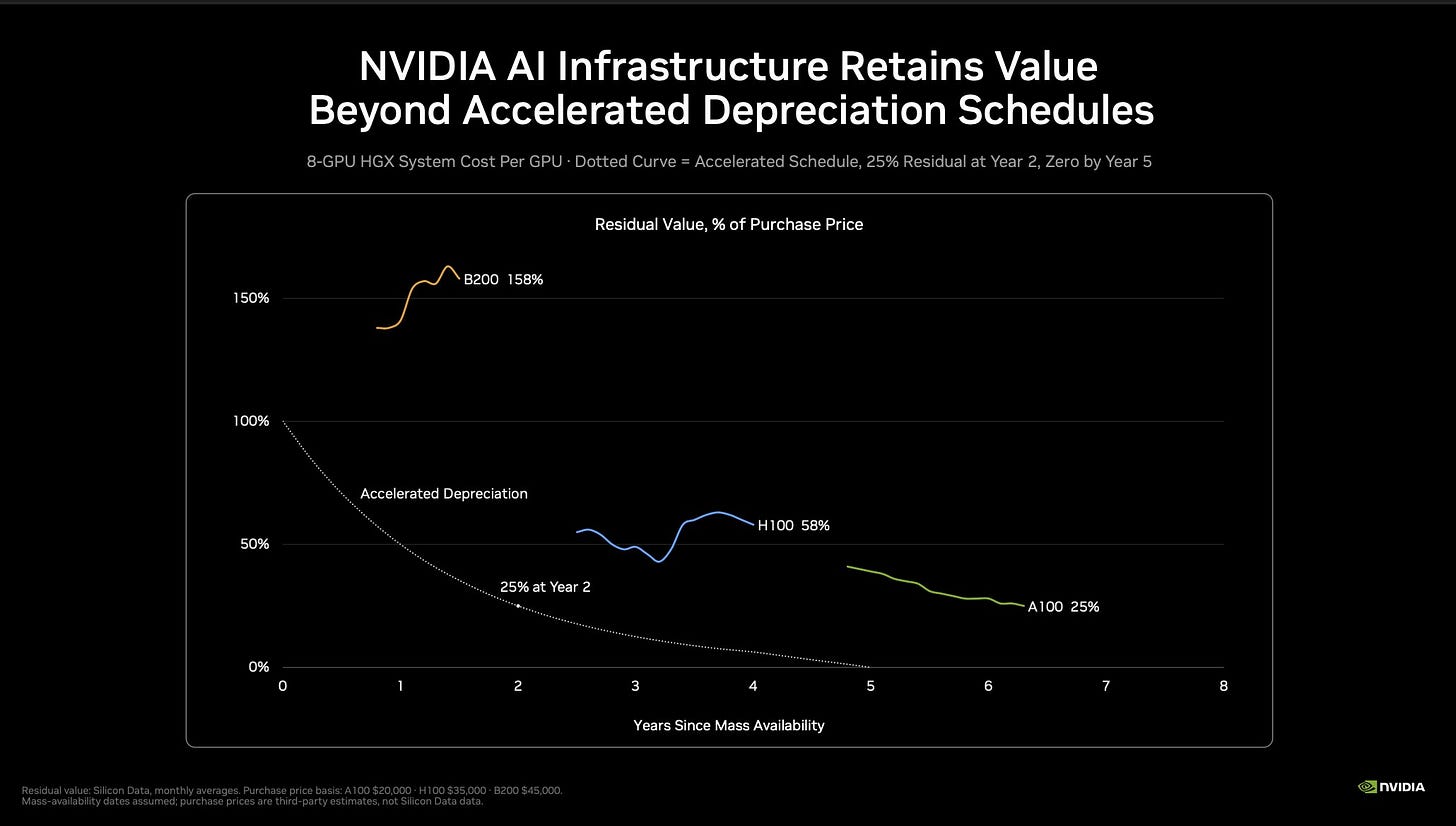
Another major hurdle in credit underwriting involves persistent misconceptions surrounding hardware depreciation schedules. Critics frequently argue that specialized processors are subject to rapid obsolescence, rendering them financially worthless within a few years of deployment. Market data, however, challenges this assumption. Older generation hardware, such as processors introduced years ago, remains actively rented out and fully operational in production environments, establishing a proven floor of useful economic life that extends nearly a decade or more.
More remarkably, the secondary and rental markets for advanced hardware have demonstrated that specific chips can appreciate or retain substantial value long after their initial commercial release, defying standard depreciation models. Newer generations of hardware undoubtedly offer enhanced performance and efficiency, but actual deployment realities involve critical constraints, including power availability, data center site limitations, and software compatibility layers that ensure legacy hardware remains heavily utilized across the ecosystem.
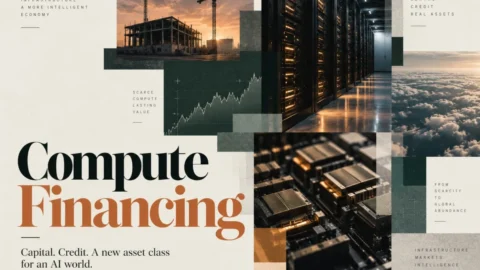
As financial markets continue to adapt to these unprecedented dynamics, industry leaders emphasize that compute is steadily evolving into the largest asset class on earth, marking the beginning of a multi-decade structural shift. Financing this monumental transition requires a sophisticated synthesis of deep technological comprehension and rigorous financial market expertise. For those willing to engage directly with the operational realities on the ground, credit-backed compute represents an emerging financial frontier that is only just beginning to unfold.



Comments (0)