



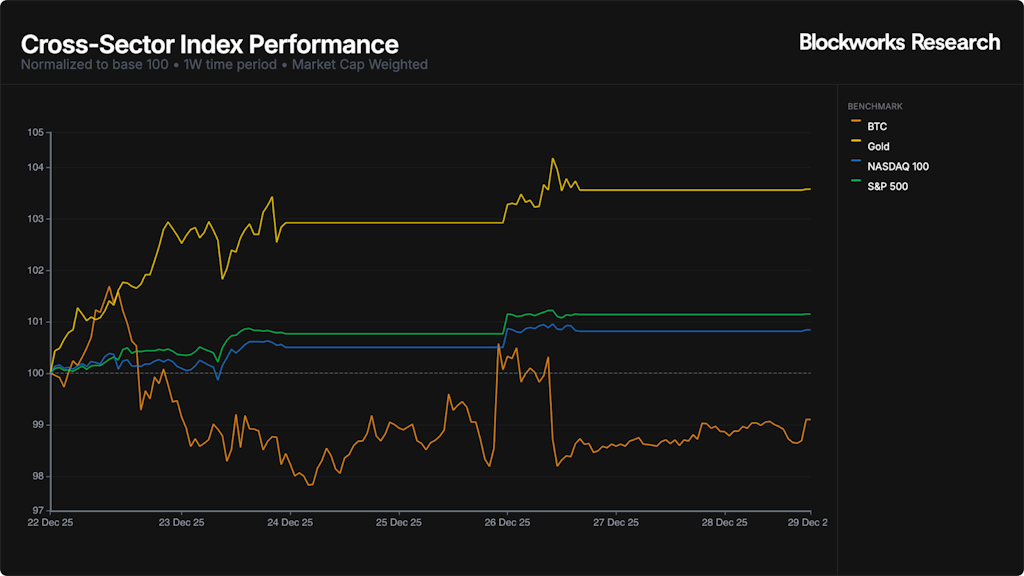
As the crypto market steps across the threshold into the New Year following the Christmas holiday, traditional and digital asset benchmarks are painting a divergence of sentiment. While traditional risk-on benchmarks and safe-haven assets alike have managed to edge upward, the premier digital asset, bitcoin (BTC), has experienced a slight retracement, slipping nearly 1% and bucking the broader macroeconomic tailwinds. Meanwhile, sector-specific rotations are vividly apparent beneath the surface of the broader market indices, with the Solana ecosystem shining brightly on the back of double-digit gains for key tokens, while Ethereum-linked sectors and layer-2 protocols face sustained downward pressure.
Traditional financial benchmarks drifted slowly higher over the course of the holiday-shortened week, led notably by gold, which surged 3.57% to capture the top spot among major asset classes. Equities also enjoyed modest, steady advances, with the S&P 500 rising 1.15% and the tech-heavy Nasdaq 100 gaining 0.84%. Bitcoin, however, moved counter to this broader risk-on mood, slipping 0.90% as traders reassessed positions heading into the final stretch of the year.

Indices and Sector Divergence
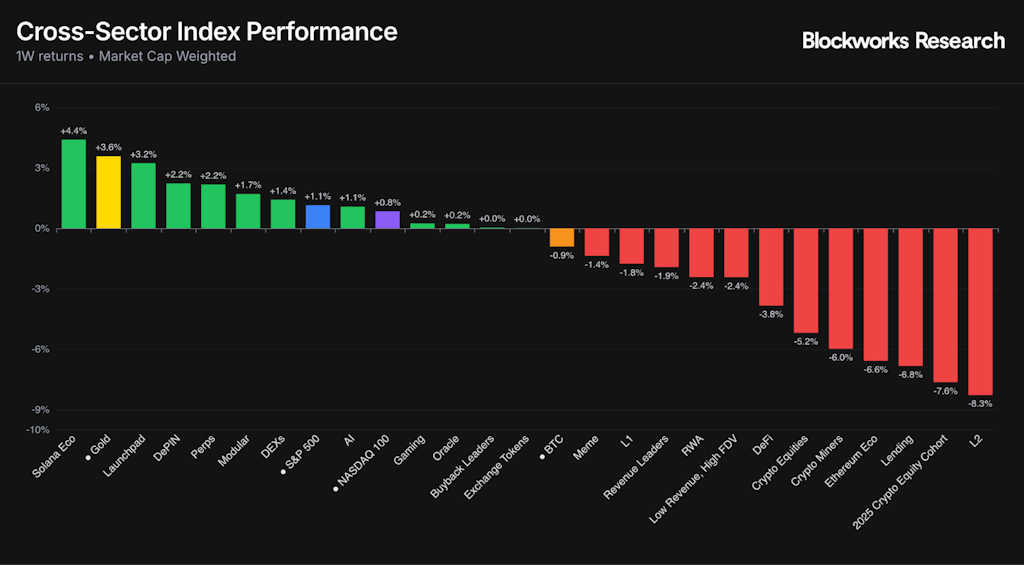
Digital asset sector indices reflected a stark divergence in market sentiment over the past week. On the winning side of the ledger, the Solana Ecosystem index led the charge with a 4.4% gain, energized by renewed interest in liquid staking and perpetual futures narratives. Launchpads followed closely with a 3.23% increase, while Decentralized Physical Infrastructure Networks (DePIN) added 2.23%. Perpetual protocols and modular blockchain architectures also carved out positive returns, advancing 2.17% and 1.7% respectively, alongside modest upticks for decentralized exchanges (DEXs) at 1.42% and artificial intelligence-linked tokens at 1.07%.
Conversely, other corners of the market faced heavy selling. Layer-2 scaling solutions suffered the steepest declines, plunging 8.27% over the week, closely followed by the lending sector, which dropped 6.82%. The broader Ethereum ecosystem slid 6.57%, and crypto mining equities retreated 5.97% as miners faced continued pressure on profitability and network revenues.
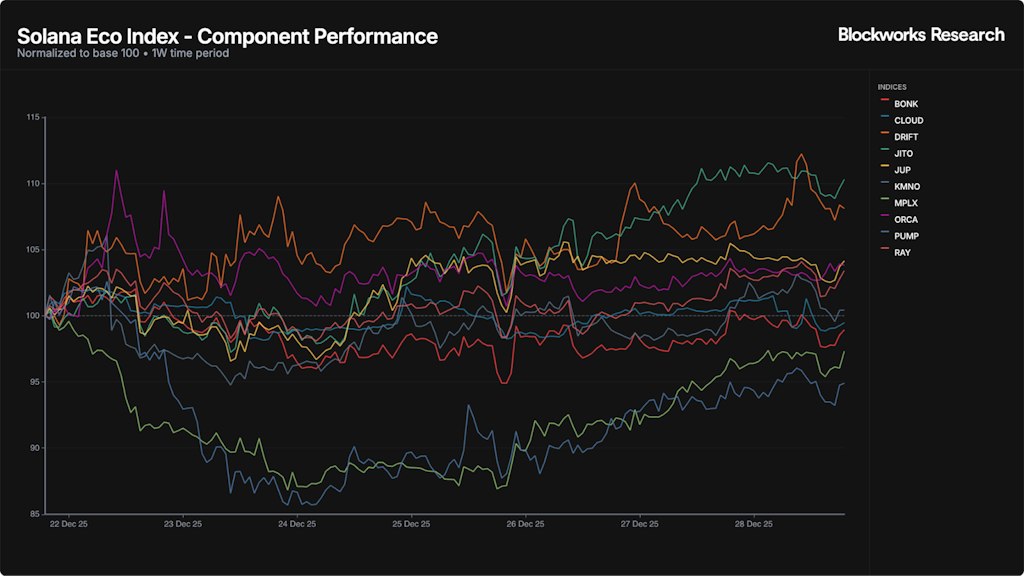
Within the high-performing Solana ecosystem, specific tokens drove the upward momentum. JTO led the sector index with an impressive 10.30% surge, supported by DRIFT, which added 8.10%. Broader decentralized exchange strength on the network was further underscored by solid gains from JUP, which rose 4.14%, ORCA at 3.81%, and RAY at 3.40%.
Not all Solana-adjacent assets shared in the celebration, however. MPLX struggled to find a solid footing, slipping 2.68%, while the PUMP token turned in the week’s worst performance, dropping 5.11%. Market participants noted that PUMP’s ongoing decline highlights a broader fatigue setting in among memecoin launchpads, a sector that previously dominated speculative retail attention earlier in the cycle.
Charts for the Week: Aave’s Dominance and Lending Shifts
An analysis of DeFi lending data underscores a shifting competitive landscape. Aave has maintained its commanding leadership position within the decentralized finance lending space throughout the year, capturing a dominant 86% of protocol revenue and generating an impressive $120.9 million year-to-date. Despite this overwhelming market capture, Aave’s grip has loosened slightly compared to earlier in the year, sliding from a 91% revenue share in January down to 86% by December.
Newer market entrants have capitalized on this slight contraction. Protocols such as HyperLend, which launched in March, and Jupiter Lend, which debuted in July, have successfully captured a combined 3.4% of the protocol revenue market. Meanwhile, Fluid has emerged as the fastest-growing competitor among established platforms, more than doubling its revenue market share from 2.4% to 4.9% over the same timeframe.
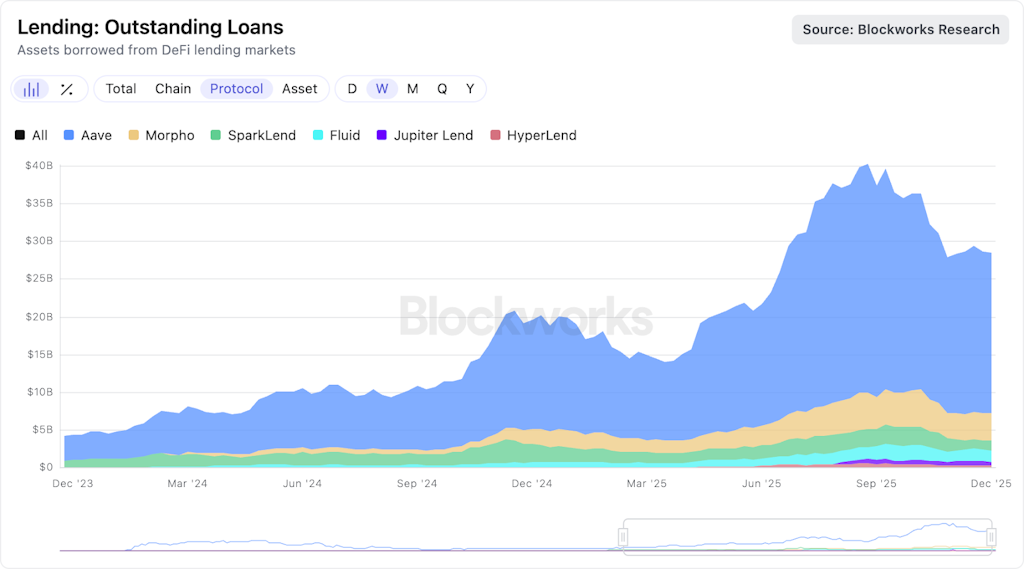
A similar narrative plays out when examining total outstanding loans across the lending ecosystem. Aave currently anchors $21.3 billion in outstanding loans, representing 74.7% of the total market—a metric that has remained relatively stable since January. However, considerable movement has occurred among secondary players. Morpho successfully expanded its market share of outstanding loans from 10.6% to 12.8%. In contrast, Spark experienced a sharp contraction, watching its share collapse from 11.5% down to just 4.7%. Fluid nearly doubled its share of outstanding loans from 3.6% to 5.0%, while newer challengers Jupiter Lend and HyperLend carved out smaller yet growing positions of 2.1% and 0.7%, respectively.
Network Revenues and Perpetual Volume Dynamics
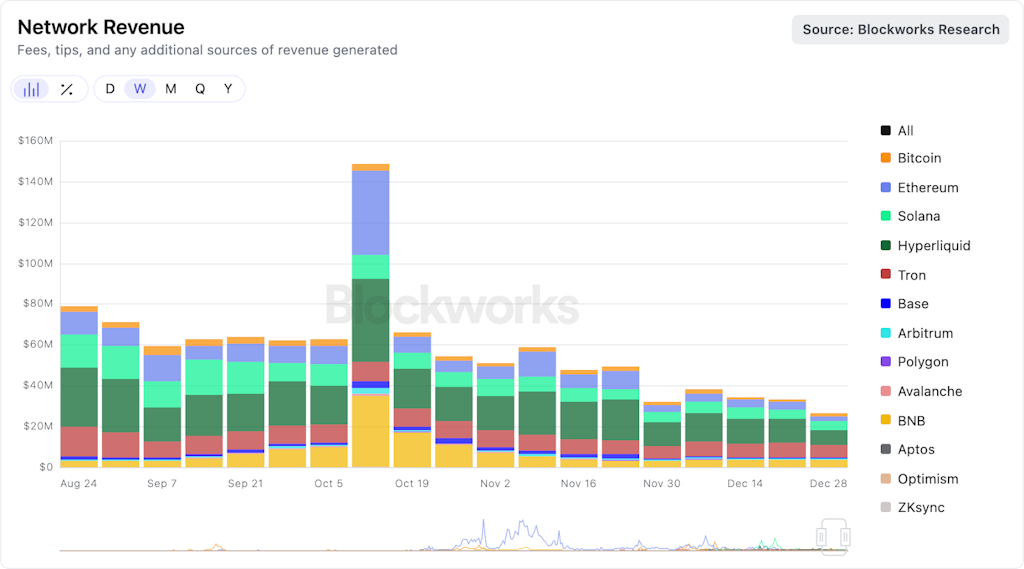
The downward trend in overall network revenues persisted across major blockchains, with total weekly revenue dropping 21% to $26.4 million, marking one of the lowest weekly totals in over a month. Among major chains, Hyperliquid experienced the most severe contraction in absolute terms, with revenue falling 40% from $11.8 million down to $7.1 million. Ethereum network revenue mirrored this downward pressure, dropping 38% to $2.2 million.
Solana demonstrated relatively greater resilience, slipping just 2% to hold steady at $4.7 million in weekly revenue. Tron continued to maintain its position as a major revenue generator, sitting right behind Hyperliquid at $6.1 million despite experiencing an 11% decline of its own. The few notable revenue gainers were smaller-cap chains, including Arbitrum, which rose 37%, Polygon, up 50%, and Binance Smart Chain (BSC), which added 2%, though these increases stemmed from much smaller absolute baselines.
The competitive landscape among decentralized perpetual exchanges has also entered a fascinating phase. Earlier in the year, specifically in August, Hyperliquid achieved monumental metrics, posting $396 billion in monthly volume and $121 million in revenue, while commanding a dominant market share of over 80% in the decentralized perpetuals sector.
Recent weekly data, however, reveals a tightening race. Lighter recorded $30.9 billion in perpetual volume over the past seven days and $203.7 billion over the past month, accompanied by $1.48 billion in open interest. Aster closely followed with $26 billion in weekly volume and $160.6 billion over 30 days, backed by a substantially larger open interest pool of $7.4 billion. Hyperliquid slipped behind these competitors in weekly volume, registering $21.5 billion, though it continues to maintain a commanding lead in capital depth, holding more than double the combined open interest of its rivals at $2.4 billion.
Industry analysts are monitoring these volume metrics closely, particularly in light of Lighter’s looming token airdrop. Market observers note that a critical test for these competing derivatives platforms will arrive once current points programs conclude, revealing whether baseline user volumes can sustain themselves without the artificial stimulation of impending token distributions.





Comments (0)