


As nearly every large enterprise adopts an aggressive artificial intelligence mandate, corporate leadership is increasingly confronting a daunting reality. While organizations rush to deploy autonomous agents to streamline daily workflows, very few understand the precise consequences of granting these digital workers deep access to corporate systems and sensitive data. When an agent is unleashed across a network, questions regarding what it can reach, how its actions are tracked, and what happens to the information it touches remain largely unanswered. According to industry observers, these fundamental concerns over visibility and control—rather than model quality, cost, or talent shortages—are the primary reasons so many corporate artificial intelligence initiatives remain indefinitely stalled in pilot phases.
Enterprises are discovering that while autonomous agents can be provisioned in minutes and operate continuously across vastly more systems than any human employee, this exact capability is what triggers immediate resistance from internal security teams. Cymphony was built specifically to address this tension, offering a specialized approach to enterprise security designed to help organizations safely manage the boundaries of autonomous software.
Agent Data Access is the Constraint
In modern workplaces, employees increasingly collaborate alongside artificial intelligence agents to execute day-to-day operations. However, the typical software agent bears little resemblance to a human worker. It can be spun up almost instantly, it works continuously around the clock, and it possesses the capability to traverse across far more systems, databases, and functional tools than an individual person could ever access simultaneously. Every one of these operational properties is precisely what makes an artificial intelligence agent valuable and worth deploying in the first place. Yet, paradoxically, every one of those exact same properties is what routinely causes corporate security teams to veto their implementation.
Governance and security are already proving to be major barriers to widespread artificial intelligence adoption across the corporate landscape. Market projections indicate that a significant portion of enterprises—as many as 40 percent—may demote or decommission their autonomous artificial intelligence agents over mounting governance concerns within the coming year. Industry analysts emphasize that this trend is not a reflection of artificial intelligence failing to perform its technical tasks effectively. Instead, it stems directly from enterprises pulling back fully functional agents because they simply lack the tools to see or control what those agents are reaching. The fundamental challenge facing modern businesses is not utility, but accountability.
For decades, enterprise security teams have built their defensive strategies around two distinct and traditionally separate concerns: determining where sensitive data actually resides, and controlling who has authorized access to it. The first of these concerns gave rise to a mature ecosystem of tools designed to monitor files, email inboxes, and databases for unauthorized leaks or exfiltration. The second concern produced the vast enterprise identity and access management industry. However, both of these foundational paradigms were built on the implicit assumption that the "who" accessing the system is always a human employee.
The rapid rise of artificial intelligence has effectively broken that long-standing assumption. Modern identity management tools can inform administrators that a specific software agent exists within the network. Data loss prevention tools can successfully flag a particular file as sensitive and confidential. Yet, neither of these systems possesses the capability to determine whether a given agent, acting on behalf of a specific employee, has the capacity to reach and interact with that sensitive file at any given moment. In the era of autonomous software, traditional identity security and data security can no longer be treated as separable domains.
Cymphony is the Solution
To bridge this dangerous security gap, Cymphony continuously maps both human employees and autonomous agents across an entire enterprise infrastructure. The platform dynamically graphs precisely who and what can reach specific corporate systems and pieces of information. Solving this challenge represents a formidable engineering hurdle. In a typical modern enterprise, the exact same human user routinely holds a dozen different user accounts scattered across disparate software systems that were never originally designed to communicate with one another. Furthermore, autonomous agents inherit their access permissions dynamically from the humans and applications that spawned them. Stitching all of these fragmented relationships back together into a single, accurate, and real-time picture requires far more than a basic dashboard that merely aggregates security alerts.
Industry backers have highlighted the founding team’s distinct technical philosophy. Rather than stopping at mere detection and leaving a security analyst to manually figure out what course of action to take next, Cymphony’s platform pushes further into the workflow. The system is designed to recommend and even automate remediation steps, while seamlessly coordinating with the specific personnel within an organization who need to take decisive action.
Early enterprise customers, including major global organizations such as Syngenta, KKR, Cass Information Systems, and Athennian, are already reporting tangible results from deploying the technology. Investors have also become internal users of the platform, noting its practical utility in real-world environments. Following strong initial momentum, venture capital firm Sequoia Capital, which previously led Cymphony’s seed funding round, has now returned to co-lead the startup’s Series A financing round.
Why We Partnered
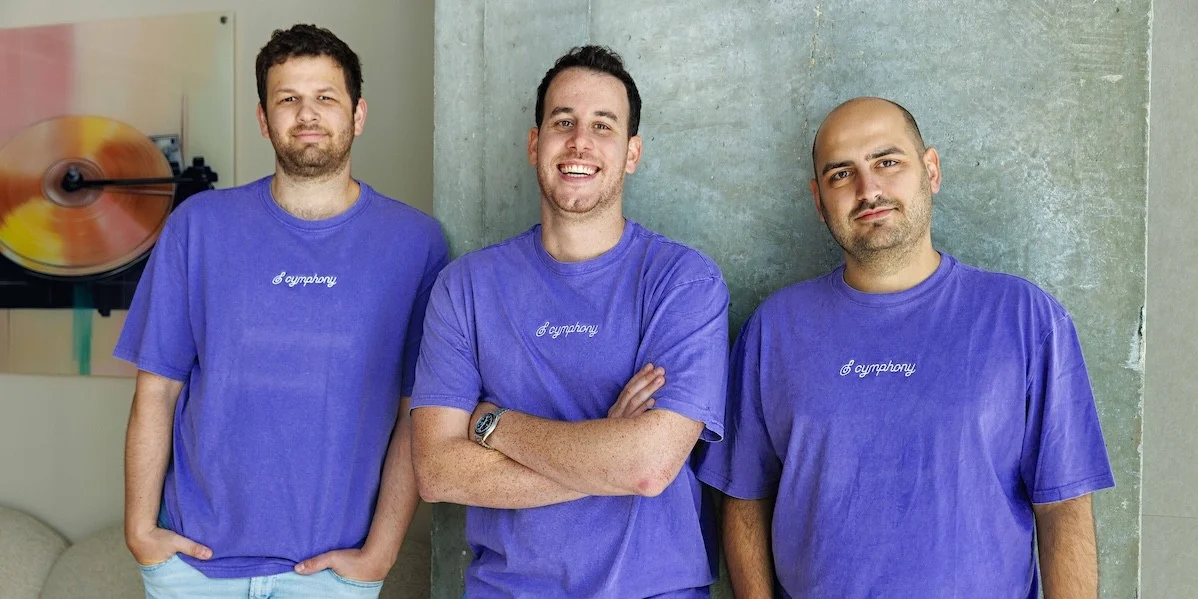
The investors behind the backing of Cymphony first connected with co-founders Shy Dekel, Idan Berkovits, and Edi Gotlieb through Sequoia’s extensive professional network in Israel. The founders were introduced independently by multiple industry contacts, each of whom shared a remarkably similar observation: these three entrepreneurs had spent their respective careers tackling difficult, unglamorous security problems that most founders deliberately avoid, and they were building something fundamentally different around those challenges.
All three co-founders share elite technical backgrounds, having emerged from Israel’s renowned Talpiot program, and each brings deep, specialized experience to the venture. Shy Dekel previously led the cyber department for Unit 8200, Idan Berkovits directed a specialized research group within the Office of the Prime Minister and was awarded the prestigious Israel Defense Prize, and Edi Gotlieb spent years building advanced hardware systems at Apple and at the Israeli Ministry of Defense.
Historically, every major enterprise software category has been built on a structural technology transition where the underlying unit of work shifts, rendering old management categories obsolete. When cloud computing arrived, it transformed where software ran, and the security industry successfully rebuilt itself around that new reality. Later, the proliferation of mobile devices fundamentally changed what constituted an enterprise endpoint, and security frameworks evolved once more. During each of these generational shifts, the companies that ultimately provided comprehensive visibility and operational control over the new paradigm eventually became foundational infrastructure that everyone else took for granted.
The rise of artificial intelligence is proving to be no exception to this historical rule, representing the first major technology shift where the new unit of work possesses the capacity to act entirely on its own. The enterprise software company that successfully enables organizations to say yes to autonomous agents—doing so confidently, at scale, and with an immutable record of what those agents actually accomplished—will not merely serve as an isolated feature tucked inside the broader artificial intelligence stack. Instead, it will function as a fundamental precondition for the entire ecosystem. Observers and investors alike believe that Cymphony is actively constructing that vital infrastructural layer, marking an important step forward in the ongoing evolution of enterprise technology governance.





Comments (0)