


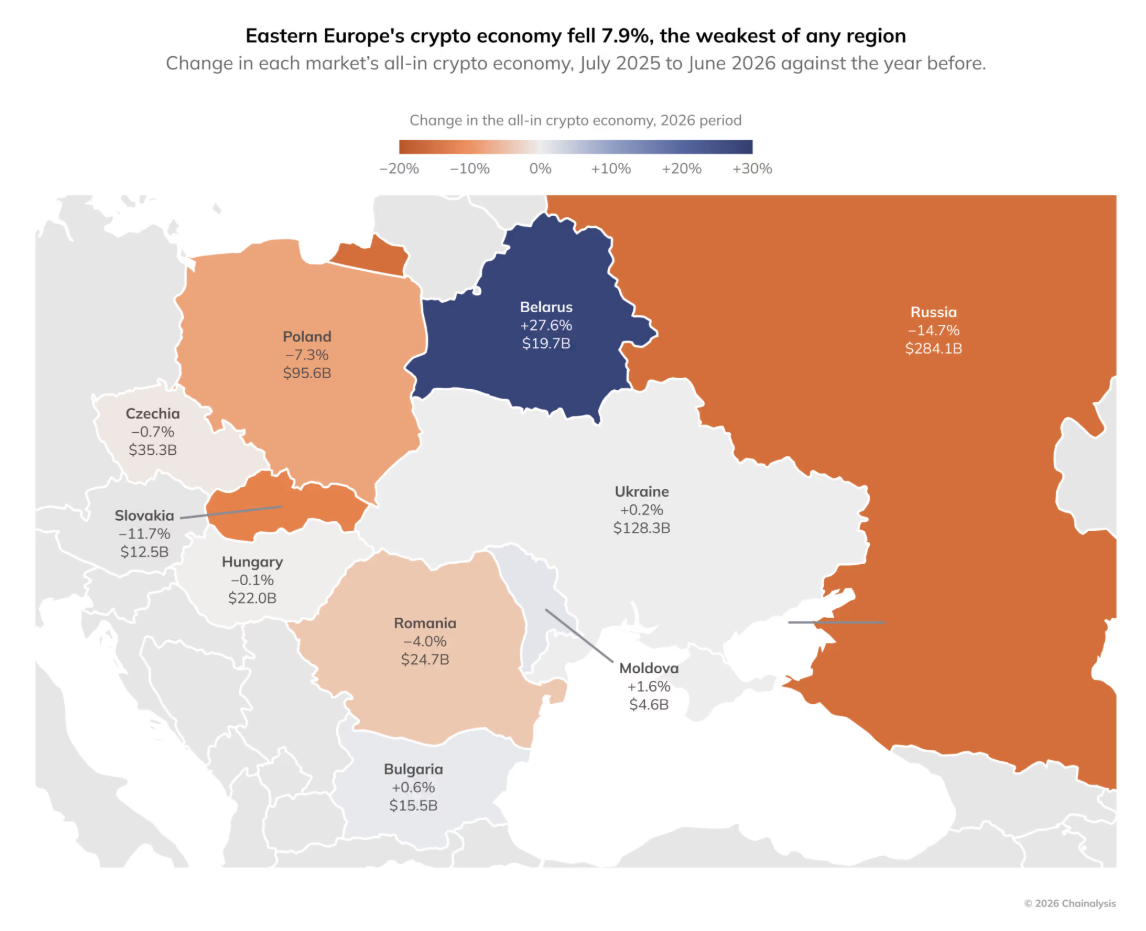
The latest figures show that Eastern Europe’s total crypto economy shrank to $642.1 billion during the twelve-month observation period, down from $697.1 billion recorded a year earlier. This contraction was largely driven by a sharp pullback in high-value transactions and a notable decline in Russia, which historically commands the lion’s share of the region’s digital asset volume. Russia accounted for approximately 44% of the regional total during this period, but saw its activity drop by 14.7% to $284.1 billion.
In contrast, other parts of the region moved in the opposite direction. Belarus stood out with a robust 27.6% growth in crypto activity, while smaller positive increments were observed in countries such as Bulgaria, Moldova, and Ukraine. This fragmented performance highlights how local regulatory developments, economic pressures, and geopolitical dynamics continue to shape crypto adoption across different national borders within Eastern Europe.
The broader regional contraction was primarily fueled by a steep reduction in institutional and high-net-worth capital flows. The value of large transfers—defined as transactions of $10,000 or more directed to crypto services—plummeted by 17.4%, dropping from $591.5 billion down to $488.6 billion. This substantial outflow of large-scale capital accounts for the vast majority of the overall shrinkage in Eastern Europe’s aggregate figures, suggesting that major investors, institutional traders, and high-value participants adjusted their strategies or shifted capital away from regional intermediaries.
However, a closer look at the data reveals a different story at the grassroots level. While institutional and whale-sized transactions declined, the value of smaller transfers directed to crypto services moved in a positive direction, rising by 8.3%. These retail-sized transfers—representing everyday users, small traders, and grassroots participants—accounted for 13.1% of the total value sent to crypto services across Eastern Europe. This metric represents the highest retail share of any world region studied by Chainalysis, placing Eastern Europe well above the global average of 10.1%. This indicates that while major capital may be retreating or consolidating, everyday interest and retail engagement with digital assets remain deeply rooted in the region.
Polish crypto ATM activity grows
Physical-world crypto interactions also experienced notable shifts during the tracking period. Crypto ATM activity across Eastern Europe saw a sharp upward trajectory, with total transaction volumes nearly doubling from $17.3 million to $33.9 million. This surge underscores a growing consumer reliance on physical access points for digital assets, bypassing traditional banking rails where access might be restricted or heavily scrutinized.
Poland emerged as a standout market within this sector, recording a massive 120% increase in crypto ATM transactions. This exponential growth in physical kiosk usage occurred despite a concurrent 5% decline in centralized exchange activity within Poland, pointing to a shift in how Polish users prefer to interact with digital assets. A closer examination of the data shows that stablecoins dominated this physical channel, accounting for roughly 90% of all ATM transactions in the country, as users sought out the stability and utility of dollar-pegged tokens over volatile cryptocurrencies.
When analyzing these trends, Chainalysis applies a rigorous methodology to measure the size of the crypto economy. The firm’s calculations incorporate inflows to centralized and decentralized crypto services, domestic transfers between personal wallets, and cross-border inflows directed to personal wallets. Because these figures are measured and aggregated in United States dollars, fluctuations in cryptocurrency prices can also exert a measurable impact on the final volume totals, a factor that must be considered when evaluating year-over-year changes in valuation.
Ukraine receives billions in stablecoins
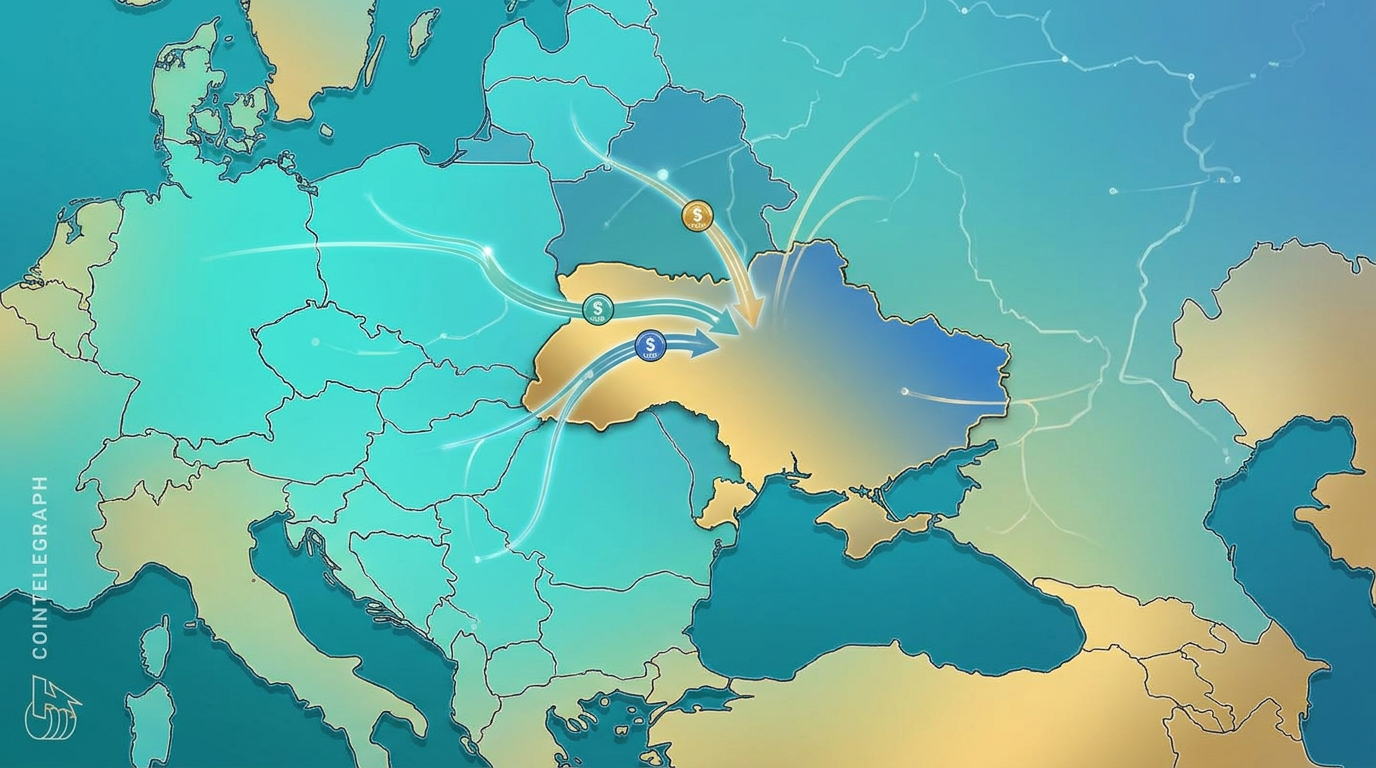
Despite the broader economic slowdown and the geopolitical turmoil affecting the country, Ukraine maintained its position as a vital hub for digital asset activity, particularly regarding stablecoins. Throughout the tracking period, Ukraine received a staggering $12 billion in cross-border wallet-to-wallet transfers, demonstrating the ongoing utility of digital currencies in regions facing severe traditional financial disruption. Of that substantial total, $2.41 billion consisted of retail-sized transfers valued below $10,000.
The Chainalysis report sheds light on the socio-economic drivers behind these massive cross-border flows, revealing a strong correlation between stablecoin transfers to Ukraine and countries with significant Ukrainian diaspora populations. This includes both prewar diaspora communities and the millions of refugees who fled the country following Russia’s full-scale invasion in February 2022. Out of 36 countries analyzed across Europe and North America, Canada emerged as the single largest source of retail-sized, remittance-like stablecoin transfers to Ukraine, contributing $359 million during the period.
A spokesperson for Chainalysis confirmed to Cointelegraph that these cross-border remittance and support flows were overwhelmingly denominated in US dollar-pegged stablecoins, serving as a financial lifeline for families, displaced individuals, and communities navigating currency devaluation and banking infrastructure challenges. While the analytics firm did not provide a granular breakdown of the specific stablecoin tokens utilized, the heavy reliance on dollar-pegged assets underscores their critical role in cross-border humanitarian and economic support. As Eastern Europe continues to navigate a shifting landscape of regulation, economic volatility, and geopolitical friction, the data demonstrates that while institutional volumes may contract, retail adoption and stablecoin utility remain central to the region’s financial resilience.




Comments (0)