



SHENZHEN, CHINA — Leaders from the United States, China, Russia, and major Asia-Pacific economies converged in Shenzhen this week for the annual Asia-Pacific Economic Cooperation summit, confronting a volatile landscape defined by active conflicts, escalating trade disputes, and high-stakes technological competition.
Against a backdrop of a brilliantly illuminated Shenzhen skyline—China’s premier southern tech hub and home to industry giants like Huawei and BYD—the multilateral gathering kicked off with low expectations for sweeping geopolitical breakthroughs. Instead, delegates and analysts alike noted that the primary objective for many participating nations is risk mitigation, navigating strained bilateral ties, and managing the profound economic fallout from protracted global conflicts.
The geopolitical atmosphere surrounding the summit is markedly tense. Since the conclusion of the previous APEC leaders’ meeting, friction between Beijing and Tokyo has intensified significantly. Meanwhile, the fragile stabilization of U.S.-China relations faces fresh pressure following heightened scrutiny from Washington over advanced semiconductor sales to China. Compounding these economic pressures, the prolonged war in Iran, now stretching into its ninth month, continues to exert heavy upward pressure on global energy markets, while the devastating war in Ukraine grinds forward with no immediate diplomatic resolution in sight.
For Beijing, serving as the host for this year’s series of APEC meetings, the summit represents a vital strategic venue to project global influence and solidify diplomatic partnerships. Chinese President Xi Jinping engaged in a series of bilateral meetings early in the week, holding discussions with Canadian Prime Minister Mark Carney and Vietnamese President To Lam. Vietnam is scheduled to host next year’s iteration of the APEC economic leaders’ meetings.
Diplomatic arrivals underscored the global significance of the event. Russian President Vladimir Putin landed in Shenzhen early Wednesday morning and was formally received by Cai Qi, a member of the Standing Committee of the Political Bureau of the Chinese Communist Party Central Committee, according to state media reports. U.S. President Donald Trump arrived in the region following a prior stop in the Philippines for the Association of Southeast Asian Nations (ASEAN) Summit.
U.S.-China Talks and the Trade Truce
The most anticipated bilateral event of the week is the scheduled meeting between U.S. President Donald Trump and Chinese President Xi Jinping on the sidelines of the APEC Economic Leaders’ Meeting. Their landmark encounter at last year’s summit in South Korea successfully birthed a one-year trade truce characterized by reduced tariffs and a steady, albeit restricted, flow of critical rare earth minerals. That provisional agreement was subsequently extended by two months, pushing its expiration date to January 2027.
Despite lingering trade frictions, U.S. officials indicated that President Trump does not intend to formally raise the contentious issue of Nvidia or recent allegations involving former CEO Jensen Huang during the leaders’ bilateral discussions. Instead, the focus of the diplomatic talks is expected to center strictly on the effective implementation and enforcement of the existing trade agreement.
In September, Washington and Beijing jointly announced intentions to lower tariffs on $30 billion worth of cross-border goods, though a specific implementation date was omitted from the announcement. Beijing reiterated this month that any subsequent expansion of agricultural purchases from the United States remains contingent upon the actual reduction of those tariffs.
Concurrently, Washington is actively moving to tighten regulatory loopholes that have historically afforded Chinese enterprises access to advanced American artificial intelligence technology. Beijing’s response thus far has involved direct warnings of potential economic and regulatory countermeasures.
Market analysts suggest that the realistic scope for cooperation between the two economic superpowers remains limited to risk containment. "If there is room for genuine U.S.-China cooperation this week, it’s on managing risk rather than sharing advantage," said Reema Bhattacharya, head of Asia research at risk intelligence firm Verisk Maplecroft. She noted that potential areas for cooperation could include establishing a direct artificial intelligence security hotline.
"Across Asia, governments under mounting pressure to pick a side will be watching Shenzhen for signs of how much room they still have to maneuver," Bhattacharya added, emphasizing that the majority of regional economies harbor little appetite for a global technology landscape cleaved into two distinct camps.
Geopolitical Posturing and Trilateral Dynamics
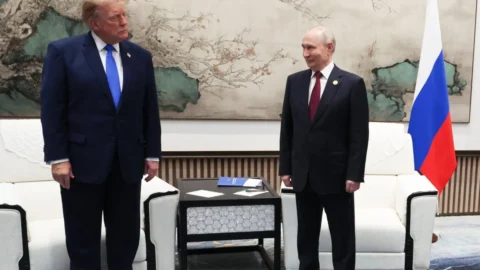
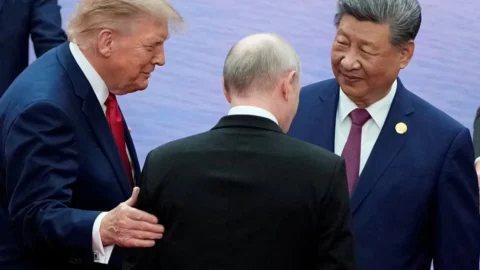
Diplomatic maneuvering extended far beyond traditional bilateral engagements. Beijing officially confirmed plans for a historic trilateral gathering on Thursday, designated as the "China-Russia-U.S. Summit," bringing Presidents Xi, Trump, and Putin together in the same room.
While diplomatic observers maintain low expectations for substantive policy breakthroughs given the limited timeframe, the unprecedented summit provides a powerful symbolic backdrop. The encounter guarantees a globally influential photo opportunity, drawing inevitable comparisons to the high-profile alignment between Xi, Putin, and Indian Prime Minister Narendra Modi on the sidelines of the Shanghai Cooperation Organization summit hosted by China in September 2025.
Attention is equally focused on potential interactions involving Japanese Prime Minister Sanae Takaichi. Last November, Takaichi drew sharp condemnation from Beijing after indicating that Tokyo would extend support to Taiwan in the event of a serious military threat from the mainland. Her attendance at the Shenzhen APEC meetings marks her first official visit to China since assuming the office of prime minister, following an initial meeting with Xi on the sidelines of last year’s APEC summit in South Korea.
Broader business and political leaders participating in the summit expressed hope that the high-level dialogues would ultimately pivot toward stability. Anindya Bakrie, CEO of major Indonesian conglomerate Bakrie & Brothers, noted in an interview that the overriding narrative expected by regional stakeholders from the Trump-Xi meeting must be one anchored in peace and economic predictability.
Technological Transformations and Corporate Earnings
Technology remains a dominant theme throughout the summit, underscored by high-profile corporate delegations. Tesla and SpaceX CEO Elon Musk joined President Trump’s delegation in Shenzhen, while other prominent American corporate leaders, including Visa CEO Ryan McInerney, actively participated in the two-day APEC CEO Summit.
Summit organizers capitalized on Shenzhen’s reputation as a global technological powerhouse by prominently featuring local robotics startups and advanced automation exhibits alongside traditional policy discussions.
The economic and diplomatic developments coincided with a crucial period for global corporate earnings. Nvidia released its quarterly financial results on Wednesday morning Beijing time, following a tumultuous two-week period of regulatory scrutiny and corporate restructuring that saw the departure of longtime founder Jensen Huang. Despite the turbulence, the chipmaking giant posted an upgraded outlook, prompting an immediate rise in its shares during extended trading.
Simultaneously, Shenzhen-based gaming and social media behemoth Tencent prepared to release its quarterly earnings report, with market watchers closely monitoring the company’s navigation of ongoing hardware and computing power constraints.
The corporate calendar also featured significant milestones in the American financial markets, with U.S.-based artificial intelligence pioneer Anthropic pricing its highly anticipated initial public offering. The company is scheduled to list its shares on the Nasdaq, bringing increased investor attention to the sector. Anthropic CEO Dario Amodei has previously advocated for a measured approach to artificial intelligence development, warning publicly about the systemic risks of a global race if international counterparts do not adopt similar regulatory guardrails.


Comments (0)