


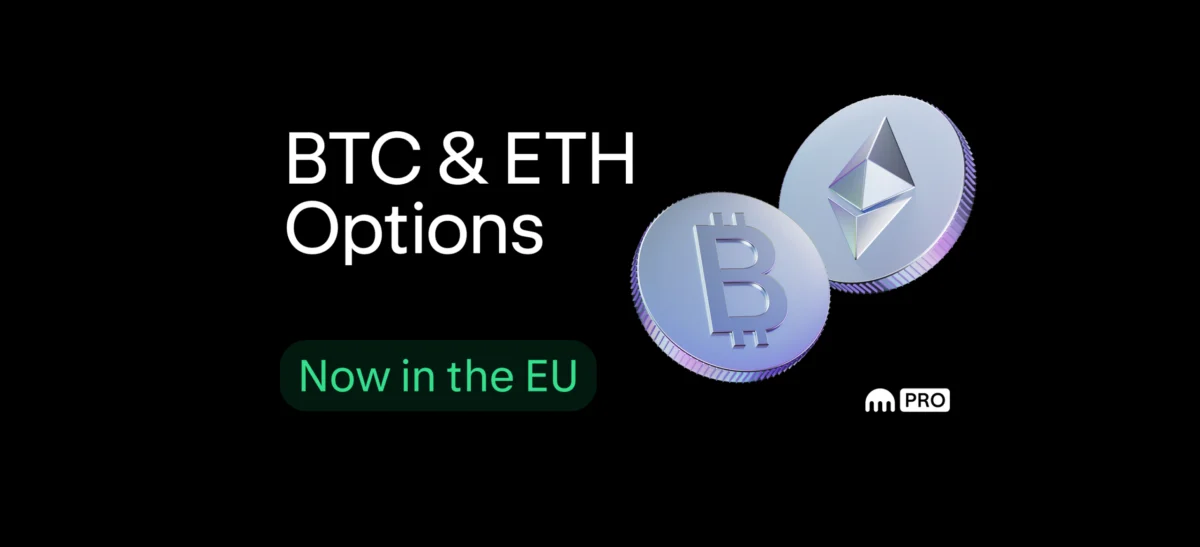
Major cryptocurrency exchange Kraken has expanded its advanced trading offerings in the European Economic Area (EEA), launching a comprehensive crypto options suite on its professional-grade platform, Kraken Pro. The rollout allows eligible European clients to trade Bitcoin (BTC) and Ether (ETH) options utilizing the same unified derivatives account they currently use for futures trading.
The strategic expansion represents a major milestone for Kraken’s regulatory footprint in Europe, heavily supported by the platform’s recently secured Markets in Financial Instruments Directive (MiFID) license. By bridging traditional financial regulatory standards with digital asset infrastructure, Kraken aims to provide institutional and advanced retail traders with a more sophisticated, compliant, and flexible toolkit for navigating volatile cryptocurrency markets.
Why Options, and Why Now
For years, digital asset derivatives markets have leaned heavily on futures and perpetual contracts, instruments that primarily measure risk and reward through a single primary dimension: price direction. While effective for directional speculation or hedging, futures leave traders exposed when markets consolidate, experience sudden volatility expansions, or shift in ways that defy simple bullish or bearish theses.
Options introduce a multidimensional approach to digital asset exposure. Unlike futures, which give traders only price, options introduce volatility and time into the equation. This allows market participants to express nuanced views on how far an asset might move, the speed at which that movement could occur, or whether the market will remain range-bound entirely. Used strategically, options can help market participants hedge existing spot or futures exposure, protect portfolios against downside tail risk, or capture yield and directional moves without the immediate pressure of picking a definitive market direction.
Europe has emerged as a core focus for Kraken’s global growth strategy, and the acquisition of a MiFID license has served as the operational catalyst for bringing these advanced instruments to the region. Operating under a MiFID framework allows Kraken to offer options to EEA clients on a fully regulated venue, instilling a heightened sense of legal certainty and institutional-grade compliance that traditional finance participants expect.
Beyond the regulatory backing, Kraken has engineered the product launch around operational efficiency. Rather than forcing traders to fragment capital across multiple siloed accounts or isolated wallets, the options infrastructure is integrated directly into the existing Kraken Pro ecosystem. Eligible clients utilize a single account structure spanning spot, futures, and now options. This unified approach shares the same underlying collateral, applies portfolio margining by default, and operates entirely on USD settlement.
What You Can Trade and How the Markets Operate
At launch, Kraken Pro’s options suite focuses on the two most liquid and widely traded digital assets in the global ecosystem: Bitcoin and Ether. By concentrating liquidity on BTC and ETH, Kraken ensures that professional traders can execute larger ticket sizes with minimal slippage and tighter bid-ask spreads.
Trading options on Kraken Pro deviates from standard continuous order book mechanics, utilizing a Request for Quote (RFQ) system tailored for complex derivatives transactions. Through the RFQ workflow, traders can construct multi-leg strategies—combining up to five distinct legs into a single cohesive trade—before submitting the package to the market. Once submitted, users receive time-limited quotes reflecting current market conditions, implied volatilities, and liquidity provider pricing. Traders then have the choice to accept or pass on the quote, keeping in mind that any acceptance is immediately binding and executed on-chain or within the matching engine environment.
This RFQ methodology is particularly advantageous for options trading, where multi-leg structures such as spreads, straddles, and strangles are common. By pricing these strategies as a single package rather than executing individual legs separately, traders avoid the execution risk of one leg filling while another fails, ensuring cleaner entry and exit prices for complex positions.
Three Dimensions, Three Ways to Use Them
The addition of volatility and time dimensions transforms how market participants can approach digital asset exposure. While market strategies vary widely based on individual risk tolerances and market outlooks, professional traders frequently employ options in three primary contexts to manage risk and capital efficiency.
First, options are widely utilized for portfolio hedging. During periods of heightened macroeconomic uncertainty or impending regulatory decisions, holders of large spot or futures positions often face significant downside risk. By purchasing put options, traders can establish a price floor for their digital assets. If the market experiences a sharp correction, the gains on the put option help offset the losses incurred on the underlying holdings, effectively insuring the portfolio against catastrophic declines without forcing the liquidation of long-term spot positions.
Second, options allow traders to speculate on volatility rather than direction. Digital asset markets are notoriously cyclical, oscillating between prolonged periods of tight consolidation and explosive breakouts. Traders who anticipate a massive market move—such as ahead of protocol upgrades, macroeconomic data releases, or ETF approvals—but remain uncertain whether the price will break upward or downward can deploy non-directional volatility strategies, such as straddles or strangles. These strategies profit from significant price movement in either direction, provided the magnitude of the move overcomes the cost of the options.
Third, options can be leveraged to generate yield or optimize entry and exit points. By selling out-of-the-money options, market participants can collect upfront premiums, effectively generating income on idle capital or acquiring desired assets at a discount if the market moves against the short option position. However, these strategies require active risk management, as writing options exposes the seller to substantial or even unlimited risk if market conditions shift violently.
How Margin and Risk Work on Kraken Pro
Margining mechanics in options trading are notoriously complex, often leading to misunderstandings regarding leverage, maintenance requirements, and liquidation risks. On Kraken Pro, the options infrastructure is built on portfolio margin by default, reflecting the sophisticated nature of the platform’s user base.
Portfolio margining evaluates the risk of an entire portfolio holistically rather than calculating margin requirements for each individual position in isolation. Because options offset the risk of other holdings—such as a long futures position hedged by a put option—portfolio margining recognizes these offsets, reducing the total collateral required to maintain the positions and capital efficiency for the trader.
Despite the efficiencies of portfolio margin, options remain complex financial instruments that carry substantial risk. The value of an option is dynamic, changing rapidly in response to shifts in the price of the underlying asset, changes in implied volatility, and the relentless decay of time as the expiration date approaches.
When a trader buys an option, their maximum loss is strictly capped at the premium paid to enter the position. However, selling options introduces a vastly different risk profile. If a trader sells an option, their potential losses can substantially exceed the initial margin posted to the account, and under certain market scenarios, losses can be theoretically unlimited. Furthermore, margin requirements are subject to change at any given moment based on market volatility and risk parameters. If an account’s equity falls below the mandatory margin requirement due to adverse price or volatility movements, positions are subject to automated liquidation.
Getting Started in the EEA
Eligible clients across the EEA can access Kraken Pro options immediately through both web and mobile interfaces. Because the options infrastructure is embedded directly into existing Derivatives accounts, traders who already utilize Kraken for futures do not need to onboard, complete redundant verification checks, or establish new segregated wallets.
To ensure consumer protection and regulatory compliance under MiFID guidelines, users must complete a mandatory appropriateness assessment before gaining trading privileges for options. This assessment evaluates the client’s knowledge and experience with complex derivatives to ensure they fully understand the mechanics and risks associated with options trading. Key Information Documents (KIDs) are also provided for every available option contract, offering transparent breakdowns of potential outcomes, costs, and risk profiles.
While the launch marks a significant step forward for European cryptocurrency derivatives trading, Kraken emphasizes that the offerings are intended for sophisticated participants. The unpredictable nature of crypto-asset derivatives markets means that capital can be lost rapidly, and past performance serves as no indicator of future results. EEA clients are encouraged to review all risk disclosures and seek independent financial and tax advice before engaging in complex options strategies.



Comments (0)