


Somewhere between major industry headlines regarding high-profile exploits and macroeconomic shifts, Paul Sztorc’s long-anticipated Bitcoin hard fork, known as the eCash network, officially went live.
On October 29, Sztorc—the founder of LayerTwo Labs and the primary architect behind the prominent Bitcoin Drivechain proposals designated as BIP300 and BIP301—launched a separate, independent Bitcoin fork. The newly minted network is engineered specifically to introduce advanced payment features, enhanced privacy options, and a broad suite of decentralized applications to an infrastructure constructed directly from Bitcoin’s foundational source code.
"We need to actively sabotage the ‘degrowth’ policies killing Bitcoin," Sztorc told Magazine in an interview surrounding the launch. "We want to find the true Bitcoin builders and give them the tools to actually innovate. We just need the open-minded, risk-taking contrarians to come and build."
The execution of this hard fork grants eligible Bitcoin holders a notable digital asset windfall: an equivalent balance of the new chain’s native token, ECX, matching their holdings of BTC at the exact moment of the network split. This development immediately raises critical questions regarding the tangible benefits the eCash ecosystem brings to developers, as well as the practical utility and options available to Bitcoin holders now in possession of the new tokens.
What is eCash?
Developed under the stewardship of Sztorc’s LayerTwo Labs, eCash emerges as a distinct hard fork of Bitcoin born out of growing frustration with what Sztorc characterizes as "complacency narratives" and a "cult-like toxicity" that he believes has severely restricted Bitcoin’s functional evolution over the years.
The core technological innovation powering eCash is the implementation of Drivechains. This system grants software developers the freedom and flexibility to construct independent sidechains featuring customized parameters, functionalities, and use cases without requiring any modifications to the base-layer protocol of Bitcoin—or, in this current context, the base layer of eCash itself.
Through this architecture, developers gain the ability to experiment freely with diverse applications geared toward instant payments, enhanced financial privacy, digital asset issuance, and decentralized prediction markets. Simultaneously, miners are presented with opportunities to maximize their operational revenues by earning additional transaction fees generated across the auxiliary networks.
At the time of the eCash mainnet launch, five distinct sidechains went live alongside the primary network: BitNames, BitAssets, Thunder, Truthcoin, and zSide. LayerTwo Labs has indicated that two additional sidechains—the quantum-resistant Photon and the decentralized exchange platform CoinShift—are currently under development and slated for future release.
Sztorc has spent more than a decade advocating passionately for the integration of Drivechains, maintaining that Bitcoin’s notoriously conservative and cautious development methodology has historically stifled its broader potential in the competitive digital asset landscape.
"Anything that isn’t maximizing network usage is simply a distraction," Sztorc emphasizes, underscoring his philosophy on network utility. "Users, the ones who actually pay transaction fees to miners, will win in the long run."
Getting Access to the New Coins
The eCash hard fork was formally executed at Bitcoin block 973,728. Consequently, any individual or entity that maintained direct control over their private keys at the exact moment of this snapshot automatically qualified for an equivalent balance of ECX tokens on the new network.
"If you held the keys to your BTC at that exact block, you now own the exact same amount of ECX," representatives from LayerTwo Labs explained to Magazine. "It is that simple, and you can access them right now."
In practice, however, claiming and managing these newly minted assets requires careful execution by self-custody participants. Bitcoin holders utilizing self-hosted wallets must employ a wallet interface that explicitly supports the eCash network and follow precise procedures to properly separate their ECX tokens from their underlying BTC balances.

Because the two independent blockchain networks share an identical historical transaction ledger up to the point of the fork, an unprotected transaction executed on one chain carries the risk of being inadvertently replayed on the other chain.
LayerTwo Labs has issued stern security warnings regarding this dynamic. "Never move your BTC first, as an ordinary, unprotected BTC spend can easily be replayed on the ECX network," the firm cautions. While built-in replay protection controls are embedded within the eCash protocol, the development team strongly advises token holders to isolate and move their ECX assets first before initiating any standard transactions involving their BTC holdings.
For market participants storing their Bitcoin assets on centralized cryptocurrency exchanges, access to the airdropped tokens remains entirely contingent upon third-party platform policies. Such holders are described as being "at their mercy regarding distribution," and are urged to verify whether their chosen exchange intends to support the hard fork and facilitate the automated distribution of ECX.
Where Can Holders Trade ECX?
Acquiring technical access to ECX tokens via the network snapshot does not automatically equate to immediate liquidity or the ability to seamlessly liquidate holdings, as the tokens are not yet widely integrated across major centralized cryptocurrency exchanges. Furthermore, individuals navigating the tax implications of receiving assets from a Bitcoin hard fork are advised to consult regional tax guidelines prior to filing annual returns, as regulatory treatment varies significantly by jurisdiction.
Initial exchange support has begun to materialize incrementally. NeoxEX announced that it officially opened native ECX deposits, withdrawals, and spot trading on October 29, supporting trading pairs including ECX/USDT, ECX/USDC, and ECX/BTC. Meanwhile, CoinW outlined its intention to distribute ECX to eligible Bitcoin holders, with timelines for deposits, withdrawals, and active trading markets to be communicated at a later date.
Alternative avenues for market exposure have also emerged within the decentralized finance sector. Orca, a prominent automated market maker and decentralized exchange operating on the Solana blockchain, allows users to swap USD Coin (USDC) for wrapped ECX (wECX) through established liquidity pools. This mechanism provides holders with an alternative method to gain market exposure to ECX, though it relies on a wrapped token representation on an entirely separate blockchain rather than native trading directly on the eCash infrastructure.
Market valuation metrics for the nascent token have varied across independent data aggregators. As of early November, CoinMarketCap placed the valuation of ECX at approximately $32.63, registering roughly $355,000 in 24-hour trading volume. Concurrently, CoinGecko categorized the token as a preview listing, noting that official market prices and tracked exchange metrics were not yet fully integrated. Prominent crypto market data provider Kaiko stated that it does not currently track ECX, highlighting the current scarcity of consolidated independent market data.
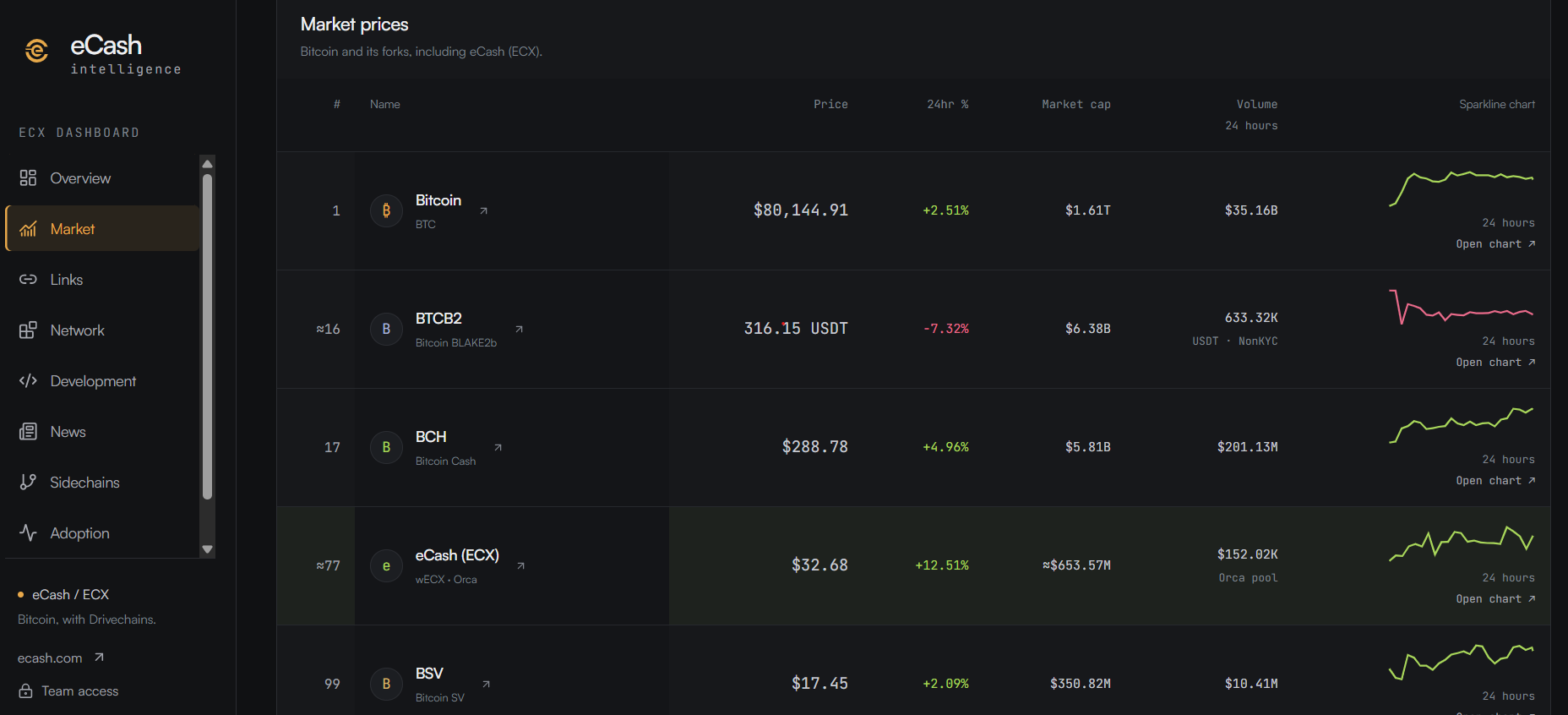
LayerTwo Labs reported that early informal trading activity saw ECX fluctuate between $40 and $50 per token, though the organization did not provide formal order book depth metrics or verified trading volume figures to substantiate those claims, pointing instead to the total value locked within the Orca liquidity pool as a preliminary gauge of available market liquidity.
"If our fork replicates even a fraction of [Bitcoin Cash] BCH’s initial performance, the liquidity will be staggering," Sztorc asserts, adding that participants concerned about near-term liquidity constraints retain the option to retain their coins and evaluate market conditions at a later date. "We are actively adding new exchanges and trading pairs, so the user experience will only improve. Otherwise, you’re welcome to take your free money and leave."
A Different Vision for Bitcoin
Ultimately, Sztorc maintains that the long-term viability and intrinsic value of eCash will rest squarely on whether software developers choose to construct practical, high-utility applications and whether end users demonstrate a willingness to pay for them. Generating active transaction fee revenue and attracting paying customers serve as the project’s principal benchmarks for success during its foundational first year.
Sztorc remains entirely undeterred by ongoing criticisms directed at the security architecture of Drivechains, particularly regarding longstanding theoretical concerns that a coalition of miners could theoretically coordinate to compromise funds held within sidechains.
"If you genuinely believe miners will torch their own billion-dollar operations for a short-term theft on an L2, then you shouldn’t trust Bitcoin’s L1 either," he contends.
For the immediate future, the deployment of eCash provides the broader cryptocurrency community with a novel digital asset and offers developers an expansive experimental playground. Whether ECX evolves into a sustained, thriving economic ecosystem or remains an experimental offshoot will depend entirely on broader market adoption and real-world utility in the months ahead.



Comments (0)