



Over the past several days, the exchange between prominent Solana decentralized finance protocols Kamino and Jupiter has escalated rapidly from what initially appeared to be healthy ecosystem competition into a clear, public dispute. The tensions came to a head following a strategic product rollout by Jupiter’s lending arm, Jup Lend, which triggered defensive smart contract updates from Kamino and a subsequent debate over open-finance principles, risk transparency, and the broader competitive landscape within the Solana money market sector.
The friction point emerged on November 27, when Jup Lend introduced a refinancing tool on its frontend interface designed to allow users to migrate their looping positions from Kamino Multiply directly into Jup Lend with a single click. This automated refinance operation was structured to execute an atomic transaction involving multiple steps behind the scenes to seamlessly shift user capital between the competing platforms.
Rather than allowing the migration tool to capture its user base without resistance, Kamino moved quickly to protect its platform. On December 2, Kamino updated its smart contracts to actively block Jupiter’s program, effectively halting the one-click refinancing functionality. The reaction from the competing camps was swift. Both the Jupiter and Fluid teams—noting that Jup Lend utilizes Fluid technology on its backend infrastructure—framed Kamino’s defensive maneuver as overtly anti-competitive and contrary to the core open-finance principles that traditionally govern decentralized applications.

The dispute intensified further on December 6, when Kamino’s co-founder took to social media to publicly explain the underlying rationale for blocking Jup Lend’s migration tool. According to the co-founder, Jupiter had repeatedly suggested to users that borrowers’ collateral within Jup Lend is strictly isolated, which implicitly meant the assets were neither rehypothecated nor exposed to cross-contamination risks. However, Kamino argued that this narrative was factually misleading. The debate gained further validation when even Fluid’s co-founder publicly acknowledged that rehypothecation does indeed take place within Jup Lend.
Despite accusations of undermining open finance, industry observers noted a distinct nuance in Kamino’s implementation: the protocol never blocked users from executing manual repayments of their loans and withdrawing their capital to move it to Jup Lend on their own terms. Ultimately, whether categorized as a violation of open-source ethos or simply aggressive market defense, Kamino’s move to block the automated refinancing program was fundamentally a business decision. Industry analysts have drawn parallels between Kamino’s defensive update and Jup Lend’s own commercial strategies, such as its decision not to open-source its code—though Jupiter has indicated plans to do so in the future.
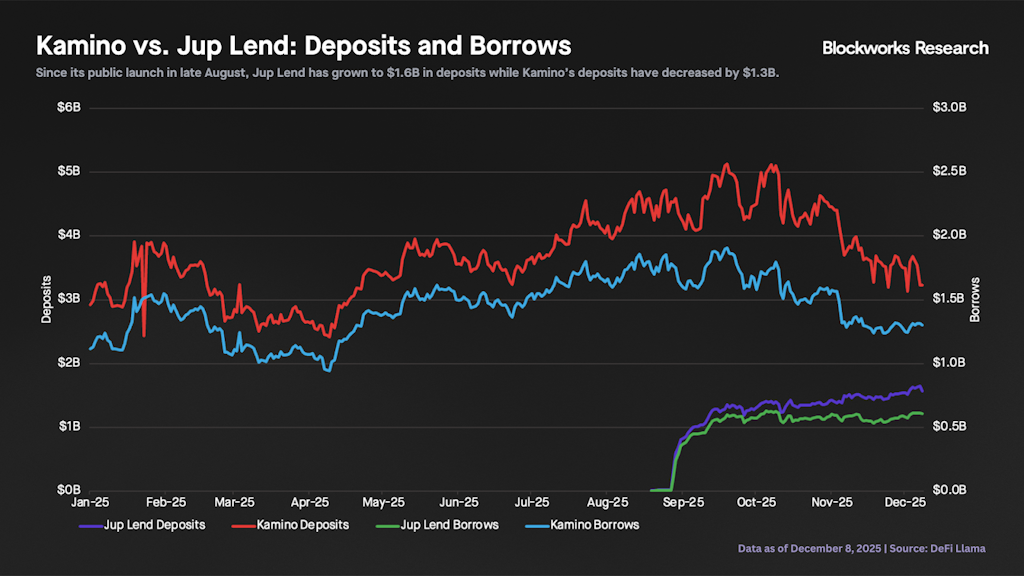
To fully understand the gravity of this public fallout, it is helpful to analyze the broader competitive dynamics that have played out between the two money markets over the past few months. Since its launch in late August, Jup Lend has experienced explosive growth, scaling rapidly to reach $1.6 billion in total deposits and $610 million in active borrows. During the exact same timeframe, Kamino has felt the squeeze of this new market entrant, witnessing its deposits and borrows decrease by $1.3 billion, representing a 28 percent drop, and $460 million, marking a 26 percent decline, respectively.
A deeper look at asset flows highlights the areas where Jup Lend has successfully captured market share. The top five assets driving deposit growth since Jup Lend’s launch include USDC, which pulled in $485 million; JLP, capturing $225 million; SOL, bringing in $206 million; syrupUSDC, attracting $174 million; and jupSOL, with $85 million. During this parallel period, Kamino experienced sizable outflows across nearly all of these major assets, with syrupUSDC serving as the lone exception. Even in the case of syrupUSDC, however, Jup Lend still managed to attract roughly three times the volume of inflows compared to Kamino.
Faced with intense pressure in core asset categories, Kamino has been forced to adapt by focusing its growth on specialized niches and assets not yet supported by Jup Lend. For instance, Kamino’s stablecoin inflows throughout the fourth quarter have been largely sustained by alternative assets such as PYUSD, which brought in $42 million, and Phantom’s CASH stablecoin, which added $125 million. Additionally, Kamino has proactively worked to capture yield-seeking capital by onboarding various liquid staking tokens, most notably dfdvSOL and, more recently, fwdSOL.
Looking ahead, Kamino is positioning upcoming integrations as key catalysts that could drive net new inflows into its money market and differentiate its offerings from competitors. Among these, Kamino’s PRIME integration stands out prominently. The PRIME integration grants users direct exposure to a regulated credit pool backed by United States real estate loans that are originated and serviced through Figure. By introducing this product, Kamino is effectively offering access to an institutional-grade source of yield that remains largely uncorrelated from broader cryptocurrency market volatility, which could attract a fresh wave of institutional borrowers.
As the dust settles on the recent public sparring, industry leaders are reflecting on the broader implications for the ecosystem. Both Kamino and Jup Lend are direct competitors, and healthy competition remains a vital driver of innovation that ultimately benefits everyday users. However, as Solana Foundation’s Lily Liu recently pointed out, public infighting and friction between native protocols may be a misallocation of energy. Instead of battling one another for domestic market share within a localized ecosystem, growing protocols like Kamino and Jupiter should ideally focus on expanding the overall pie and capturing significant market share from rival blockchain ecosystems and traditional finance. Combined, both Solana money markets still account for less than ten percent of the total deposits held by industry giant Aave, underscoring the reality that collaborative ecosystem expansion and aggressive external targeting remain essential tasks if Solana DeFi is to close the generational gap with established decentralized finance giants.





Comments (0)