



Ethereum co-founder Vitalik Buterin has sparked widespread debate across the cryptocurrency ecosystem by suggesting that the Ethereum network should actively promote Ether (ETH) as a store of value rather than relying on an economic model driven primarily by fee-burning mechanisms.
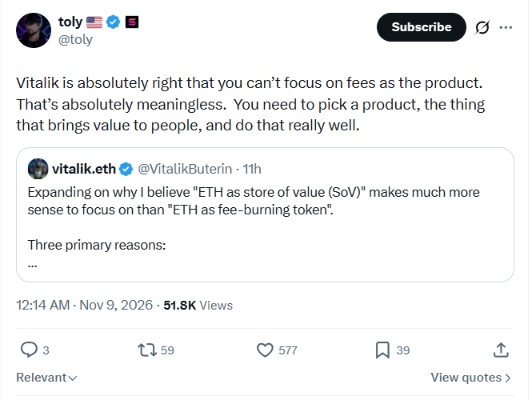
In an extensive social media discussion thread, Buterin argued that the notion of "ETH as a fee-burning token never was as strong as it seemed" and cautioned that optimizing the network strictly around fee revenue would ultimately compromise Ethereum’s foundational commitments to "decentralization and CROPS"—an acronym referring to censorship and capture resistance, open source principles, privacy, and security. He expressed confidence that these core security and decentralization properties will become increasingly valuable in an upcoming "era of AI disruption."
The debate follows years of deflationary narratives that took root after the 2021 EIP-1559 upgrade. During periods of peak network activity, the upgrade successfully flipped Ethereum into a deflationary asset as high fee revenues were systematically burned. This dynamic prompted prominent industry commentators, including the hosts of the Bankless podcast, to popularize the term "ultrasound money."

However, evolving design choices and scaling solutions have altered the network’s economics. Transaction fees have steadily declined alongside total revenue, rendering the previous ultrasound money narrative increasingly difficult to sustain. Data from January to October shows that median transaction fees dropped sharply from 35 cents to 3.5 cents, even as the number of daily transactions surged by more than 50%.
The pivot toward a store-of-value narrative drew sharp criticism from figures in the Bitcoin community, who view Bitcoin’s status as digital gold as sacred. Held Media founder Dan Held dismissed Buterin’s remarks, characterizing them as an attempt by the Ethereum community to adopt Bitcoin’s store-of-value narrative after earlier frameworks lost momentum. Held argued that a protocol with a continuously shifting monetary policy cannot realistically achieve the status of sound money. In contrast, Ethereum proponents countered that the network’s monetary policy has remained strictly unchanged since The Merge in 2022, with subsequent adjustments serving to reduce issuance rather than inflate it.
Ethereum supporters largely welcomed the clarity from the protocol’s creator. MetaLeX attorney Gabriel Shapiro described Buterin’s comments as a reassuring return to fundamentals, suggesting that ETH could eventually surpass both Zcash and Bitcoin in its long-term viability as a store of value. Solana co-founder Anatoly Yakovenko also weighed in, agreeing that blockchain networks cannot sustainably focus on transaction fees as their primary product, though he offered a characteristic critique of Ethereum’s broader ecosystem.
Democrat Sweep Spells Uncertain Future for Crypto Regulations
Political dynamics in Washington are also shifting following the recent US midterms, introducing new regulatory uncertainties for the digital asset industry. Despite heavy financial commitments by political action committees—including $176 million spent across 100 congressional races, highlighted by a $64 million effort that ultimately failed to unseat Senator Sherrod Brown—the overall electoral influence of crypto super PACs remains a subject of intense debate.
While Democrats have secured control of both the Senate and the House of Representatives, advocacy groups such as Stand With Crypto report that a majority of lawmakers in both legislative chambers now maintain a pro-crypto stance. Out of 100 senators, 50 are designated as pro-crypto compared to 33 anti-crypto members, while the House counts 241 supporters against 106 vocal opponents.
Nevertheless, key legislative committees are expected to be led by figures known for their skepticism toward digital assets. Senator Brown is positioned to join the Senate Agriculture Committee, while Elizabeth Warren is tipped to take the helm of the Senate Banking Committee. Industry analysts warn that the incoming Congress will likely introduce a significantly stricter oversight environment. Kyle Bligen, executive director at the Decentralization Research Center, noted that the upcoming congressional session will bring a fundamentally different atmosphere to Washington, advising the industry to prepare for heightened scrutiny.

Discussions are already underway among Democratic lawmakers to expand proposals originally introduced by Representative Maxine Waters into a comprehensive market structure bill. While a resurrected version of the CLARITY Act remains possible, it would likely require stringent ethics provisions addressing alleged conflicts of interest surrounding executive branch participants. Fidelity Digital founder Hadley Stern pointed to the governance challenges posed by political figures launching memecoins and stablecoins while in office, comparing such activities unfavorably to traditional corporate compliance standards. Amid these regulatory headwinds and political shifts, broader financial markets saw artificial intelligence-related equities decline, while Bitcoin retraced below the $76,000 threshold.
Fake Job Interview Led to Binance’s $6.34 Billion Hack
Security concerns dominated industry headlines following revelations regarding the massive $6.34 billion exploit suffered by Binance. According to an official incident report released by the exchange, North Korean threat actors initiated their campaign as early as June when an employee inadvertently downloaded a compromised Homebrew package while attempting to install an AI coding tool. Although the initial intrusion was swiftly identified, attackers had already harvested identifying information regarding personnel working on Binance’s wallet infrastructure.
In September, attackers adopting false identities as recruiters targeted another software engineer, tricking them into downloading malicious code disguised as a technical assignment. By October 20, the perpetrators leveraged the compromised workstation alongside an internal AI tool to infiltrate the systems of two additional engineers, ultimately deploying malware that granted them unauthorized access to the exchange’s internal wallet-signing service and facilitating the multi-billion-dollar theft. Binance co-CEO Richard Teng described the breach as a coordinated, multi-month campaign rather than a single isolated error.

Ethereum Dev Targets 2028 for Quantum Resistance, a Year Early
In technical developments, Ethereum Foundation researcher Justin Drake announced an accelerated timeline for the network’s long-term security upgrades. Speaking at Devcon 8 in Mumbai, Drake stated that developers are aiming to complete the full post-quantum and post-AI transition by December 2028, moving the target up by one year from the previously announced December 2029 deadline established in the foundation’s September roadmap.
Achieving this milestone will require the successful delivery of three major network upgrades over the next 24 months. However, the broader protocol roadmap faces short-term delays, as core developers have temporarily postponed the upcoming Glamsterdam upgrade to resolve critical security questions surrounding specific smart contract invariants.
THORChain Restarts Despite FBI Warning
Decentralized liquidity protocol THORChain resumed trading operations across the majority of supported networks, including Bitcoin, Ethereum, Bitcoin Cash, Dogecoin, Litecoin, Tron, and Zcash, despite an explicit warning from the Federal Bureau of Investigation urging the protocol to block funds associated with the recent Binance exploit. Avalanche, Base, and XRP pairs had already remained operational.

Data compiled by Chainalysis indicates that THORChain processed over $46 million connected to the hack during its initial 72 hours of activity, generating roughly $200,000 in fee revenue before trading was temporarily paused due to an unrelated Ethereum block reorganization. Commenting on the situation, co-founder JPThor argued that the protocol’s inability to comply with federal directives underscores its true decentralization, asserting that no centralized entity within a Western jurisdiction would willfully disregard such an instruction.
Market Performance and Institutional Perspectives
Broader crypto market valuations dipped over the conclusion of the week. Bitcoin declined by 4.5% to trade near $74,302, Ethereum fell 6.3% to $2,117, and XRP dropped 5% to $1.11, bringing the total cryptocurrency market capitalization to $2.49 trillion. Among the top 100 digital assets, top altcoin performers included Pieverse with a 39.2% gain, Injective up 11.1%, and Tether Gold rising 4.2%. Conversely, the most significant weekly decliners included Official Trump down 32.8%, Worldcoin down 20.8%, and Ethena down 19%.
Industry analysts at Grayscale suggested that while the Binance security breach may introduce temporary friction and weigh on investor confidence, the incident will ultimately drive the broader sector toward more rigorous security protocols and institutional custody solutions. Grayscale’s head of research, Zach Pandl, emphasized the growing importance of U.S.-based exchange-traded products that rely on qualified custodians, state-chartered banking partners, cold storage infrastructure, and comprehensive insurance frameworks to protect investor assets.




Comments (0)