



The digital asset market has kicked off the new year with a remarkably mixed performance, characterized by a modest overall upward trajectory for Bitcoin alongside sharp, sector-wide divergences among alternative tokens. While macroeconomic pressures and choppy institutional flows continue to dictate the broader sentiment, unexpected pockets of strength are emerging from sectors that suffered heavily during the previous year.
As traders and analysts evaluate the positioning for the year ahead, market dynamics reveal a complex interplay between shifting capital allocations, institutional treasury pressures, and evolving technological infrastructure. Bitcoin managed to conclude a holiday-shortened trading week in positive territory, finishing up 1.6%. However, this top-line stability masks a highly fragmented altcoin landscape where capital is rotating rapidly and unpredictably across different categories of digital assets.

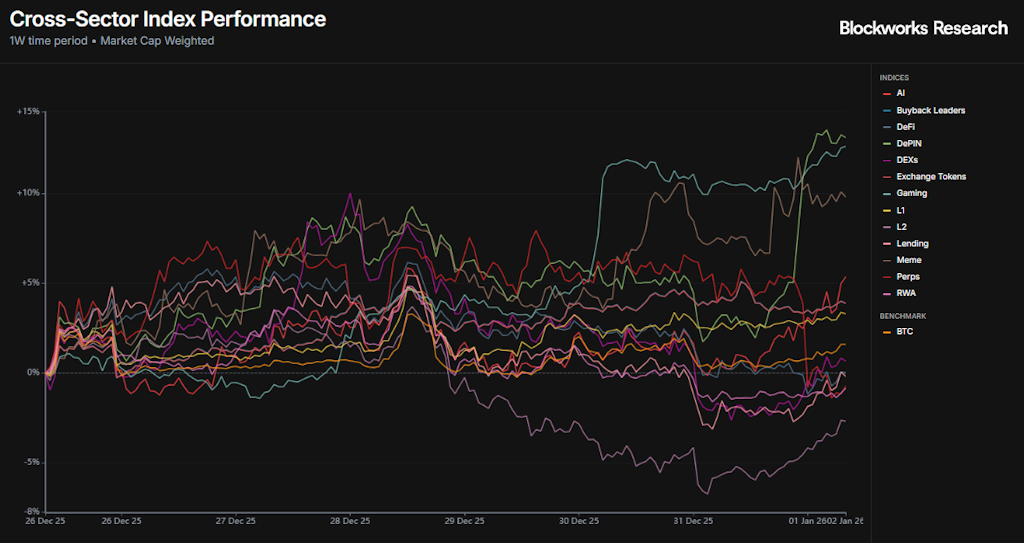
Perhaps the most striking development of the week has been the sudden resurgence of Decentralized Physical Infrastructure Networks, commonly known as DePIN, and the gaming sector. Both categories staged a surprising and aggressive rebound following a brutal preceding year that saw them heavily depressed. DePIN and Gaming led all major crypto sectors over the course of the week, recording impressive gains of 13.1% and 12.6% respectively.
These gains are particularly noteworthy given how deeply out of favor both sectors were throughout the prior annual cycle, during which they experienced drawdowns of approximately 79.5% and 81.3%. The recent recovery in the DePIN index was spearheaded by major tokens such as Filecoin and Render, which posted weekly gains of 22% and 13% respectively, a significant movement given that the pair accounts for nearly half of the entire sector index. The gaming sector followed a remarkably similar trajectory, with Immutable doing the heavy lifting for the category by climbing 11% over the same timeframe.
Sector Divergences and Institutional Pressures
In sharp contrast to the unexpected strength in gaming and DePIN, other prominent crypto sectors faced persistent headwinds. Layer-2 scaling solutions and real-world asset tokenization platforms lagged behind the broader market, slipping 2.67% and 0.84% respectively over the week.
The weakness within the Layer-2 ecosystem was primarily driven by tokens like MNT and ZORA, which recorded losses between 5.7% and 6.4%. Yet, even within this lagging category, internal fragmentation was clearly visible. Other prominent Layer-2 scaling tokens, including Optimism, Arbitrum, and various zero-knowledge infrastructure assets, managed to post robust gains ranging from 10% to 20%, demonstrating that investors remain highly selective even when broader category sentiment turns negative.
Meanwhile, the real-world asset sector found itself under pressure due to a broader market pullback in gold following its stellar performance throughout the year. Tokenized gold products such as PAXG and XAUT both retreated by approximately 3.4% as precious metal prices experienced a temporary cooling-off period.
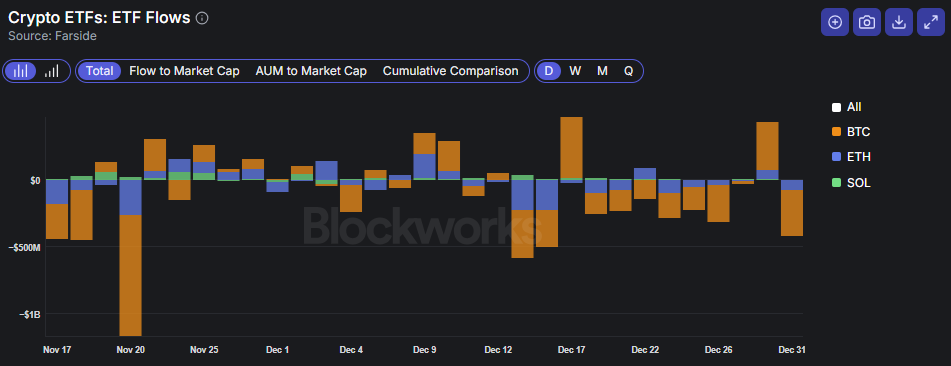
Capital flows across the wider digital asset ecosystem remain intensely volatile and directionally unstable. This chop was clearly illustrated by exchange-traded fund activity, where a single day of significant inflows was almost entirely canceled out by subsequent market movements. Specifically, spot ETFs experienced $417.8 million in net outflows, virtually wiping out the $428.2 million in inflows that had been recorded just one day prior.
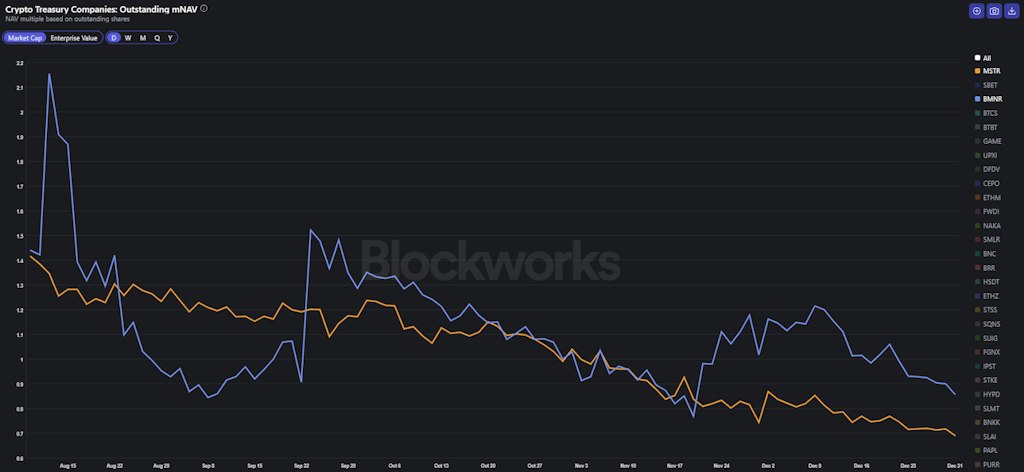
This underlying friction is also weighing heavily on corporate digital asset treasuries. Companies holding large reserves of cryptocurrencies continue to experience strain as market-to-net-asset-value multiples undergo further compression. High-profile corporate treasury vehicles and investment proxies, such as MicroStrategy and other digital asset treasury operations, are seeing their mNAV multiples compress to levels around 0.69 and 0.85. This ongoing multiple compression underscores the mounting pressure facing the treasury trade as market participants navigate changing macroeconomic conditions and liquidity constraints at the dawn of the new year.
End-of-Year Analyses Point to Structural Maturation
To gain deeper context on where the industry stands heading into the new year, market analysts and research firms have published comprehensive year-in-review studies examining the fundamental shifts that shaped the landscape over the past twelve months. These reports offer valuable perspective on stablecoin yield generation, payment infrastructure evolution, cross-chain interoperability, and the rapid pace of narrative cycles.
One prominent area of focus is the evolution of stablecoin yield products and institutional market mechanics. Recent research highlights how emerging protocols are attempting to bridge traditional institutional over-the-counter arbitrage strategies directly into stablecoin wrappers. By offering market-neutral yields that rely less on traditional crypto funding rate cycles, these models aim to provide more sustainable returns for large-scale participants. Analysts point out that early traction and double-digit yields reflect strong institutional appetite, though the ultimate success of these models will depend heavily on robust execution, careful counterparty risk management, and scalable deployment into hedged transactions. If these structures can maintain their yields as total value locked expands, they could establish a new structural baseline for institutional liquidity in decentralized finance.
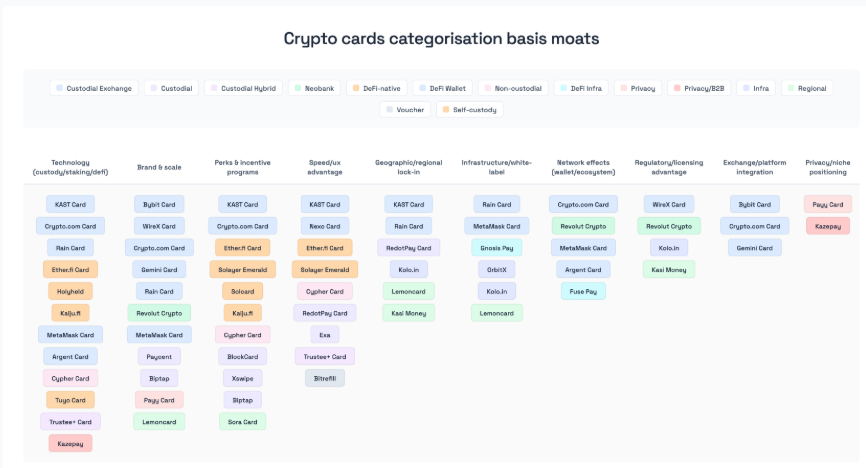
At the same time, the broader payments and consumer-facing infrastructure has reached a critical inflection point. Industry evaluations of crypto-enabled cards and neobanks indicate that the market is rapidly maturing away from superficial rewards and marketing-driven cashbacks toward deep infrastructure integration, compliance frameworks, and programmatic liquidity control. Durable business models and competitive moats are increasingly concentrated among infrastructure rail providers and decentralized finance card models that capture recurring fees and secure regulated access points. As regulatory scrutiny tightens globally across financial jurisdictions, scale is expected to favor entities that successfully control licensing, settlement, and compliance workflows rather than those simply relying on short-term consumer incentives to drive volume.
The maturation of the industry is also reflected in the technological backbone connecting disparate blockchain networks. Comprehensive data compiled on cross-chain activity throughout the year demonstrates that interoperability has officially graduated from a theoretical concept into the foundational core infrastructure of the digital asset economy. Tokenized assets and stablecoin supplies are now distributed fluidly across a multitude of distinct layer-1 and layer-2 networks. This deep interconnectivity has dramatically accelerated asset velocity, optimized capital mobility, and improved global access for users. Instead of individual blockchains operating in isolated silos, the broader crypto ecosystem now functions as a unified, connected network where value flows seamlessly to areas of highest demand. The widespread adoption of message-based transfers and open communication primitives has successfully reduced friction and costs, transforming cross-chain interactions into a seamless software experience rather than a cumbersome financial hurdle.
Finally, a retrospective look at the relentless pace of market narratives over the past year reveals both the fragility and the resilience of crypto adoption cycles. Analysts note that the previous twelve months were characterized by rapid, almost dizzying narrative cycles that generated speculative attention faster than the underlying technology could validate it, leading to widespread fatigue and skepticism among market participants. While many high-flying narratives faded just as quickly as they arrived, a core subset of use cases successfully translated into genuine, long-term utility that pushed the market forward. Areas featuring simple, intuitive retail onboarding—such as scalable stablecoin settlement, prediction markets, and robust payment rails—demonstrated clear product-market fit. This ongoing evolution suggests that durable value in the digital asset space continues to emerge only when speculative narratives successfully align with tangible, real-world utility and robust underlying infrastructure.





Comments (0)