



The decentralization of crypto market infrastructure has reached a critical inflection point, mirroring the evolution of traditional equity markets. At the center of this transformation is Hyperliquid, a prominent derivatives execution and settlement layer that has popularized a novel protocol-level parameter known as builder codes. By fundamentally decoupling execution from settlement, these codes have unlocked a powerful distribution flywheel, allowing third-party frontends to capture millions in revenue while shifting the competitive dynamics of onchain trading.
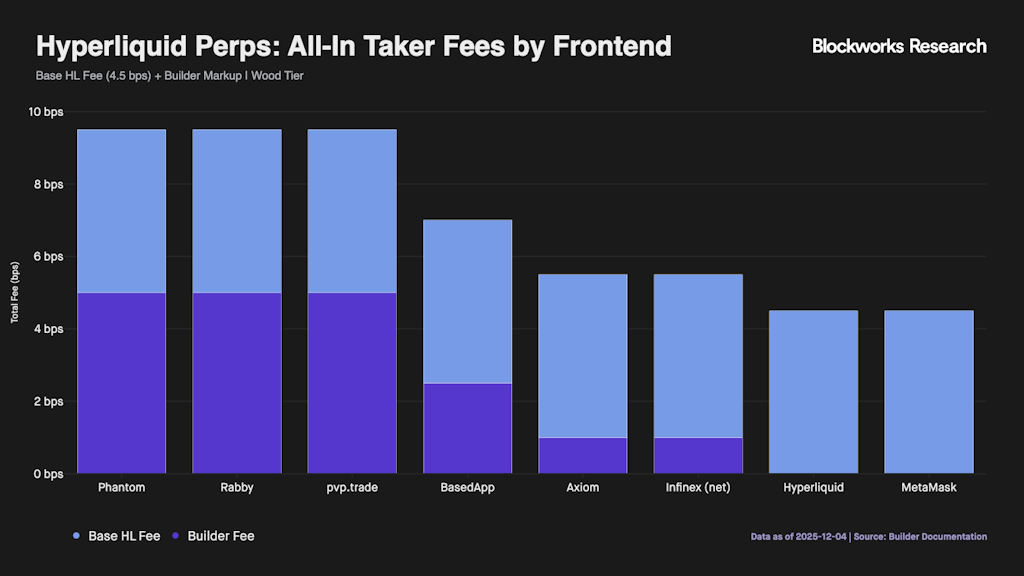
Introduced as a core protocol innovation, builder codes function directly within transaction payloads. They empower third-party interfaces to seamlessly append a builder address for automated, onchain fee capture. Through this mechanism, external developers and platform operators can attach a customizable surcharge of up to 100 basis points, or 1%, on spot transactions, and up to 10 basis points, or 0.1%, on perpetual contracts.
This technical architecture allows trading terminals and wallets to monetize proprietary user flow without undertaking the immense technical complexities of maintaining a high-performance orderbook. Furthermore, it spares them from the severe capital inefficiencies typically required to bootstrap deep liquidity from scratch. Third-party frontends can integrate Hyperliquid perpetuals directly into their systems and layer their own variable fee tiers on top. As a result, the ecosystem has witnessed the emergence of a differentiated pricing landscape for the exact same underlying execution.

The Rise of Layered Intermediation and Distribution
This structural design has propelled Hyperliquid away from the traditional, fully integrated crypto exchange model—exemplified by centralized giants like Binance, where a single entity controls the entire stack from user onboarding and order routing to matching and custody—and pushed it much closer to the layered intermediation seen in traditional US equities.
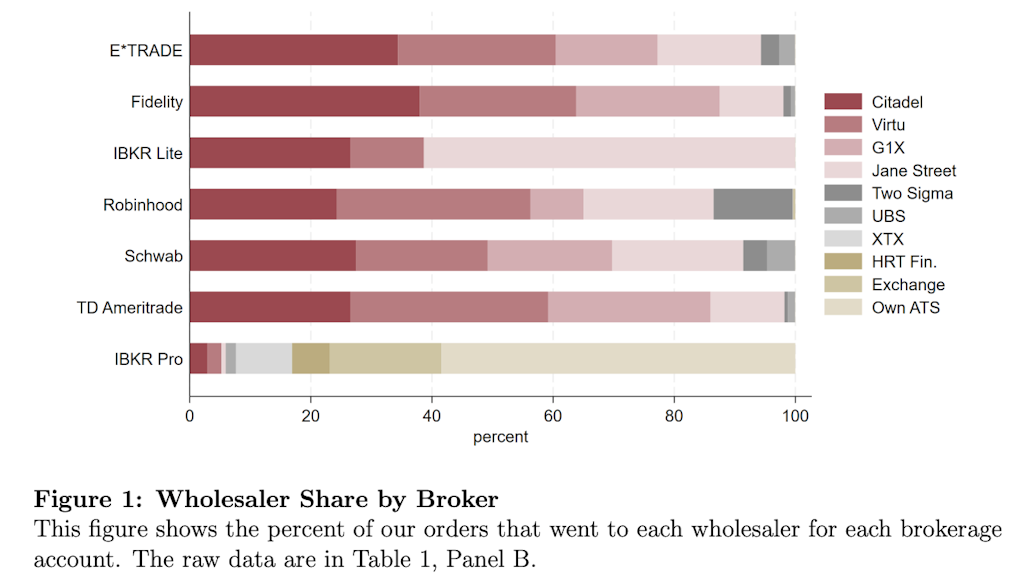
In the traditional equities model, retail-facing brokers such as Robinhood and Charles Schwab own the vital client relationship and monetize distribution. Meanwhile, they route their order flow to wholesale market makers like Citadel Securities and Virtu Financial, which handle the heavy lifting of execution and settlement. Hyperliquid’s emerging ecosystem mirrors this exact two-tiered dynamic.
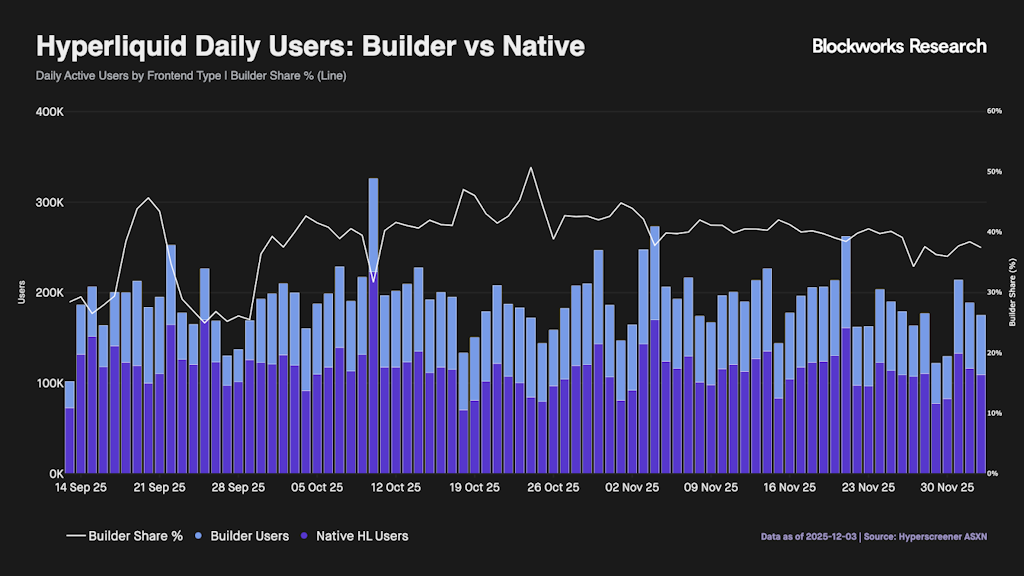
The impact on user distribution has been dramatic. Nearly 40% of Hyperliquid’s daily active users now execute their trades through third-party frontends rather than relying on the protocol’s native user interface. This share of third-party volume even crossed the 50% threshold briefly in late October. Major builders operating within the ecosystem—such as Based, Phantom, and pvp.trade—have capitalized on this trend, collectively pulling in more than $31 million in fee revenue.
While novel in the realm of crypto perpetuals, this decoupling mechanism bears a striking resemblance to developments previously witnessed on the Solana network. On Solana, consumer-facing trading terminals like Photon and Axiom successfully captured massive user flow by focusing heavily on the consumer experience layer. Photon initially surged in popularity by offering lightning-fast memecoin sniping capabilities, while Axiom later challenged its dominance with an expanded product suite and aggressive point systems and rebate designs.
These Solana terminals operated essentially as builders: they sat on top of decentralized exchanges, bolted on their own fee markups, and managed internal accounting manually. Hyperliquid’s builder codes have effectively transformed that ad-hoc pattern into a native, protocol-level primitive.
Lessons from Solana and the Value of the Frontend
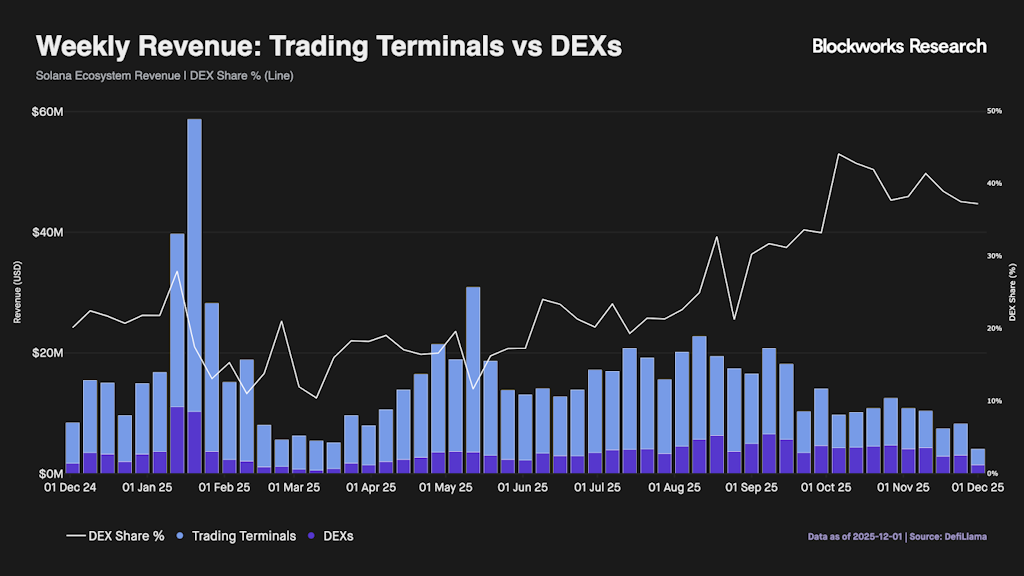
However, the Solana ecosystem also serves as a cautionary tale regarding the inherent risks of giving third parties control over distribution. Over the past year, trading terminals on Solana captured a staggering 77% of total decentralized exchange revenue, generating $633 million compared to just $188 million for the underlying DEXs. This 3.4x multiple underscores a stark economic reality in modern crypto markets: owning the frontend and the customer relationship is often far more valuable than owning the backend infrastructure.
This dynamic naturally raises questions about whether frontends could eventually become too valuable for base layers like Hyperliquid to accommodate on generous terms. The relationship between frontends and backends is rarely purely symbiotic. In mature aggregator environments like Jupiter on Solana, frontends aggregate various liquidity backends such as Meteora, Raydium, and Orca, routing trades based strictly on size, fee structures, and slippage constraints.
This level of aggregation forces underlying DEX backends into severe margin compression. Lacking a durable competitive moat, backends are forced to offer the absolute cheapest execution route simply to win order flow. Because they do not own the end user, backends remain perpetually vulnerable to replacement. A clear historical example occurred when pump.fun bypassed Raydium entirely, replacing it with its own in-house automated market maker and severely impacting Raydium’s volume share.
At present, Hyperliquid does not face this exact vulnerability. By pioneering builder codes specifically for perpetuals, it currently operates within a singular-builder code environment. Yet, if builders eventually evolve from simple user interfaces sitting atop Hyperliquid into sophisticated, multi-chain routers capable of directing order flow to competing backends, they will begin to resemble smart-order routers found in traditional finance.
In such a scenario, builders could dynamically pit liquidity venues against one another, extracting concessions, demanding payment for order flow, and optimizing execution quality across rival protocols. Just as traditional wholesale market makers compete fiercely for volume from broker-dealers based on execution quality, onchain builders could theoretically evaluate multiple derivatives backends simultaneously.
The Defenses of Perpetual Margins and Future Headwinds
While rival decentralized perpetual venues such as Drift and Ostium have integrated builder codes into their own systems, none have yet emerged as genuine threats to Hyperliquid’s market dominance. Nevertheless, significant structural risks linger. If a competitor like Lighter were to pair attractive builder rebates with a zero-fee model, it could theoretically enable popular wallets like Phantom and Rabby to completely bypass Hyperliquid’s baseline 4.5 basis point fee. This shift would allow frontends to capture the entire fee stack, effectively doubling their revenue per trade compared to the current Hyperliquid framework.
The emergence of platforms like LiquidTrading points toward this competitive horizon. Backed by Paradigm and having raised $7.6 million in its seed round, the trading terminal has facilitated $5.6 billion in volume on Hyperliquid. Crucially, however, it also enables users to trade on Ostium and Lighter through the exact same interface. If larger builders follow this trajectory and begin actively routing order flow based primarily on venue rebates rather than platform loyalty, Hyperliquid builder frontends could eventually commoditize into generalized perpetual aggregators, directly threatening the protocol’s ability to capture long-term value.
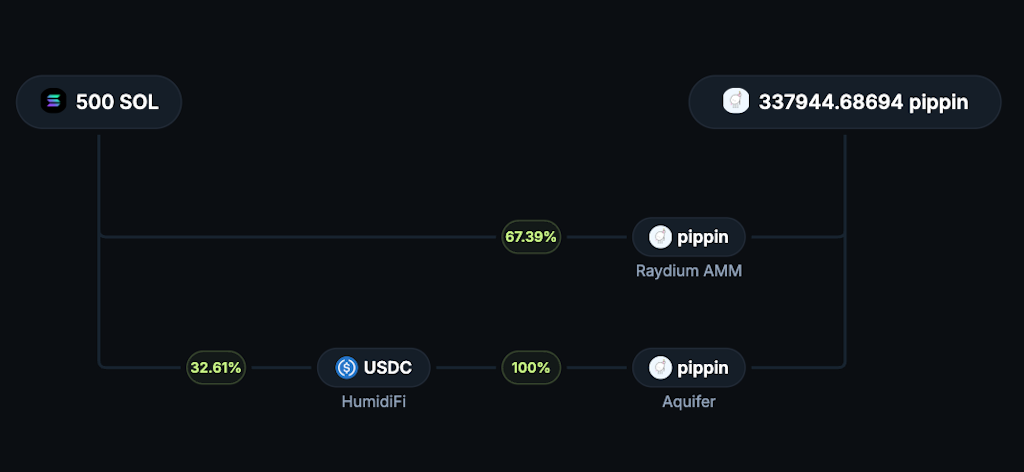
Despite these theoretical risks, a fundamental technical barrier separates spot markets from perpetual derivatives. Spot trading is easily aggregated because each swap is an atomic transaction and underlying assets are entirely fungible across disparate venues. A single transaction can easily be split into multiple fills across various liquidity pools by an automated router.
Perpetual positions, by contrast, are persistent and strictly venue-specific. A bitcoin perpetual position opened on one venue is not fungible with a position on another venue due to structural differences in index composition, funding rate calculations, liquidation engines, and risk management limits. Routing perpetuals across multiple competing venues in a meaningful way requires complex cross-margin architectures or unified liquidity layers that remain difficult to implement seamlessly.
This inherent non-fungibility provides Hyperliquid with a vital short-term defense. Furthermore, current market data suggests that the threat of disintermediation is well contained. Despite high user activity on third-party interfaces, the overwhelming majority of trading volume—over 90%—still originates directly from Hyperliquid’s native frontend.
Additionally, the native HYPE token introduces a powerful retention layer for the ecosystem. Builders can hold HYPE tokens to unlock valuable fee discounts, allowing them to stack multiple revenue streams simultaneously, including referral payouts, builder fees, and volume-based rebates. Given these integrated financial incentives, the economic switching cost for frontends to migrate for marginally better fees may simply not be worth the operational friction. Moreover, data indicates that the order flow originating from third-party builders is largely additive rather than cannibalistic, representing brand-new market participants entering the crypto ecosystem via consumer wallets and specialized terminals rather than existing users deserting native interfaces.
While builder codes have proven to be an extraordinarily effective expansion vector for Hyperliquid, expecting any protocol to maintain absolute, unchallenged dominance over its distribution layer over the long term is unrealistic. As the decentralized derivatives sector matures, Hyperliquid will undoubtedly face a more rigorous competitive battle to defend its market lead against emerging aggregators and low-fee challengers.
Even so, constructing a high-performance, resilient onchain orderbook remains an immense technical moat. With frontend profit margins currently remaining healthy across the board, the near-term incentives for builders to abandon the platform are minimal. In a rapidly expanding global market, the ongoing struggle is not merely about retaining existing volume, but rather participating in a fiercely competitive race for broader adoption where Hyperliquid remains the heavyweight to beat.





Comments (0)