


After training hundreds of creators through masterclasses and corporate sessions at major French studios, a persistent pattern has emerged that undercuts even the most ambitious artificial intelligence video projects. Long before anyone opens an advanced video model, a fundamental breakdown occurs. Creators will spend an entire evening building a single shot—perfecting the lighting, ensuring the camera movement is smooth, and keeping the character stable mid-motion—only to find that the shot ultimately fails. The reason is deceptively simple: no one in the room, including the creator, can articulate what happens immediately before or after that specific frame.
This phenomenon highlights a widespread misconception across the digital media landscape. After two years of teaching AI filmmaking, the biggest mistake observed is not a settings issue, a hardware limitation, or a flaw in the underlying generative model. Instead, it is that beginners routinely start generating visual assets before establishing a coherent narrative structure from shot to shot. Creators open advanced tools like Kling, Runway, or Veo carrying a mental image of a final scene while lacking any written record of how that scene breaks down sequentially. Consequently, they find themselves bewildered when the individual pieces refuse to fit together in the timeline.
What initially appeared to be isolated incidents have formed a clear, repetitive trend across countless training sessions, removing any doubt that this is merely a rare coincidence.
What Is the Actual Mistake, If It’s Not the AI Model?
The root of the problem lies in skipping the shot list. Creators do not omit this step out of sheer ignorance; most are familiar with the term. Rather, the lightning-fast nature of modern AI video generation creates a deceptive sense of efficiency, making traditional planning feel like an unnecessary hurdle that squanders the speed they paid for.
The trap is easy to fall into. A single AI-generated clip can now look visually complete in under a minute. That rapid rendering creates the illusion that filmmaking itself has accelerated. In reality, only the rendering step has sped up. The fundamental thinking step—determining what each shot must convey, where the camera is positioned, and what narrative baton the previous shot is handing off—takes exactly as much time as it always has. Bypassing this crucial phase does not actually save time; it merely defers the labor to the editing stage, where rectifying structural errors becomes significantly more expensive.
This exact misstep occurred during the early production of Lost Garden, an AI-animated series. Eleven strong individual shots were generated before sitting down to assemble the sequence, only to reveal that four of them were entirely incompatible in succession. The classic warning signs of skipped pre-production were immediately visible on the timeline. Rebuilding three of those eleven shots from scratch underscored a harsh reality: the initial generation phase was by far the cheapest part of the process.
Why Does This Happen to Almost Everyone?
This oversight transcends experience levels, appearing consistently among solo hobbyists and professional video teams alike. The user interfaces of modern generative tools actively encourage this behavior. Every AI video platform is engineered to propel users from a text prompt to a finished clip as rapidly as possible, without ever prompting them to consider how that clip connects to adjacent footage. Speed is frequently mistaken for genuine progress.
Another contributing factor is the isolated nature of modern digital workflows. In traditional film production, artifacts like shot lists, beat sheets, and continuity notes were essential communication tools designed to align a director with a large crew. Operating entirely solo, creators often fall into the trap of assuming they can retain all necessary narrative parameters in their head. Once a sequence exceeds six or seven shots, however, virtually no one can maintain perfect mental continuity.
Traditional film education also fails to address this specific modern challenge. Film school shot lists are traditionally structured for human camera crews, lighting departments, and script supervisors. Because these legacy formats lack an obvious direct equivalent in AI prompting, many beginners have simply never encountered a shot list tailored for generative models, leading them to abandon planning altogether.
While a shot list built for a human crew instructs people on physical execution, a shot list designed for an AI model must serve a different purpose. It needs to constrain the model, preventing it from reinventing stylistic or narrative elements between one clip and the next.
How Do You Fix It Before Generating a Single Clip?
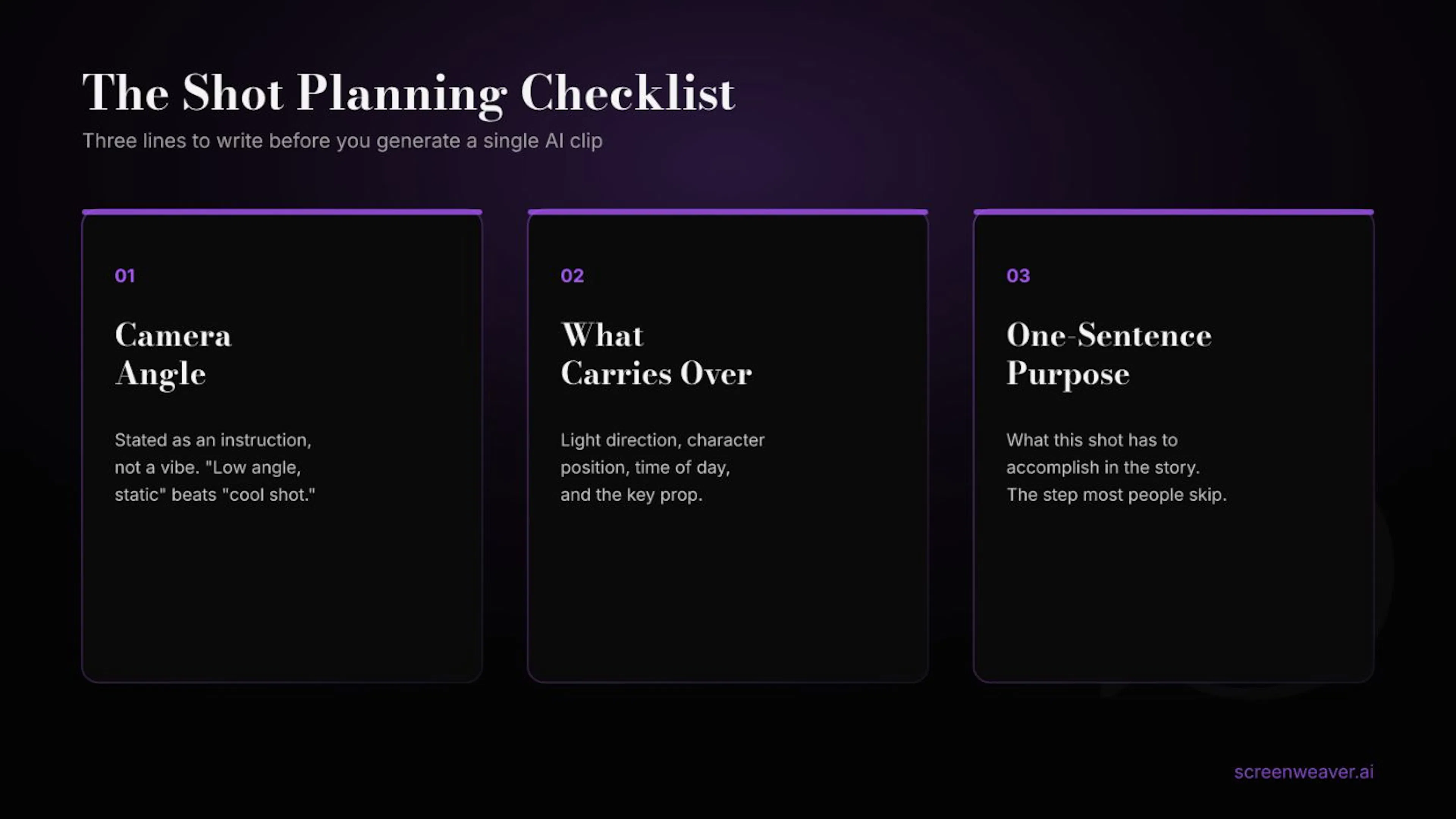
The remedy is straightforward, which paradoxically leads many creators to underestimate its value. Before opening any video model, creators must explicitly document specific parameters for every shot in a sequence. This includes defining the exact purpose of the shot, establishing its spatial and temporal relationship to the preceding clip, and outlining the narrative shift that occurs within the frame.
Failing to define the precise purpose of a shot is where most creators encounter downstream failure. If a creator cannot articulate in a single sentence why a shot exists, the AI model certainly cannot deduce it, resulting in generic visual output that bridges narrative gaps with meaningless filler.
Recognizing this industry-wide bottleneck led to the development of dedicated workspaces designed to keep scripts, shot breakdowns, and storyboards interconnected. Such tools ensure that essential planning occurs before generation credits are expended rather than after the fact. Implementing these systems does not replace pre-production; it simply makes bypassing the planning phase much harder to do by accident.
Does Planning First Actually Slow You Down?
Addressing the common objection that planning inhibits creative momentum requires looking closely at production metrics. Upfront planning does require an initial investment of time, but it actively prevents the massive expenditure of time spent on endless regenerations—the true time sink for most modern creators.
Industry reviews from ProductionHub focusing on AI integration within pre-production workflows indicate that producers utilizing structured script breakdowns, storyboarding, and shot planning are already capturing measurable productivity gains. At the same time, reports remain candid about technological limitations, noting that pre-visualization and AI-assisted storyboards still demand substantial human revision. The financial and temporal savings stem from rigorous planning executed correctly, not from rapid generation executed blindly.
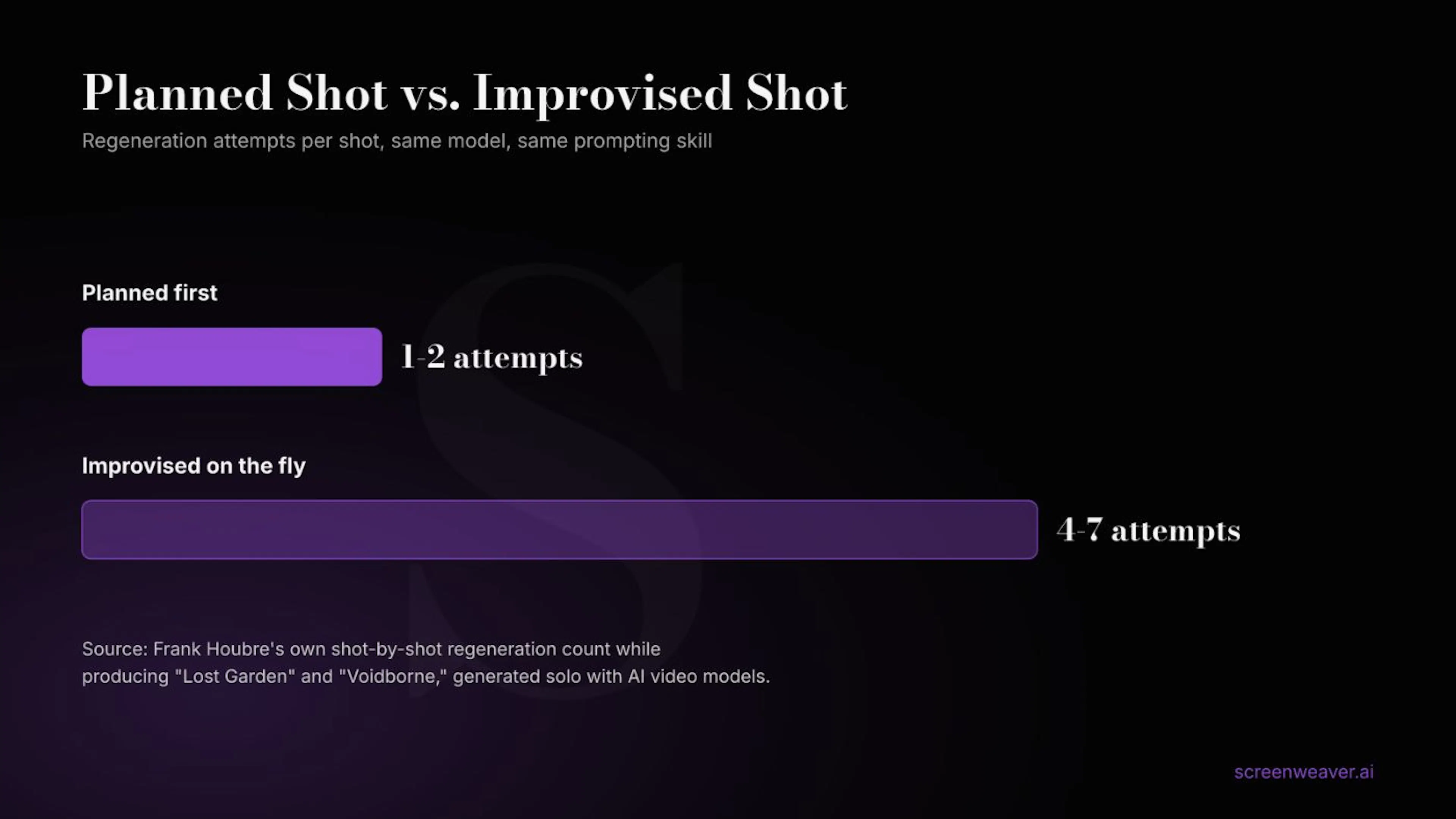
The mathematics of this approach are stark. On the solo-produced anime short Voidborne, shots that were meticulously planned prior to generation required only one or two attempts to get right. Conversely, improvised shots demanded four, five, or even seven regenerations before yielding usable material. Despite utilizing the exact same underlying models and prompting techniques, the cost varied wildly based solely on whether the creator knew what the shot required before asking the system to render it.
Voidborne ultimately garnered recognition across more than a dozen international AI film festivals, including a notable placement at the Chroma Awards, a prominent global AI media competition supported by industry leaders such as ElevenLabs, Google, and Adobe. To the casual viewer watching the finished piece, the origin of each shot—whether meticulously planned or repeatedly rerolled—is imperceptible. Behind the scenes, however, the unplanned shots carried a heavy toll in lost time and effort.
What Actually Changes Once You Fix This?
Prioritizing pre-production triggers an immediate and noticeable shift in workflow efficiency, even for veterans of AI video generation. The frequency of regeneration attempts drops sharply because the AI model is being asked a precise, constrained question rather than an open-ended one. Editing timelines accelerate because continuity is resolved during the planning phase rather than discovered haphazardly halfway through post-production.
Weeks after completing masterclasses, creators frequently report an unexpected psychological shift: the medium stops feeling like a slot machine and begins feeling like directing again. Overcoming these hurdles does not require securing a larger production budget, upgrading to a more powerful model, or mastering hyper-complex prompting tricks. It simply demands taking the time to write down the specific function of each shot before generating a single frame. Though less flashy than watching an AI render a stunning standalone image, this disciplined habit represents the definitive boundary between a cohesive visual sequence and a disorganized pile of disconnected clips.



Comments (0)