


The cryptocurrency ecosystem is watching closely as Ranger, a comprehensive full-stack trading terminal encompassing three core products, officially launches its Initial Coin Offering (ICO) today, running through January 10. Representing a major event for the broader decentralized finance sector, the Ranger token sale marks a notable milestone for the MetaDAO platform, serving as the first token offering on the infrastructure to feature a project with pre-existing, pre-ICO investors. As the market digests the mechanics of the sale, the event is also drawing attention to MetaDAO’s broader economic outlook, revenue models, and upcoming catalysts that analysts believe could fundamentally reaccelerate its growth trajectory in the new year.
Under the structure of the Ranger token sale, the project is seeking a minimum raise of $6 million while offering 39% of the total RNGR token supply to the public. In a governance structure designed to protect participants, the proceeds generated from the raise will be held directly within a token holder-governed treasury. Meanwhile, the core development team will receive a fixed monthly stipend of $250,000 to support ongoing operations and product development. The distribution of the RNGR supply sets up distinct terms for different stakeholder groups, balancing liquidity at launch with long-term incentive alignment.
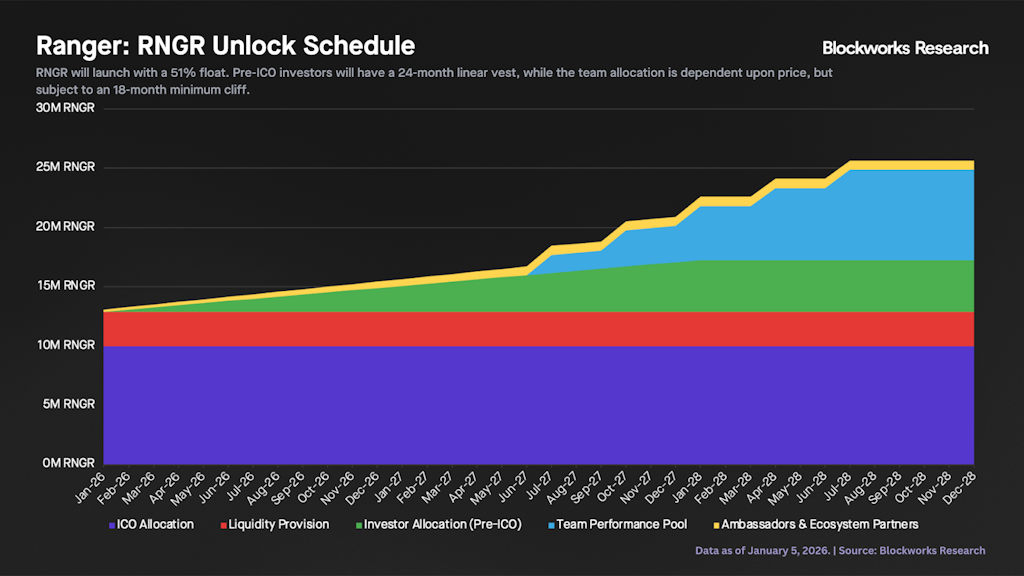
Participants who secure an allocation through the public ICO will receive tokens that are 100% liquid at the Token Generation Event (TGE), meaning there is no vesting period for public buyers. Conversely, pre-ICO investors are subject to a strict 24-month linear unlock schedule with no cliff. To ensure the development team remains deeply invested in the long-term success of the trading terminal, the team allocation is tied directly to performance milestones. Up to 7.6 million RNGR tokens, representing 30% of the total supply, become unlockable through five distinct milestone tranches. These are triggered when the token price achieves 2x, 4x, 8x, 16x, and 32x of the initial ICO price. Furthermore, each milestone must be successfully maintained via a three-month Time-Weighted Average Price (TWAP), accompanied by a mandatory minimum 18-month cliff before any team tokens can officially begin to unlock. This structure ensures that realized team token releases will ultimately depend on sustained post-ICO price performance rather than short-term market volatility.
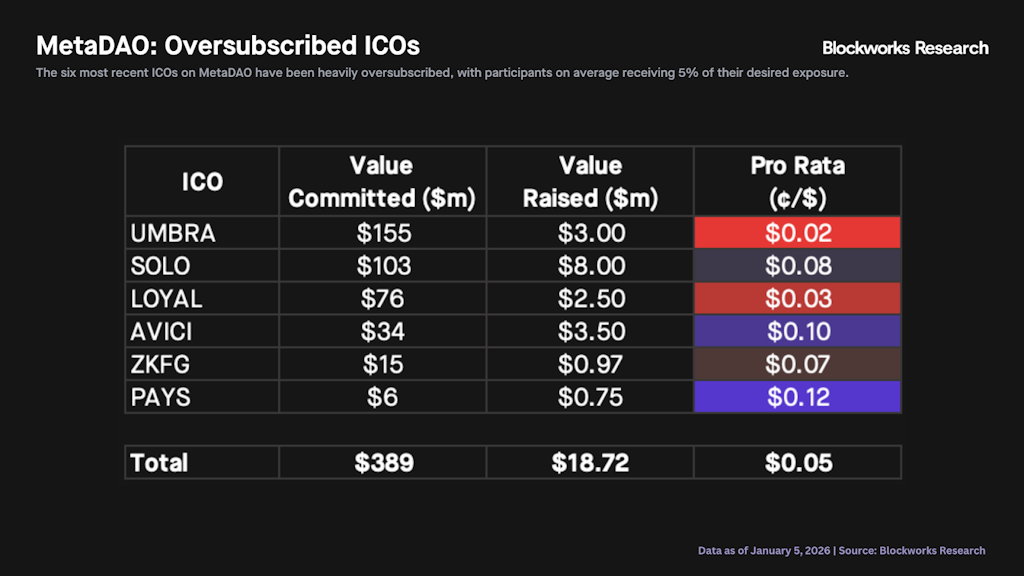
The mechanics of MetaDAO’s ICO platform have historically fostered significant demand. Over the past six MetaDAO ICOs, token sales have been heavily oversubscribed, forcing platforms to settle allocations on a pro rata basis. This particular allocation mechanism naturally favors larger capital allocators, often referred to as whales, who possess the financial capacity to overcommit capital to secure a meaningful stake in promising projects. Data from previous sales shows that participants have typically received an average of approximately 5% of their desired exposure.
To address this oversubscription dynamic head-on, Ranger has implemented a dedicated allocation bucket to guarantee point holders direct access to the ICO. Market observers have noted that this structure offers a constructive path forward, rewarding early platform users and active contributors through preferential access rather than relying on traditional airdrops. Distributing 10 to 30% of supply via airdrops can often introduce unnecessary immediate sell pressure and weaker community alignment. Under Ranger’s design, any portion of the dedicated allocation not claimed by eligible point holders will seamlessly roll over and be distributed pro-rata to public ICO buyers.

While the Ranger token sale presents an compelling opportunity on its own—particularly for existing point holders—industry analysts view the event as a much broader bellwether for MetaDAO itself. Specifically, the ICO serves as a vital market catalyst that could successfully reaccelerate launch cadence and protocol revenue as the market moves further into the year.
MetaDAO monetizes its ICO infrastructure primarily through swap fees collected on its innovative Futarchy automated market maker (AMM) alongside its liquidity provider (LP) position on Meteora. The Futarchy AMM charges a 0.5% fee on trading volume. Originally, this fee was split evenly between MetaDAO and the specific project conducting the raise, with each entity taking 0.25%. However, following mutual agreement with project teams, the fee split was retroactively adjusted on December 28 so that the full 0.5% fee now accrues directly to MetaDAO, enhancing the protocol’s revenue-generating efficiency.
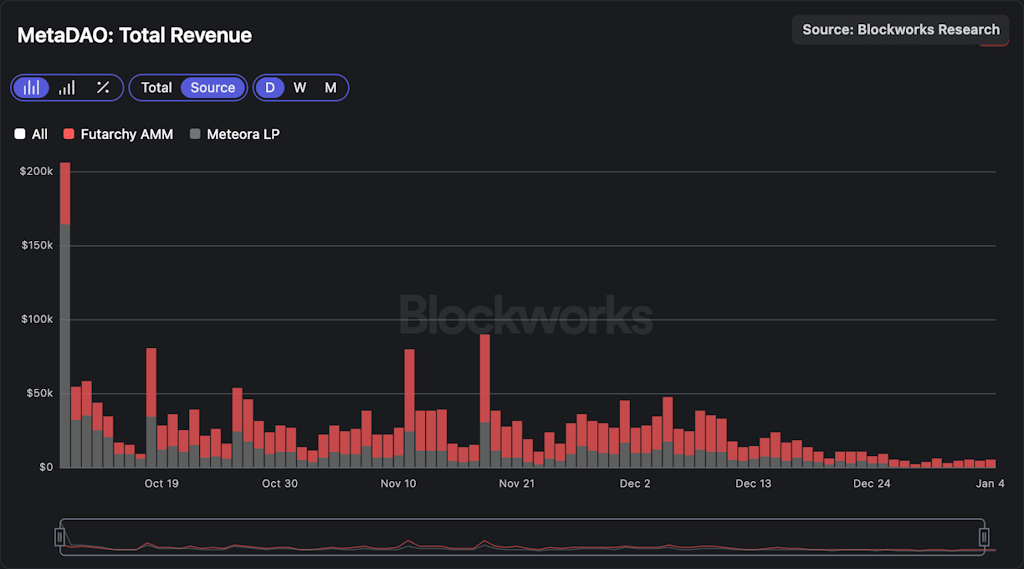
Since the Futarchy AMM officially went live on October 10, 2025, MetaDAO has accumulated approximately $2.4 million in total revenue. A breakdown of these earnings reveals that roughly 60% originated from the Futarchy AMM swap fees, while the remaining 40% was generated through its Meteora LP position.
Despite this strong foundational period, MetaDAO’s revenues have experienced a sharp decline since mid-December as broader ICO activity temporarily slowed down. In its current operational phase, MetaDAO maintains a highly curated approach to its token launches, placing significantly more weight on founder quality, operational credibility, and long-term project alignment rather than simply maximizing the sheer volume of launched tokens. While this meticulous curation strategy was entirely necessary to validate the underlying product and prove the viability of Futarchy governance, it has introduced a clear operational tradeoff. Without a steady, uninterrupted stream of new launches, protocol revenues find it challenging to scale upward, resulting in a slight lag in launch cadence over the past few weeks.
Market data illustrates that token trading volumes are consistently highest around the TGE and the immediate days following the event. Consequently, sustained Futarchy AMM trading volumes—and by extension, protocol revenues—remain heavily dependent on a continuous pipeline of fresh token launches.
Despite the temporary dip in daily revenue performance, the platform’s native token, META, has demonstrated remarkable strength, rallying roughly 40% over the course of a single week. This strong price action has pushed META’s 30-day trailing price-to-sales (P/S) ratio up to approximately 36x, sitting notably higher than its preceding two-month trading range of roughly 10x to 15x. Because cryptocurrency markets are fundamentally forward-looking, market participants anticipate that META’s P/S ratio will naturally compress back toward its historical range over the coming weeks and months. This normalization is expected to occur not through a decline in token price, but rather through the reacceleration of protocol revenues driven by new activity.
This revenue reacceleration is underpinned by near-term catalysts. The immediate driver is the Ranger ICO, which is widely expected to be oversubscribed and prompt a substantial spike in Futarchy AMM trading volumes in the days following the TGE. The second catalyst involves the recent passage of the Omnibus proposal, which concluded its governance voting cycle.
Looking past the immediate days and further into the upcoming months, market analysts project that MetaDAO’s overall revenues will trend upward as launch cadence scales significantly. Two major structural catalysts are expected to drive this expansion: the introduction of permissionless launches and the integration of Colosseum’s STAMP initiative.
MetaDAO has engaged in extensive public community discussions regarding whether to maintain a strictly curated, permissioned launch model or to begin experimenting with permissionless launches. While permissionless models inherently carry the risk of introducing lower-quality projects to the ecosystem, they represent a necessary experiment to test platform scalability, increase overall market throughput, and validate the long-term utility of the infrastructure.
Additionally, market participants suggest that the broader ecosystem may be underpricing the long-term significance of Colosseum’s STAMP for MetaDAO. Operating at the foundational level of Solana’s startup funnel, Colosseum manages comprehensive hackathons, specialized accelerators, and active venture funds. Many of the Solana ecosystem’s most successful infrastructure and DeFi protocols—including Jito, Kamino, Drift, Exponent, and Hylo—trace their earliest origins directly back to these hackathon environments. The STAMP initiative effectively bridges MetaDAO directly into this robust deal flow pipeline, establishing a consistent and reliable stream of high-quality project launches. This pipeline is expected to complement future permissionless ICOs and normalize launch frequency over time.
Ultimately, while events like the Ranger token sale and the implementation of the Omnibus proposal are positioned to drive near-term revenue recovery, the eventual transition toward permissionless launches and ecosystem integrations like Colosseum’s STAMP are viewed as the primary forces capable of driving a substantial expansion in MetaDAO’s launch cadence, trading volumes, and protocol revenues in the months ahead.



Comments (0)