



Semiconductors and other prominent artificial intelligence and market-momentum equities have experienced dramatic pullbacks, dropping roughly thirty to forty percent from their all-time highs. Amid this broader market correction, a vocal segment of investors and market observers has been quick to declare a definitive top for the semiconductor, memory, and artificial intelligence sectors, effectively validating those who chose to sit on the sidelines rather than participate in the recent rally. However, industry analysts and market observers suggest that those celebrating an early victory over the AI trade may be doing so prematurely.
At the core of the ongoing debate surrounding semiconductor and AI investments lies a fundamental philosophical question regarding the nature of modern technological growth: Does the global demand for compute represent a finite resource, or is it fundamentally infinite?
In many casual market conversations, participants tend to anchor their outlook on localized, personal experiences of enterprise software adoption and corporate usage, subsequently extrapolating those micro-trends onto the broader macroeconomic landscape. While it is true that enterprise adoption of artificial intelligence tools can occasionally lag due to internal bureaucratic friction, legacy system integrations, and compliance frameworks, this dynamic simultaneously generates a powerful counter-incentive. Smaller, more agile, and inherently AI-native firms are increasingly empowered to outcompete traditional legacy enterprises with significantly leaner workforces. When deployed effectively, artificial intelligence often proves vastly more cost-effective than scaling an organization through traditional human labor, bypassing extensive legal overhead, HR management, and operational drag.

Zooming out beyond the immediate confines of enterprise software capex, the broader AI buildout is fundamentally an industrial effort focused on bringing massive quantities of compute online. This compute capacity is slated to serve a diverse and expanding ecosystem of buyers, including sovereign governments, major cloud hyperscalers, advanced frontier AI research laboratories, and smaller autonomous enterprises.
Each distinct category of buyer operates with a vastly different budget and price elasticity when acquiring compute resources. While a certain segment of the market may eventually tap out if the cost of compute rises beyond their immediate operational thresholds, it is historically shortsighted to assume that another well-capitalized buyer will not step in to absorb the excess capacity. For critical entities such as sovereign nations and global hyper-scalers, compute spending has transformed into a non-negotiable strategic race where falling behind carries existential geopolitical and commercial risks. For other market participants, compute is deployed as a direct substitute for the rising cost of human labor, remaining an economically attractive alternative despite short-term price fluctuations.
The belief that the market is currently overbuilding or racing past capacity implicitly relies on the assumption that these primary buyer groups will eventually reach a permanent end-state of technological satisfaction. It assumes that governments, enterprise leaders, and technology labs will eventually look at their technological capabilities, declare themselves content, and halt further infrastructure expansion. Those who subscribe to this view naturally conclude that the artificial intelligence sector represents an inflated speculative bubble characterized by severe over-investment.
Conversely, market participants who view human ambition and technological evolution as inherently boundless conclude that the global demand for compute will continue on an exponential trajectory. Under this framework, the industry is currently engaged in a massive, high-stakes race to secure sufficient compute infrastructure, a reality that broader financial markets are only beginning to price in fully.

As financial markets navigate this transitional phase, the most persistent anxiety among institutional investors centers on the unprecedented capital expenditures being poured into compute infrastructure by major cloud hyperscalers. Critics repeatedly question whether hyperscalers are burning through their free cash flow at an excessive rate and essentially gambling their corporate futures on an unproven technological paradigm. Compounding these worries is intense scrutiny over the specific revenue streams and profit margins captured by major artificial intelligence research laboratories, a landscape further complicated by the rapid emergence of sophisticated open-source models that threaten to erode the pricing power of proprietary frontier models.
A closer examination of hyperscaler capital expenditure reveals a more calculated commercial reality than external critics often acknowledge. Public cloud infrastructure offerings have historically commanded substantial profit margins, with providers adeptly extracting premium revenues from corporate clients. Over the past two decades, cloud providers have successfully convinced an entire generation of businesses that they are fundamentally incapable of scaling modern infrastructure independently.
In return for this managed infrastructure, hyperscalers have traditionally marked up the cost of non-CPU compute significantly while layering on auxiliary fees for data storage, system logs, data transfer egress, and essential management services. This ecosystem thrives on high switching costs and customer lock-in. Within a major cloud provider’s proprietary kingdom, internal bandwidth is kept relatively inexpensive, whereas migrating data and workloads out of the ecosystem incurs steep financial penalties.
For the major hyperscalers, maintaining an uninterrupted supply of cutting-edge compute is an existential requirement. When corporate tenants house their core data and heavy workloads within a specific cloud environment, experiencing a shortage of advanced graphical processing units is entirely unacceptable. Such shortages risk driving enterprise clients directly into the arms of competing cloud providers. This dynamic grants hyperscalers substantial pricing power over their tenants, who are often divorced from bare-metal hardware realities and locked into multi-year architectural frameworks that make migration difficult, if not impossible.
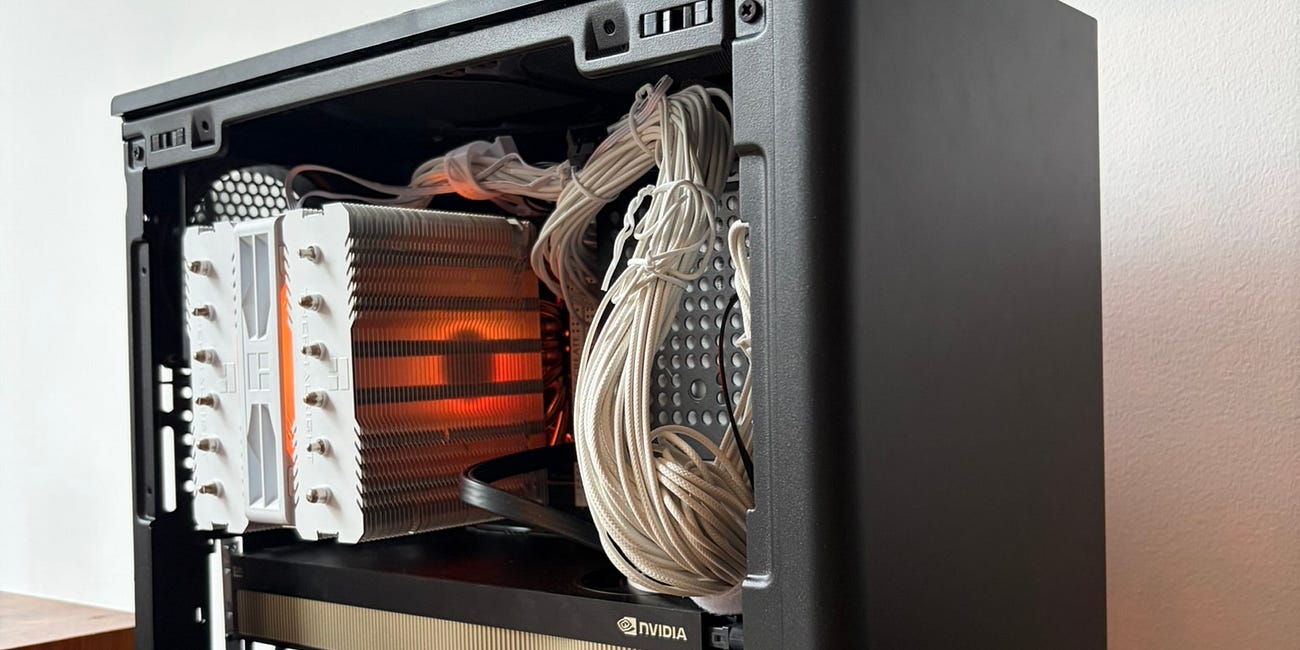
Recent real-world cost comparisons underscore the immense margins embedded within managed cloud compute offerings. Building high-end local AI inference hardware independently often requires an upfront capital investment that can be amortized rapidly when compared against on-demand cloud rental rates. Industry calculations demonstrate that specialized high-performance GPU clusters can achieve full capital payback within remarkably short timeframes, even when excluding ancillary expenses such as real estate, continuous power supply, ongoing financing costs, and specialized on-site facility staffing.
Adding to this economic dynamic is the surprising resilience of older hardware generations. Rather than experiencing steep depreciation schedules, older-generation GPUs have frequently retained their residual value or even seen appreciation in rental markets. Although newer semiconductor architectures offer greater raw compute efficiency, those efficiency gains are frequently counterbalanced by soaring global demand and the rising cost of high-bandwidth memory.
Market observers conceptualize modern hardware infrastructure as a dual-component ecosystem where raw compute capacity may see efficiency-driven price deflation over time, while high-performance memory and specialized interconnects appreciate due to persistent structural scarcity. If this underlying economic thesis holds true, the actual return on investment realized by infrastructure builders may significantly exceed prevailing Wall Street expectations.
Market sentiment surrounding hyperscale credit risk has frequently oscillated based on headline-driven credit spread widening. However, industry analysts note that spot pricing for renting specialized GPU compute remains materially higher than contracted baseline rates. This divergence implies that major cloud providers may actually be underearning relative to spot market demand, while accelerating operating cash flows provide a robust and frequently underestimated internal source of funding for ongoing artificial intelligence development.

Skeptics frequently question whether aggregate end-user demand can sustainably absorb the colossal influx of new compute infrastructure coming online. While modeling out every individual enterprise use-case remains exceptionally complex, market participants point to the willingness of rational, profit-maximizing corporate actors to line up and pay premium prices as the strongest possible indicator of genuine economic utility.
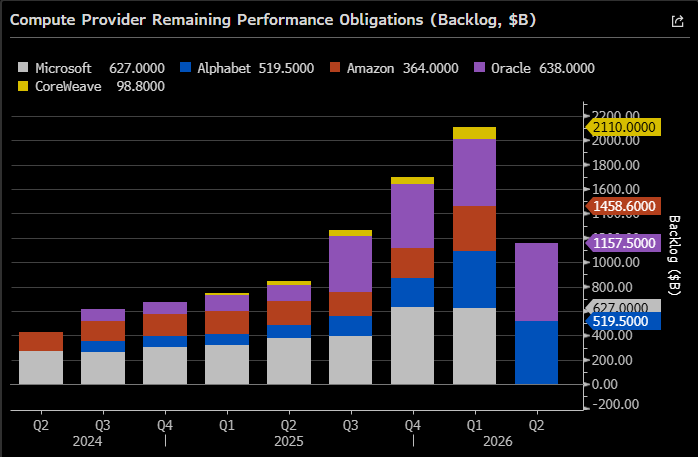
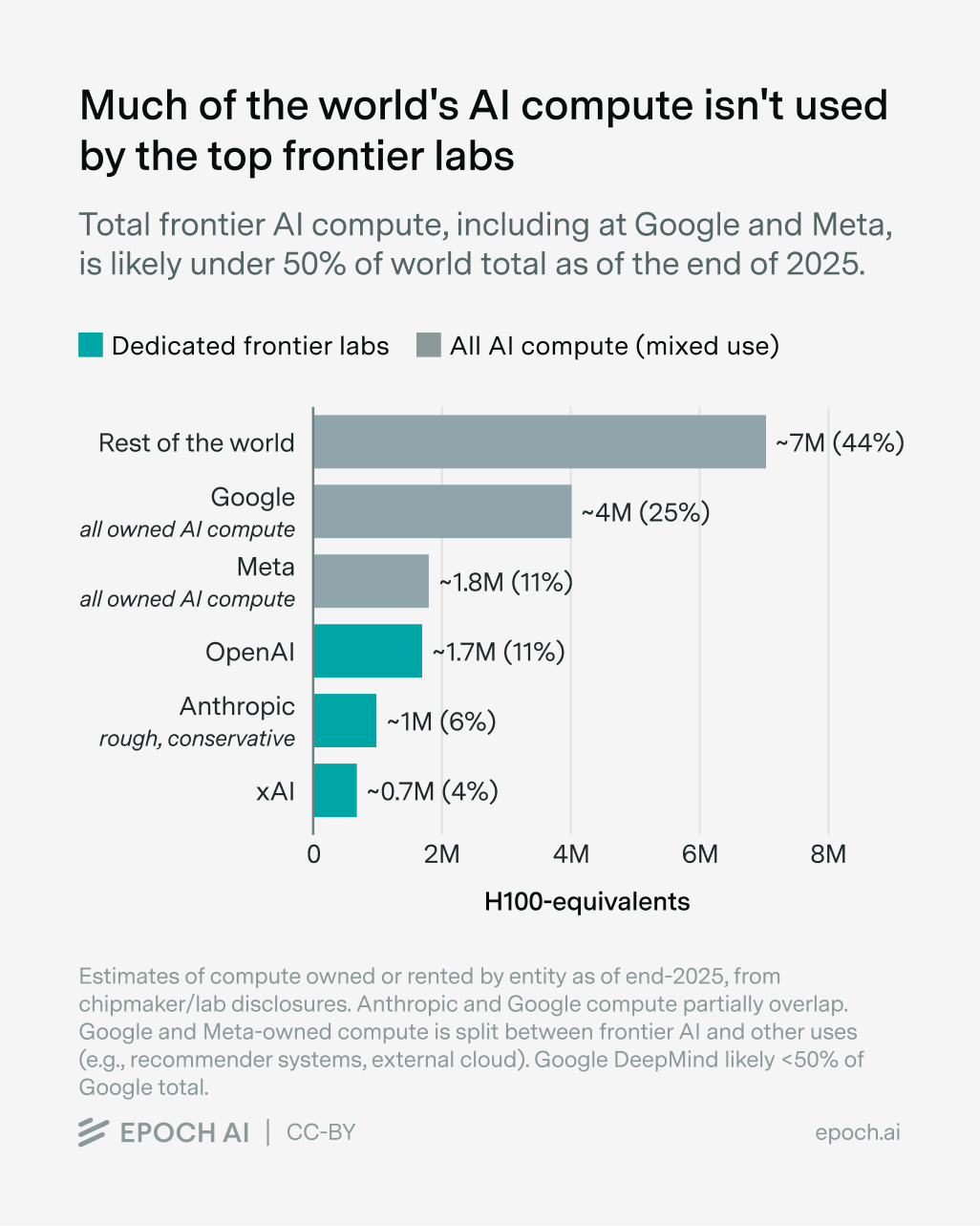
Industry data highlights the staggering expansion of order backlogs across the semiconductor and infrastructure supply chain over recent years. Dismissing this multi-trillion-dollar wave of infrastructure spending as a speculative mirage driven entirely by artificial demand ignores the widespread adoption trends visible across diverse industrial sectors. While frontier AI research laboratories represent a significant portion of total compute demand, they operate alongside a vast and growing ecosystem of enterprise, governmental, and specialized consumer applications.
Skeptics often attempt to reason through historical analogies, comparing the current artificial intelligence buildout to the nineteenth-century railway expansion, the dot-com internet boom, or past telecommunications infrastructure bubbles. While these historical parallels offer a useful macro framework, they frequently overlook a defining technological characteristic of artificial intelligence: recursive demand.
During historical infrastructure buildouts like the internet or the expansion of the rail network, widespread economic diffusion required a sequential human adoption cycle. Technologies required a critical mass of human users, each constrained by finite attention spans and physical limits, to generate sufficient economic utilization. Artificial intelligence operates under entirely different economic parameters. Within the current technological landscape, compute infrastructure possesses the unique capability to spawn its own subsequent demand for compute.

The practical upper limit of compute consumption for an individual developer or an autonomous organization is virtually limitless. When an enterprise discovers a reliable, positive return-on-use-case utilizing advanced AI agents or automated engineering workflows, it can continuously reinvest in additional compute capacity, transforming the infrastructure into a self-funding economic engine.
This dynamic explains the stark divergence in how different market participants experience artificial intelligence. Casual users interacting with AI primarily through basic single-prompt queries may perceive incremental utility. Conversely, developers and technical organizations leveraging agentic engineering and autonomous workflows find advanced models increasingly indispensable for complex operational tasks, leading to steady, compounding increases in their individual compute expenditures.
Beyond inference workloads, the demand trajectory for model training introduces another layer of complexity. The creation of successive generations of state-of-the-art frontier models requires staggering capital commitments, running into hundreds of millions of dollars per training run. These frontier models function as high-value capital assets designed to generate long-term value through inference operations, despite facing relatively steep technological depreciation curves.
As open-source models proliferate and offer increasingly competitive capabilities at lower operational costs, they exert a deflationary pressure on legacy serving models. However, advanced frontier models remain massive in scale, requiring specialized, high-capacity hardware clusters that far exceed the capabilities of consumer-grade local hardware. Even when powerful open-source models are released to the public domain, they still require massive, reliable server infrastructure to handle enterprise-grade workloads at scale. Cloud providers and frontier labs retain significant pricing power for specialized, high-complexity workloads that simpler open-source architectures cannot efficiently resolve.
The artificial intelligence trade occupies a uniquely paradoxical position within global capital markets. It is viewed simultaneously as a revolutionary economic transformation that will redefine global productivity and as an overextended speculative bubble driven by circular financing and unsustainable capital expenditures.
Many traditional market participants struggle to synthesize the intricate technological realities of modern hardware architectures with their direct impact on corporate balance sheets. Simplified news headlines highlighting the release of powerful new open-source models frequently trigger knee-jerk sell-offs in memory and semiconductor equities, often overlooking the reality that advanced models are frequently memory-intensive and drive even greater demand for specialized hardware.
Although semiconductor and AI-related equities have experienced significant appreciation over recent market cycles, many trade at remarkably modest forward earnings multiples, reflecting lingering institutional skepticism that profits and demand will experience a sharp downturn in the coming years.
From a traditional economic perspective, soaring demand should eventually be met by an equivalent expansion in supply, stabilizing market equilibrium. However, because the primary inputs required to produce artificial intelligence—specialized silicon, reliable massive-scale power generation, and suitable land for data center construction—face severe physical constraints while the output of machine intelligence remains unbounded, the traditional equilibrium model breaks down. Society is unlikely to reach a permanent saturation point where it possesses an excess of intelligence or compute capacity.
The broader implications of an economic paradigm defined by near-infinite compute demand point toward a fundamental structural shift in the global economy. Most standard macroeconomic forecasts fail to adequately account for the accelerating integration of robotics and physical automation over the coming decade. Against the backdrop of declining birth rates and aging populations across developed nations, traditional economic growth models reliant on expanding human labor forces face structural headwinds. Without artificial intelligence and advanced robotics, maintaining historical rates of economic expansion and productivity growth becomes increasingly difficult.
Without continued investment in artificial intelligence and compute infrastructure, human economic progress risks secular deceleration. To achieve the next stage of civilizational development, nations must bring unprecedented quantities of compute online. With traditional data center hubs in North America rapidly approaching local electrical grid capacity limits, development is actively spilling over into adjacent regions, pointing toward a future where computing infrastructure expands globally until localized geographic constraints necessitate orbital data centers.
This market spectacle is further amplified by a unique informational asymmetry: the supply side of the semiconductor equation is rigidly quantified through detailed earnings guidance, fab construction timelines, and known semiconductor manufacturing yields. Conversely, the demand side is expanding dynamically in real-time, frequently outpacing conservative Wall Street forecasts. This structural imbalance creates a persistent market condition where investors anchor their valuations to visible, measured supply ceilings while dramatically underestimating the underlying velocity of global demand.
For market participants attempting to navigate the complexities of the modern semiconductor and AI landscape, the foundational analytical inquiry remains unchanged: Is the global demand for compute finite or infinite? The answer an investor assigns to that fundamental question will ultimately dictate their broader positioning across the unfolding technological revolution.




Comments (0)