


As artificial intelligence continues to dominate global markets, a prominent narrative has taken root among skeptics and cautious investors alike: that the industry is rapidly inflating a massive market bubble characterized by a severe overbuild of underlying hardware and infrastructure. According to widespread market commentary, technology companies are dramatically overestimating future demand, pouring billions of dollars into data centers, specialized chips, and power grids that risk sitting underutilized as the initial wave of generative AI enthusiasm cools down.
However, a newly published comprehensive analysis argues that this prevailing viewpoint is fundamentally mistaken, suggesting that the global technology sector is looking at a drastically different reality over the coming decade.
In a newly released, exhaustive essay titled "Silicon Control," author and researcher Kerman Kohli challenges the conventional wisdom surrounding the artificial intelligence hardware boom. Spanning over 8,000 words, the detailed essay tackles the widely held market assumptions regarding infrastructure saturation head-on, presenting a thesis that the technology industry is not facing an imminent oversupply crisis, but rather a protracted, decade-long journey of being fundamentally supply constrained.
Kohli’s analysis arrives at a critical juncture for the technology sector, as public markets and venture capitalists continually reevaluate the staggering capital expenditures being deployed by major hyperscalers, cloud providers, and semiconductor manufacturers. While Wall Street analysts frequently draw parallels to historical infrastructure overbuilds—such as the telecommunications fiber-optic glut of the late 1990s—"Silicon Control" argues that such comparisons misunderstand the unique economic and computational drivers powering the current artificial intelligence revolution.
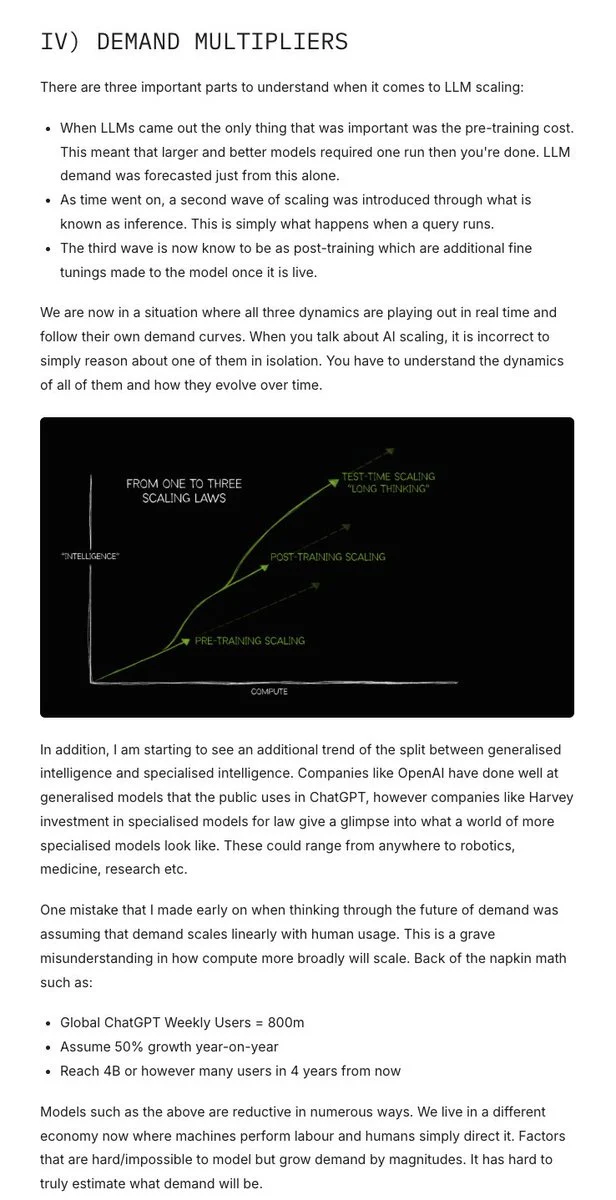
At the core of the essay is a rigorous examination of the structural factors governing modern computing, semiconductor manufacturing, and global demand scaling. Rather than a temporary spike in interest, Kohli outlines a compelling case for what he terms "infinite compute," exploring how and why real-world demand for artificial intelligence processing power is projected to scale continuously from its current baseline over the next ten years. This scaling argument looks beyond simple consumer-facing chatbot applications, delving into enterprise integration, autonomous systems, scientific discovery, and automated reasoning engines that require unprecedented levels of computational horsepower.
A significant portion of the lengthy analysis is dedicated to dismantling common misconceptions held by investors regarding the global semiconductor supply chain. For years, market observers have monitored fab capacity expansions, lithography machine shipments, and foundry yields as indicators that hardware bottlenecks might soon ease. However, Kohli suggests that the intricacies of advanced packaging, leading-edge silicon fabrication, specialized memory architectures, and the complex interdependencies of the global semiconductor ecosystem create insurmountable barriers that prevent rapid, frictionless supply adjustments.
Instead of a fragmented market where numerous players catch up to demand, the future trajectory outlined in the essay points toward intense industry concentration. According to Kohli’s projections, the long-term structural outcome of the artificial intelligence hardware race will result in a powerful silicon monopoly consisting of fewer than twenty dominant companies worldwide. This tight consolidation at the apex of the hardware stack reflects the staggering capital requirements, intellectual property moats, and engineering complexity required to design and manufacture the chips that power modern artificial intelligence workloads.
The implications of this supply-constrained future, as explored in the essay, extend far beyond semiconductor fabrication plants and stock market valuations. They touch upon geopolitical stability, energy consumption, cloud pricing, and the ability of smaller nations and enterprises to access the foundational building blocks of the next technological era. By reframing the conversation from one of excess capacity to one of persistent scarcity, "Silicon Control" offers a provocative counterweight to the prevailing market consensus, forcing a re-examination of how the digital economy will sustain its growth over the next ten years.




Comments (0)