


For many solo Software-as-a-Service (SaaS) founders, the narrative follows a depressingly familiar script. Growth hums along steadily for the first year or so. Then, almost imperceptibly, the momentum begins to decelerate. Within another few months, the growth line flatlines entirely. This happens even though the inflow of new signups has not dropped off, and marketing efforts remain just as robust as they were on day one. Faced with a stagnant business, the typical founder arrives at a panicked conclusion: the current marketing channel has stopped working, acquisition is broken, and it is time to abandon ship in search of a brand-new acquisition strategy.
Yet, a closer examination of the underlying metrics often reveals a completely different reality. In a vast number of these cases, marketing is working just as effectively as it ever did. The business has simply run up against a hard economic ceiling dictated entirely by its churn rate. No new marketing channel or acquisition tactic will alter where that ceiling sits unless it fundamentally changes one of two core numbers driving the business model.
The Formula
To understand why businesses mysteriously plateau even while acquiring customers at a healthy clip, one must look at the mechanical forces acting upon Monthly Recurring Revenue (MRR) every single thirty-day cycle. Each month, two opposing forces dictate the financial health of the enterprise. New customers add a fixed influx of revenue, a variable we can call N. Simultaneously, existing customers cancel their subscriptions, removing a proportional share of current MRR equal to the monthly churn rate, designated as c.
Expressed mathematically, next month’s MRR equals this month’s MRR plus new additions, minus the product of the churn rate and this month’s MRR. In the early stages of a startup’s lifecycle, N heavily outweighs the losses incurred by churn, causing overall MRR to climb aggressively. However, as the business grows, the absolute dollar amount lost to churn scales upward alongside MRR, while new customer acquisition N tends to hover relatively flat. Eventually, these two forces converge. The exact moment the revenue lost each month equals the revenue added by new signups, MRR ceases to grow entirely.
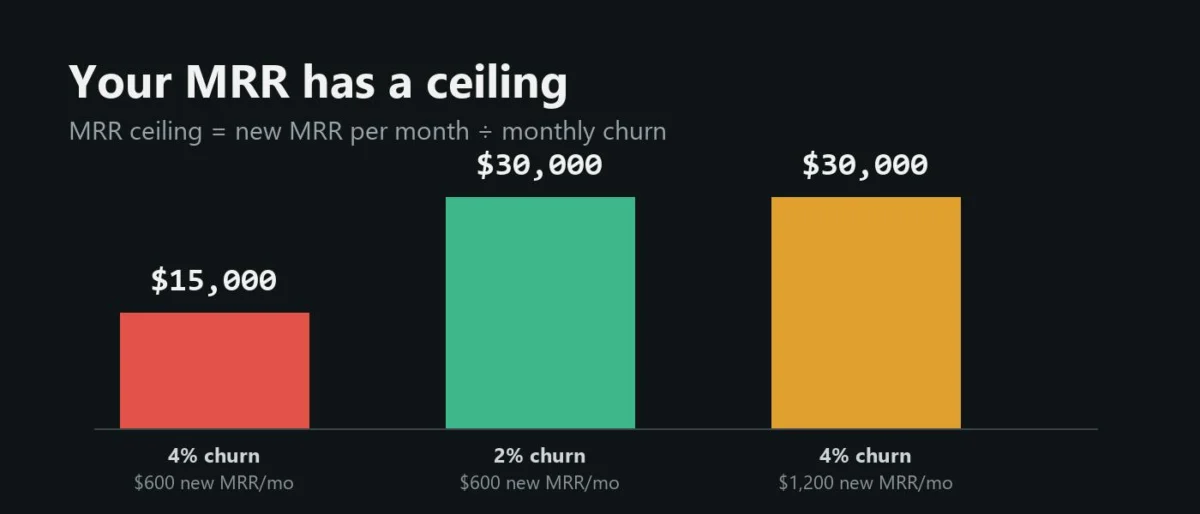
When new additions equal churned revenue, the system hits equilibrium. Mathematically, the MRR ceiling is calculated by taking the new MRR added each month and dividing it by the monthly churn rate. This ceiling represents the absolute maximum revenue threshold possible under current operating conditions.
A Worked Example
Consider a realistic scenario for an early-stage independent software developer. Imagine a business that successfully adds $600 of new MRR every month while suffering a monthly customer churn rate of 4 percent. Applying the formula, the ceiling is calculated by dividing $600 by 0.04, yielding an absolute limit of $15,000 in monthly recurring revenue.
With those specific parameters, the business will never surpass $15,000 in MRR, regardless of how many years pass or how stubbornly the founder waits for a market breakthrough. Tracing the trajectory from zero reveals a striking pattern. At month six, the business reaches $3,259 in MRR, representing about 22 percent of the ultimate ceiling. By month twelve, revenue climbs to $5,809, or 39 percent of capacity. At month twenty-four, the business hits $9,369, reaching 62 percent of the ceiling, before slowing down further to $11,550 at month thirty-six, and finally crawling to $13,705 by month sixty.
Two critical insights emerge from this trajectory. First, the growth curve looks remarkably healthy and encouraging during the initial twelve months, creating a false sense of infinite scalability, only to slow down predictably every subsequent month without any operational changes occurring within the business. Second, a monthly churn rate of 4 percent means the business loses roughly 39 percent of its entire customer base every single year, explaining why the growth curve bends so early and aggressively.
Why the Plateau Fools People
The deceleration of growth happens so gradually that it masquerades as a broader market trend or economic shift rather than a mathematical inevitability embedded directly in the company’s baseline metrics. Month after month, the net gain in revenue shrinks because the net monthly gain is simply the difference between new additions and churned revenue.
At a modest milestone of $5,000 MRR, a business adding $600 and losing 4 percent experiences a net gain of $400. Later, at $10,000 MRR, the same $600 in new signups is offset by $400 in churn, leaving a net gain of just $200. By the time the business reaches $14,000 MRR, the net monthly gain shrinks to a meager $40. The signups remain identical, the marketing campaign operates with the same efficiency, but the net growth dwindles toward zero.
Before a founder panics and burns weeks of valuable time overhauling marketing channels or rewriting acquisition funnels, running this fundamental mathematical check is essential. If the current MRR sits uncomfortably close to the calculated ceiling, maintaining the exact same marketing output will do little to push the needle further. The business is not stalling out due to external failure; it is simply arriving at its structural destination.
Two Ways to Raise the Ceiling
Because the governing formula relies on only two inputs, founders have access to just two distinct levers to elevate their growth ceiling.
The first lever is raising N. If a founder manages to double new monthly recurring revenue to $1,200 through intensified marketing or expanded sales efforts, the ceiling responds by doubling to $30,000. This can be achieved either by acquiring a higher volume of customers or by securing the same volume of customers at a higher price point. Crucially, a price increase functions powerfully here; provided that churn remains stable, raising prices elevates new MRR additions, pulling the entire ceiling upward along with it.
The second lever is lowering the churn rate parameter, c. If a founder successfully cuts monthly churn in half down to 2 percent, the ceiling also doubles to $30,000. However, these two levers are far from equivalent in practice, primarily because lowering churn drastically alters the velocity at which the business approaches its financial destination.
At a 4 percent churn rate, a business reaches half of its potential ceiling in approximately seventeen months. In contrast, at a 2 percent churn rate, hitting that same halfway mark takes roughly thirty-four months. This occurs because the ultimate ceiling is twice as high while the intake rate of new revenue remains constant. Reducing churn proves to be the more lucrative long-term prize, but it is undeniably a slower mechanical grind. During the first year, the financial trajectory of a business with low churn often looks almost identical to one with higher churn, masking the massive structural advantage building underneath.
Which Lever a Solo Founder Should Pull
For a solo entrepreneur operating with limited capital and constrained hours, these two growth levers incur vastly different operational costs.
Raising N through aggressive customer acquisition usually demands a continuous expenditure of time, money, or both, month after month, in perpetuity. The moment marketing efforts pause or ad spend dries up, new additions drop immediately, dragging the revenue ceiling down with them.
Conversely, reducing churn tends to function as a structural, one-off fix that continues yielding returns indefinitely. Examples include overhauling the user onboarding flow so that new accounts reach their "aha" moment much faster, introducing annual billing discounts, implementing a smart cancellation flow that offers a temporary pause instead of an immediate exit, or simply squashing a persistent software bug that alienates the most engaged power users. Each of these improvements operates quietly in the background long after the founder has moved on to other priorities.
Raising prices remains uniquely advantageous because it lifts new MRR additions without requiring any concurrent increase in acquisition effort, making it frequently the most cost-effective adjustment available to an indie developer.
Adopting the habit of placing the calculated revenue ceiling directly on the company dashboard alongside current MRR provides immediate clarity. When the two figures remain widely separated, pursuing growth is simply a matter of exercising patience over time. When the metrics converge, it signals the exact moment to intervene by adjusting acquisition volume or tackling retention, using the formula to evaluate the precise value of any proposed change before committing weeks of labor to it.





Comments (0)