


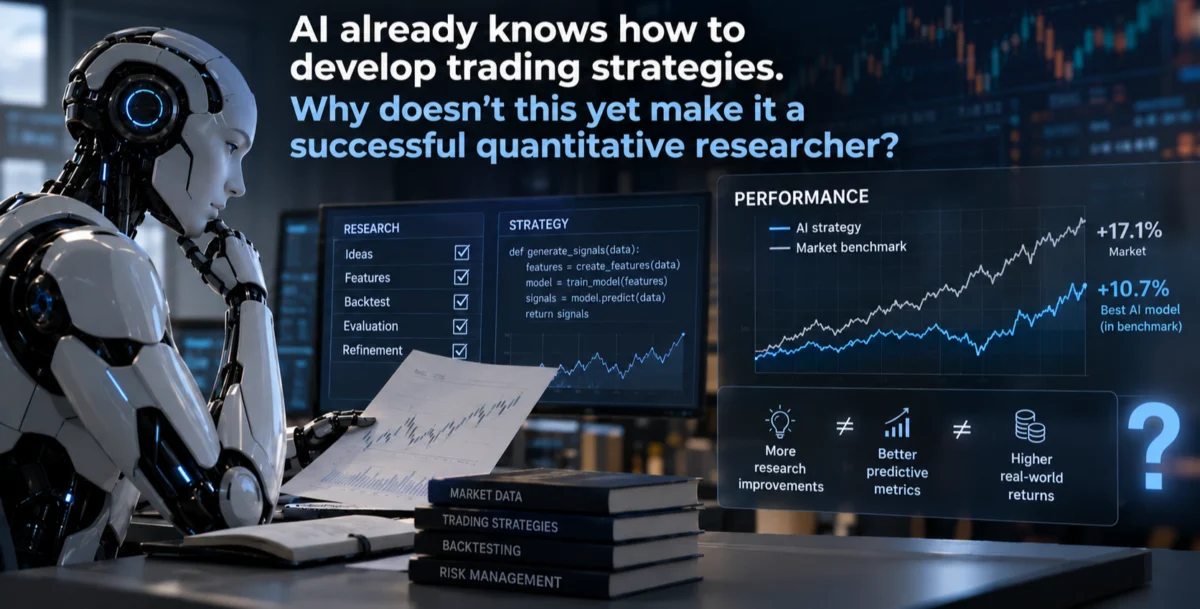
Artificial intelligence is rapidly shifting its footprint within the financial sector, moving far beyond basic data analysis and conversational customer support into the complex realm of autonomous quantitative research. Modern large language models can now formulate intricate hypotheses, generate sophisticated market features, write operational trading code, execute rigorous backtests, and independently revise strategies based on iterative feedback. Yet, as these capabilities expand, a critical and costly question continues to face asset managers, technologists, and quantitative researchers alike: does becoming better at quantitative research actually make an artificial intelligence better at discovering genuinely profitable trading strategies?
A comprehensive study published on October 21, 2026, sheds fresh light on this pressing dilemma. Titled Quant-Arena: Benchmarking LLM Agents for Quantitative Trading Research and authored by Houde Qian alongside a team of researchers, the study evaluates nine different language models across 38 distinct configurations to see how artificial intelligence handles the full lifecycle of quantitative exploration. Its central, sobering finding is that incremental improvements in a model’s research capability do not consistently translate into stronger, more reliable financial performance out of sample.
From Writing Code to Conducting Research
Traditional financial benchmarks for artificial intelligence have historically focused on isolated, transactional capabilities. They might test a model’s aptitude for predicting short-term asset prices, calculating standard technical indicators, or generating syntactically correct code snippets. While these benchmarks measure computational fluency, they fail to capture the holistic nature of professional quantitative research, which requires a continuous cycle of hypothesis generation, testing, refinement, and risk management.
Quant-Arena was designed to examine a much more complete and rigorous research process. Within this benchmark framework, models are tasked with formulating trading hypotheses, constructing complex features, generating executable strategies, analyzing diagnostic feedback, and ultimately selecting the most promising candidates for final evaluation. The benchmark grounds its experiments in real-world complexity by utilizing historical data drawn from 3,042 Chinese A-share stocks, incorporating both daily market observations and detailed Level-2 trading records that capture the granular mechanics of order books.
The evaluation process itself unfolds across three distinct stages to prevent leakage and ensure fairness. In the research stage, models develop their strategies using historical data spanning from 2022 to 2023, receiving limited and controlled feedback on up to five candidate strategies. In the commitment stage, each model must select one final, definitive strategy, after which its implementation is completely frozen. Finally, in the evaluation stage, the chosen strategy is tested against a strictly withheld 2024 out-of-sample period. This final test runs within a simulated cash-account environment that accounts for realistic trading constraints, explicit transaction costs, and estimated market impact.
By separating strategy development from final evaluation, the benchmark measures something far more meaningful than simple code generation: it tests whether an autonomous research process can successfully produce strategies that generalize effectively beyond the specific data sample used to create them.
The Results: Better Research, Disappointing Returns
To contextualize the performance of these artificial intelligence agents, consider the broader market environment during the evaluation period. Throughout 2024, the equal-weighted market benchmark returned approximately 17.1 percent. When looking across the 38 model configurations evaluated in the study, however, only 13 managed to generate positive absolute returns at all.
Among the successful configurations, performance varied significantly. One specific configuration, running GPT-6 Sol at a medium reasoning effort, achieved a return of approximately 18.4 percent, narrowly edging out the broader market. Meanwhile, the configuration that earned the highest overall research score according to the benchmark’s systematic methodology—GPT-6 Astra—returned approximately 10.7 percent, substantially underperforming the baseline market return.
This divergence between research scores and financial outcomes is a vital distinction. GPT-6 Astra performed best by the metric’s internal scoring standards yet lagged behind a passive equal-weighted market index, while a lower-ranked configuration managed to slightly exceed the market. As the researchers emphasize, no single model consistently outperformed the market when evaluating each system’s highest-scoring configuration, barring the isolated exception noted above. This disconnect underscores the reality that research quality and investment performance are fundamentally distinct measurements. Furthermore, the market comparison carries an important caveat: the evaluated portfolios factor in the friction of trading costs, whereas the baseline equal-weighted benchmark is reported on a pre-cost basis.
Why Iteration Doesn’t Guarantee Better Strategies
To understand how models arrive at their final portfolios, Quant-Arena contrasts two distinct research methodologies. In one-shot generation, models produce a strategy immediately without the benefit of iterative feedback. In iterative research, by contrast, the systems are permitted to examine their historical backtest results, identify underlying weaknesses, and actively improve their implementations over multiple cycles of revision.
Allowing models to iterate successfully improved their average research scores, lifting them from 36.47 to 43.55. However, the resulting financial outcomes were remarkably mixed. Actual portfolio returns improved for only four of the nine tested models, while the remaining five models performed demonstrably worse after revision. Across the board, the average improvement in annualized returns was a modest 2.9 percentage points.
Furthermore, the researchers observed sharply diminishing marginal returns from additional revisions. Much of the early progress achieved during the iterative phase stemmed from simply correcting basic, unsuccessful initial strategies—such as fixing logical bugs or syntax errors. Subsequent changes delivered progressively smaller and less consistent improvements in strategy viability.
This dynamic introduces a fundamental evaluation problem for financial technologists. A model may significantly improve its ability to utilize research tools, correct implementation errors, or optimize historical metrics without ever discovering a persistent, economically meaningful market relationship. Repeated optimization can easily backfire, increasing a strategy’s sensitivity to sample-specific patterns rather than uncovering robust predictive alpha. While the benchmark does not prove that every unsuccessful iteration was the direct result of overfitting, it clearly demonstrates why internal improvement during the research phase can never be treated as definitive proof of improved out-of-sample performance.
The Ranking Paradox: Predictive Skill Without Portfolio Value
Another revealing insight from the study concerns RankIC, a standard statistical metric used to measure the monotonic relationship between an agent’s predicted asset rankings and subsequent asset returns. A positive RankIC generally suggests that a model possesses some degree of predictive skill in ordering the broader market.
However, a portfolio does not automatically invest in every ranked stock with equal weight. Quant-Arena‘s portfolio construction evaluator specifically targets a concentrated basket of 75 stocks, placing the heaviest emphasis on those equities that receive the highest predictive scores from the model. Intriguingly, for several of the evaluated models, stocks residing in the second or third highest score deciles subsequently outperformed the equities placed in the absolute highest decile.
This paradox reveals that while models could rank the broader market reasonably well in aggregate, their selections degraded precisely where their predictions directly affected portfolio construction and capital allocation. Across all 38 configurations, the Spearman correlation between a model’s average RankIC and its ultimate trading returns was approximately 0.09—an exceptionally weak relationship within the context of the experiment.
The broader lesson extends far beyond this specific academic benchmark. A useful statistical predictive signal does not automatically translate into a useful or profitable trading strategy. Economic outcomes in the real world depend heavily on portfolio construction rules, factor exposures, portfolio turnover, prevailing market conditions, and execution costs. Consequently, statistical prediction quality and financial utility must be evaluated as entirely separate dimensions of performance.
What Did the LLM Already Know?
To maintain experimental integrity, Quant-Arena strictly withheld 2024 market data from the research interface, serving as an important safeguard against direct look-ahead bias during the strategy development phase. Nevertheless, the historical evaluation of modern, massive language models introduces an entirely different category of methodological challenge: data contamination.
Some advanced models may have been trained on vast web corpora that inadvertently included information published after the evaluation period closed. Even if the research interface physically prevents an agent from accessing future price series, the model’s pretraining data might still contain market narratives, corporate events, earnings surprises, or macroeconomic commentary regarding subsequent outcomes. This does not establish that Quant-Arena suffered directly from such contamination; rather, it highlights the reality that interface restrictions alone cannot definitively prove its absence.
A separate study addressing this exact vulnerability, titled From Knowing to Doing: A Memory-Controlled Benchmark for LLM Trading Agents on Stock Markets, tackles the problem through rigorous information control. The researchers behind that project introduced a benchmark that masks identifying information and calendar details to deliberately reduce a model’s reliance on memorized historical events. They also separated portfolio returns into discrete market, investment-style, and stock-selection components.
Their findings suggest that apparent financial success in AI trading experiments often reflects broad market exposure or style tilts rather than genuine, persistent stock-selection ability. Together, these complementary studies highlight two absolute requirements for trustworthy AI research: information control to ensure no future knowledge leaked into the decision process, and strict performance attribution to verify whether a strategy demonstrates independent investment skill or simply hitched a ride on favorable market conditions. A positive backtest, on its own, answers neither question.
Executable Code Is Not Necessarily Correct Research
Another significant hurdle in evaluating financial AI is the underlying reliability of generated code. A software program may execute successfully without throwing errors while simultaneously implementing a completely invalid financial hypothesis or flawed quantitative logic.
For instance, an AI-generated script might inadvertently incorporate future information into past calculations, mishandle time-series alignment, or compute technical indicators with subtle mathematical errors. These coding artifacts can easily generate highly plausible historical backtest results without producing a valid scientific experiment.
A 2026 ACL paper titled ALPHAQT-BENCH: Diagnosing the Gap between Financial Code Generation and Quantitative Reasoning in LLMs explores this exact distinction. Its evaluation framework tests four distinct properties: executability, causal correctness, functional accuracy, and structural compliance. Across 12 language models, the researchers uncovered a substantial gap between a model’s ability to produce runnable code and its capacity to satisfy rigorous quantitative correctness requirements.
This research complements Quant-Arena perfectly. While one benchmark evaluates whether an artificial intelligence can successfully conduct an end-to-end quantitative research workflow, the other examines whether the financial code produced along the way is methodologically sound. Taken together, they suggest that successful autonomous research requires far more than simply generating runnable code and reporting positive historical returns.
What Should We Actually Measure?
These combined findings point the quantitative finance community toward three distinct evaluation questions that must be answered independently.
First, researchers must determine whether the artificial intelligence can successfully formulate and implement a coherent trading hypothesis, which measures pure research capability. Second, they must verify whether that research methodology is methodologically valid, requiring correct calculations, strict causal information boundaries, and independent evaluation frameworks. Third, they must ascertain whether the resulting strategy demonstrates sustainable economic value beyond its initial development sample, which demands robust financial evidence accounting for market exposure, transaction costs, and realistic execution constraints.
A positive answer to one of these questions does not guarantee positive answers for the others.
What Quant-Arena Does—and Does Not—Prove
Quant-Arena conclusively demonstrates that modern language models are fully capable of executing substantial portions of the quantitative research workflow. They can generate innovative features, write complex trading strategies, interpret diagnostic feedback, and iteratively revise their implementations.
However, the benchmark does not establish that autonomous large language model researchers can consistently and reliably discover profitable trading strategies out of sample. Several inherent limitations must be kept in mind: the experiments focus specifically on Chinese equities rather than cryptocurrencies, foreign exchange, or derivatives; the financial evaluations rely entirely on historical simulation rather than live, real-money execution; the withheld evaluation period spans only a single calendar year; and potential contamination via pretraining data remains a persistent methodological concern.
These limitations prevent broad, sweeping generalizations about artificial intelligence trading performance across global financial markets. Nevertheless, the study reveals a crucial distinction that the industry cannot afford to ignore. The ability to automate the mechanics of quantitative research is fundamentally distinct from the ability to discover enduring investment advantages. As artificial intelligence systems become increasingly proficient at generating hypotheses and running rapid experiments, independent validation becomes significantly more important rather than less. The next meaningful advance in quantitative finance may ultimately have less to do with producing ever-larger volumes of automated strategies and much more to do with rigorously determining which research results actually deserve trust.




Comments (0)