



The cryptocurrency market experienced a distinctly mixed week of trading as the industry transitioned past the holiday season. While flagship cryptocurrency bitcoin managed to close the period higher, the broader digital asset ecosystem continued to exhibit sharp divergence across various sectors and thematic narratives. DePIN (Decentralized Physical Infrastructure Networks) and Gaming led a surprising and robust rebound following a deeply challenging year, whereas Layer 2 scaling networks, real-world assets, and corporate treasury trades continued to grind lower amid choppy capital flows and compressed asset valuations.
As market participants look forward to positioning themselves for the new year, institutional analysts and research desks have released a series of comprehensive end-of-year retrospectives. These reports examine critical sector developments, including the evolution of stablecoin yield-generation mechanisms, the shifting infrastructure moats within crypto-enabled payments, the maturation of cross-chain interoperability, and the frantic pace of narrative cycles that defined the previous year’s market dynamics.

Indices and Sector Performance
With traditional equity markets operating on a shortened trading schedule due to the holiday calendar, the primary focus of the financial community shifted toward crypto asset performance over the trailing seven-day period. Bitcoin finished the week up 1.6%, maintaining a resilient footing above key psychological levels, though underlying performance across alternative cryptocurrencies remained highly fragmented and selective.
The most notable movement across the market came from sectors that faced severe headwinds throughout the preceding year. DePIN and Gaming emerged as the week’s top-performing sectors, logging impressive aggregate gains of 13.1% and 12.6%, respectively. Both sectors suffered catastrophic drawdowns over the course of the previous twelve months, down approximately 79.5% and 81.3% on an annual basis, making their sudden, sharp rebound an intriguing development for market observers trying to gauge shifting risk appetites.
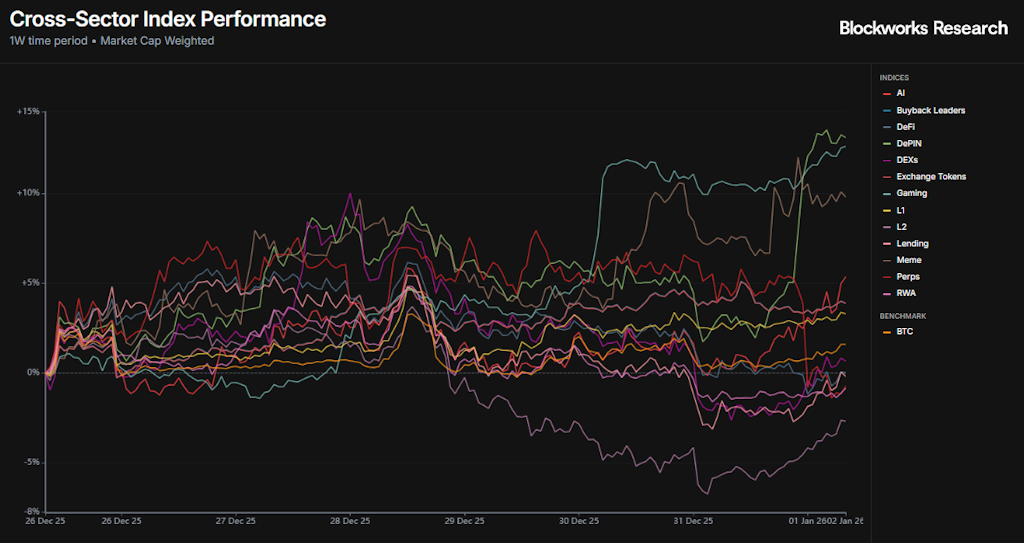
The recovery in the DePIN sector was heavily spearheaded by Filecoin (FIL) and Render (RENDER), which advanced 22% and 13% respectively over the week. Together, these two prominent assets account for nearly half of the total sector index weight at 49%. The Gaming sector followed a remarkably similar architectural pattern, with Immutable (IMX) leading the charge by climbing 11% and doing the majority of the heavy lifting required to pull the broader gaming index upward.
Conversely, Layer 2 scaling solutions and real-world asset (RWA) tokens lagged behind the broader market, slipping 2.67% and 0.84% over the course of the week. Weakness within the Layer 2 cohort was primarily driven by tokens such as MNT and ZORA, which registered declines of 5.7% and 6.4%. At the same time, however, other prominent Layer 2 networks—including Optimism, Arbitrum, and ZK-focused tokens—posted healthy gains ranging between 10% and 20%. This stark internal variance highlights the intense degree of sector divergence currently characterizing the altcoin landscape.
Meanwhile, the real-world asset sector faced downward pressure stemming from a broader market pullback in physical gold following its extraordinary multi-month rally earlier in the year. Tokenized gold products such as PAXG and XAUT both retreated by approximately 3.4% on the week.
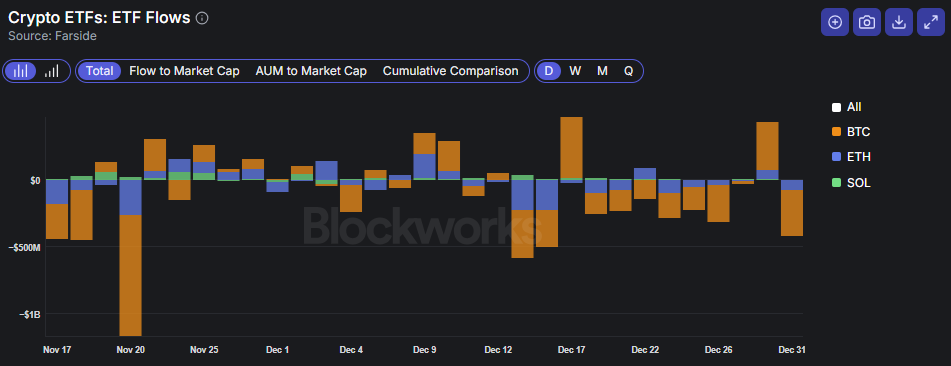
Capital flows into and out of digital asset investment products remained choppy and indecisive. On the final day of December, spot exchange-traded funds experienced substantial outflows totaling $417.8 million, which nearly completely wiped out the $428.2 million of net inflows recorded during the previous trading session.
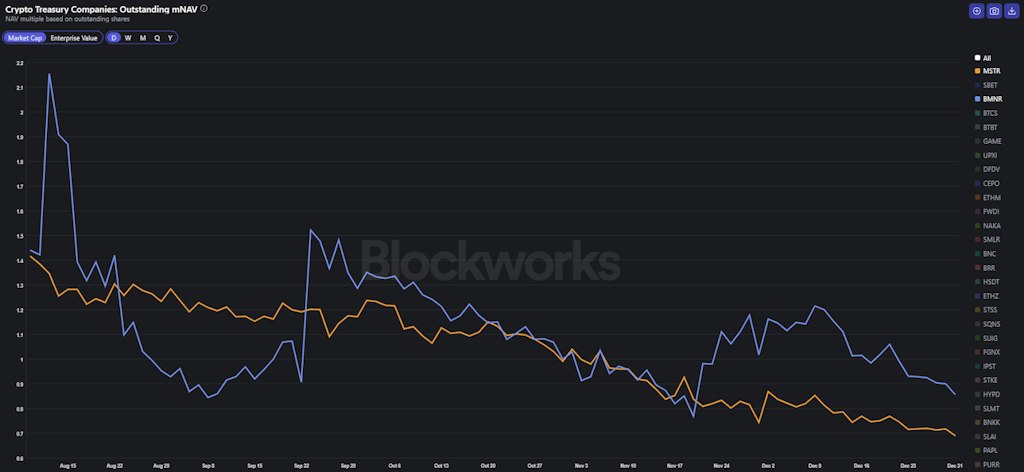
Corporate digital asset treasuries also continued to feel mounting structural strain. Modified net asset value (mNAV) multiples compressed further across major corporate holders. Corporate balance sheet pioneers like MicroStrategy and Bitcoin Miner reserves trade at compressed mNAV levels of 0.69 and 0.85 respectively, underscoring the ongoing capital pressure facing the corporate treasury trade as participants navigate the opening weeks of the new year.
Recommended End-of-Year Analyses and Market Insights
To contextualize these market movements and provide deeper foresight into structural shifts within the digital asset economy, several prominent research organizations have published extensive year-in-review analyses covering crucial technological and financial primitives.
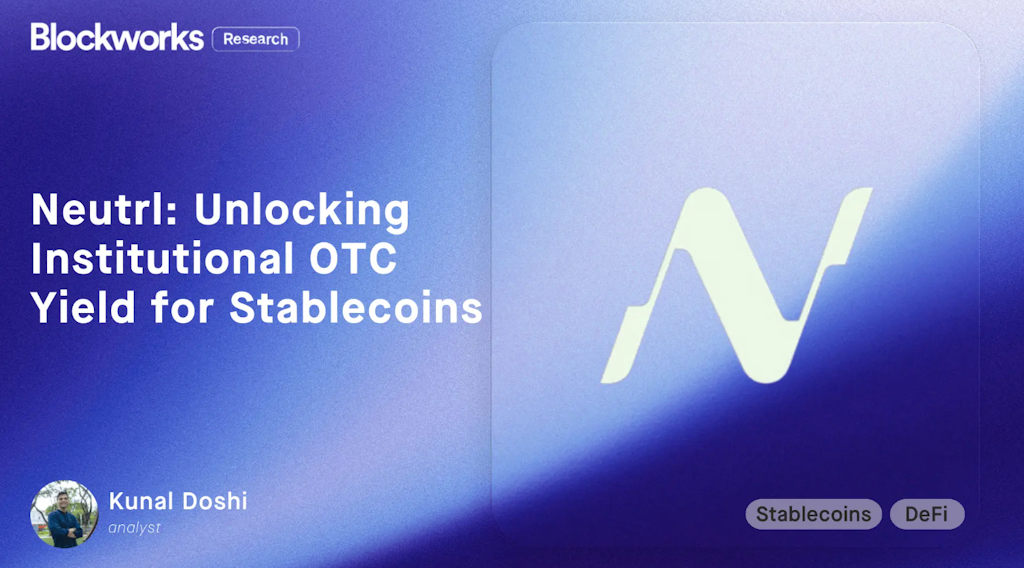
Among the standout research pieces, Blockworks Research released a detailed evaluation of Neutrl, an emerging protocol designed to bring institutional-grade over-the-counter (OTC) arbitrage strategies into a user-friendly stablecoin wrapper. The research indicates that the protocol offers market-neutral yields that are structurally less reliant on perpetual futures funding rate cycles than traditional synthetic dollar models. Early market traction, characterized by double-digit sNUSD yields, suggests robust institutional and retail demand, which is further bolstered by deep token unlock pipelines and privileged OTC execution access via STIX. The core upside for the protocol relies on its ability to scale deployment into hedged OTC transactions, while primary risks center on operational execution, counterparty performance, and ongoing liquidity management. Industry analysts suggest that if these yields can be maintained as total value locked continues to scale, Neutrl could potentially mirror the early trajectory of Ethena within a more structurally defensive framework.
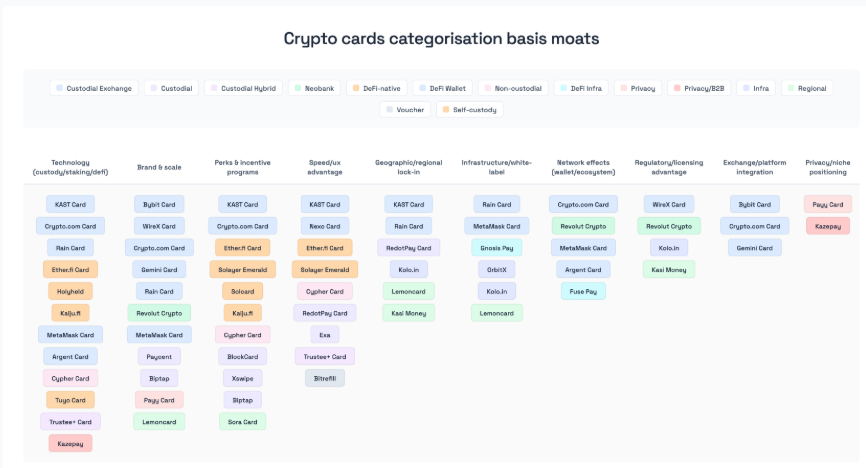
In the realm of consumer-facing financial technology, a comprehensive study published by Polaris Fund examines the changing competitive landscape of crypto-enabled payment cards and neobanks. The research asserts that the crypto card industry has reached a crucial inflection point where sustainable competitive advantages are decisively shifting away from superficial user rewards, cashback programs, and brand marketing toward robust infrastructure, regulatory compliance, and direct liquidity control. The analysis demonstrates that durable market moats are forged by owning foundational primitives—such as regulated access points, programmable liquidity management, and deep banking integrations—rather than temporary consumer incentives. Infrastructure rail providers and decentralized finance-native card designs are capturing the greatest leverage through recurring fee structures and aligned tokenomics, whereas centralized finance distributors face continuous margin compression. As regulatory frameworks tighten globally, long-term industry scale will increasingly favor entities that maintain direct control over licensing, localized settlement, and rigorous compliance workflows.
Interoperability also took center stage in retrospective analyses, with LayerZero publishing a comprehensive statistical review highlighting how cross-chain technology transitioned from theoretical architecture into foundational infrastructure for the entire crypto economy throughout the past year. Data compiled within the report illustrates that tokenized assets and stablecoins are now routinely distributed across a multitude of disparate blockchain networks. This seamless interoperability has significantly accelerated overall asset velocity, enhanced capital mobility, and expanded global financial access. Rather than individual blockchains competing in isolated silos, the digital asset ecosystem now increasingly functions as a unified, interconnected network where liquidity and value travel freely to wherever market demand dictates. The widespread adoption of message-based transfer systems and open architectural primitives has successfully reduced transaction costs and frictional barriers, making cross-chain activity feel increasingly akin to traditional software applications rather than rigid financial infrastructure. Interoperability is no longer viewed as a technical bottleneck, but rather as the default horizontal layer enabling global scale.
Concluding the retrospective slate, Tiger Research released an overarching market recap arguing that the previous year was defined by hyper-accelerated narrative cycles that generated speculative attention far faster than the market could validate underlying fundamentals. This phenomenon led to widespread user fatigue and lingering market skepticism. While the vast majority of short-term narratives faded rapidly into obscurity, a distinct subset successfully translated into genuine, functional use cases that meaningfully propelled the broader market forward—particularly in sectors where retail onboarding was remarkably simple and intuitive. Memecoins demonstrated the sheer velocity with which digital platforms can capture user attention, but they simultaneously exposed the immense fragility of user engagement in the absence of genuine utility retention. Meanwhile, experimental verticals such as information finance highlighted the potential of incentive-driven growth models while laying bare persistent quality and trust challenges. The clearest markers of structural progress emerged in areas where the crypto industry definitively proved authentic product-market fit, most notably within stablecoins, decentralized prediction markets, and high-speed payment rails. These developments reinforce the foundational reality that enduring value within digital assets is only successfully generated when fleeting speculative narratives ultimately align with tangible, long-term real-world utility.





Comments (0)