



AI-related stocks managed a tentative comeback on Friday, offering a brief respite to investors following a severe market rout that swept rapidly from Wall Street across Asian exchanges. Despite the modest recovery, a single green trading session does little to resolve the overarching question troubling financial markets as the weekend approaches: Is this recent turmoil merely an overdue correction in an otherwise healthy technology cycle, or are we witnessing the early stages of a speculative artificial intelligence bubble bursting?
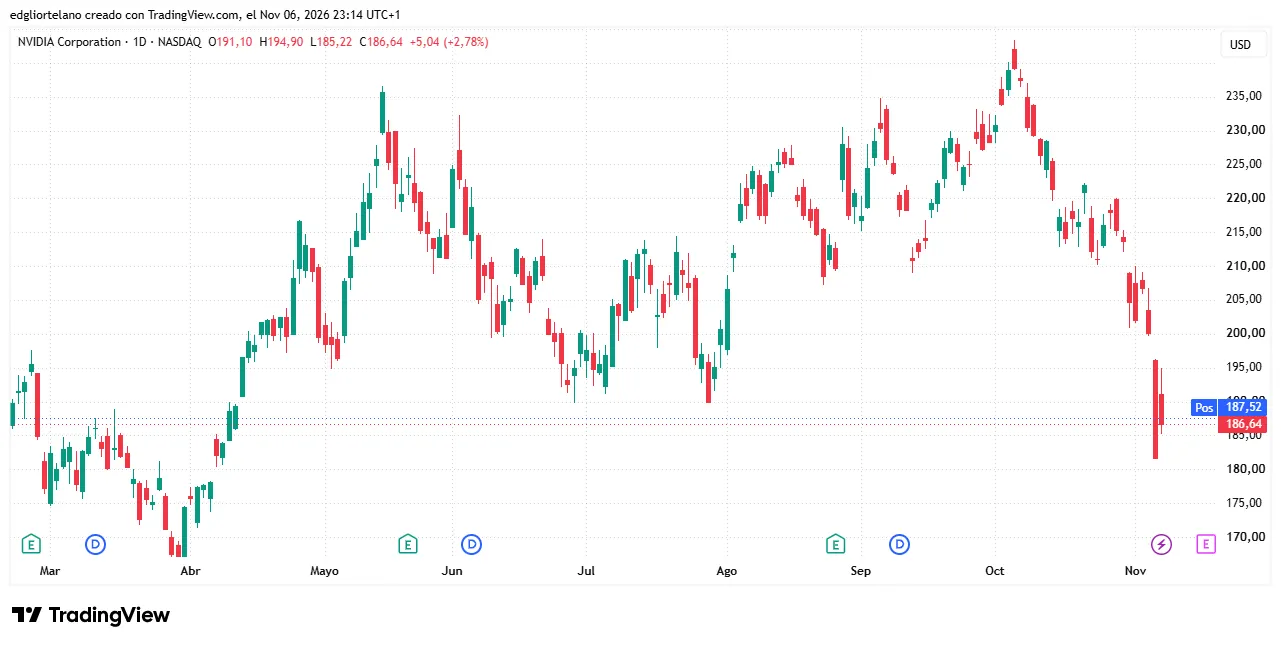
The rebound brought marginal relief to some of the industry’s most heavily traded names. Nvidia shares rose 2.78% to close at $186.64, attempting to claw back ground after plunging an alarming 9.3% just a day earlier on Thursday. Advanced Micro Devices (AMD) similarly bounced back to $449.04, following a dramatic 17.3% collapse in the previous session. Despite these upward movements, both tech giants remain significantly below their respective peak valuations reached in October, underscoring how little a single sharp relief rally can do to repair the broader technical damage inflicted on tech portfolios.
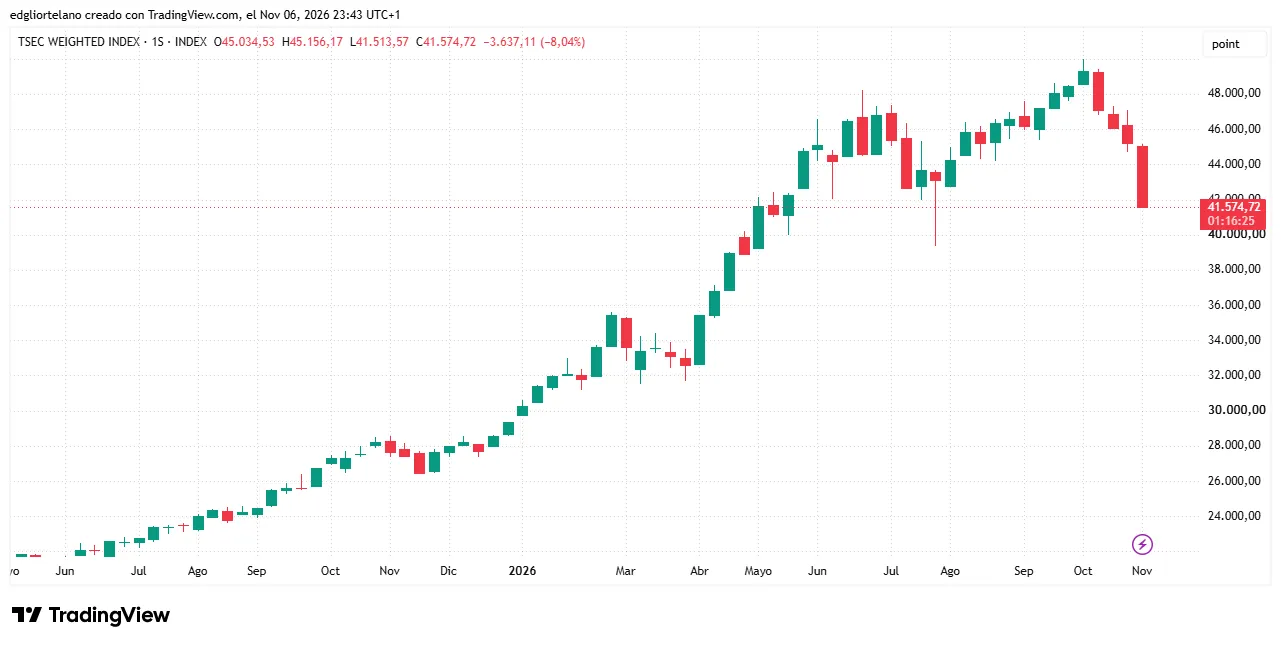
The market selloff was far from confined to the United States. International exchanges felt the shockwaves acutely, driven by heavy exposure to the semiconductor supply chain. South Korea’s benchmark KOSPI index suffered a steep 6% loss on Friday, while Taiwan’s major market index dropped more than 8% over the course of the week, marking its worst weekly performance in months. During the height of the panic, semiconductor manufacturing titan TSMC hit its daily limit-down threshold. Reuters reported that the severe market strain prompted Taiwanese financial authorities to step in, asking state-owned banks to actively intervene and help support asset prices.
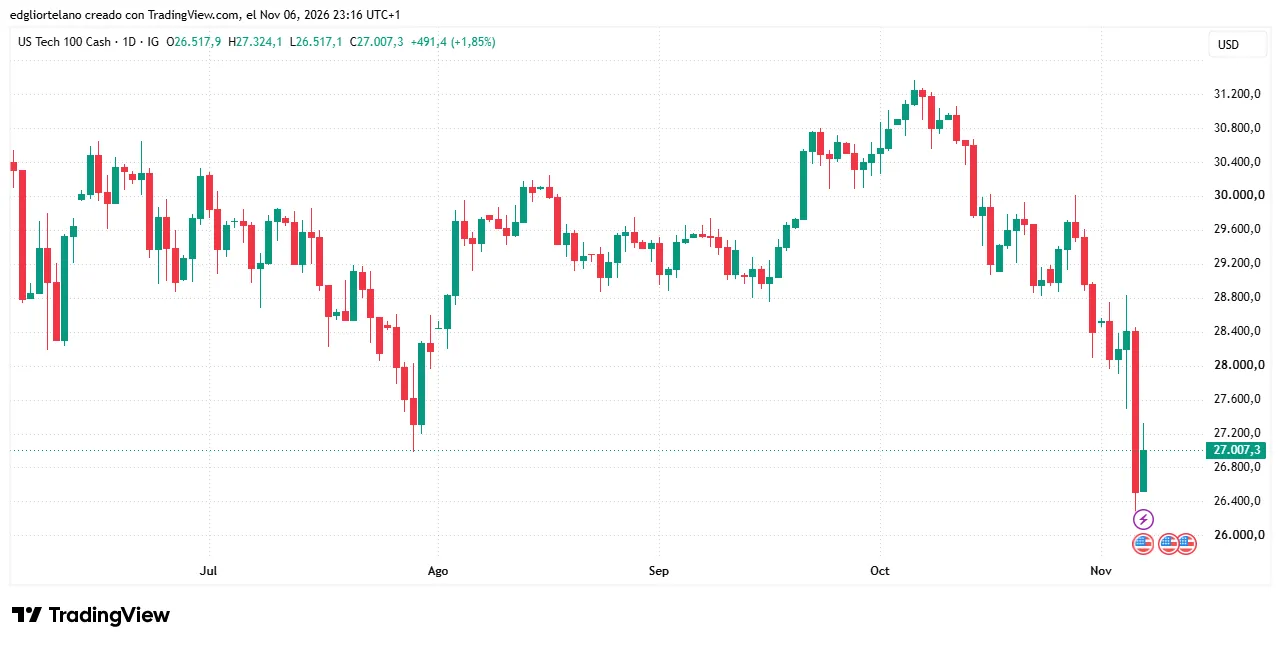
Back in the United States, the US Tech 100 cash-market proxy also experienced a modest recovery, gaining 1.85% to finish at 27,007.3. Even with this end-of-week bounce, the index remains down more than 5.5% over the course of the week. Daily candlestick charts reveal that the recent upward movement arrived strictly as a reaction to a much larger slide from October levels, rather than a genuine resumption of the previous upward market trend.
Why the AI Trade Is Unraveling
The sudden vulnerability in the artificial intelligence trade has been driven by a confluence of political, regulatory, and financial pressures. In the United States, the recent midterm elections accelerated lingering market fears that shifting political dynamics—specifically Democratic gains—could translate into much tougher regulatory scrutiny and localized resistance toward massive data center developments.

According to data compiled by Ballotpedia, voters in 40 out of 41 local ballot contests on November 3 favored measures to limit data center development, which included outright rejections of pro-construction initiatives and zoning approvals. While some of these local votes were purely advisory, the political message sent to investors was unmistakable.
This localized pushback carries significant implications for chipmakers and hardware suppliers, as massive data centers represent the primary engine of their ongoing growth story. Each new facility requires staggering capital expenditures on high-performance processors, dedicated servers, specialized networking equipment, and intensive power and cooling infrastructure. Stricter local regulations, zoning battles, and environmental pushback threaten to delay crucial orders or force developers to seek out alternative, potentially more costly, construction sites.
Yet, underlying doubts regarding the sustainability of the AI boom predated the election results. Throughout the sector, artificial intelligence companies and their enterprise customers have been spending aggressively to secure computing capacity, frequently making massive capital commitments long before clear commercial returns on those investments have materialized. This aggressive spending strategy becomes increasingly difficult to sustain in an environment characterized by elevated borrowing costs and higher interest rates. Market strategist Steve Sosnick, speaking to Reuters, pointed out that many of these heavily owned technology stocks were already "priced to perfection," leaving virtually zero room for operational or macroeconomic missteps.
Correction or Bubble Burst?
To understand the current market anxiety, analysts distinguish carefully between a routine market correction and the bursting of a structural bubble. A standard correction is generally defined as a market decline of at least 10% from a recent peak. Importantly, a correction does not inherently mean that the underlying businesses are shrinking or failing.
Consider a scenario involving a leading chipmaker whose shares trade at 60 times annual earnings because investors anticipate explosive, multi-year growth. If market sentiment shifts and investors become willing to pay only 40 times those exact same earnings, the stock can easily lose a third of its market value without the company’s actual profits dropping by a single dollar.
Conversely, the bursting of an economic bubble is a much more serious systemic event. It occurs when long-term growth expectations prove entirely unrealistic and the cheap capital supporting the speculative boom begins to dry up rapidly.
Financial history offers compelling warnings regarding this dynamic. During the infamous dot-com crash of the early 2000s, the Nasdaq composite lost roughly 77% of its value between March 2000 and October 2002. History proved that the internet itself was not a passing fad; rather, investors had vastly overestimated how quickly corporations could monetize the technology and turn it into sustainable profits.
During that era, telecom operators spent immense fortunes laying transcontinental fiber-optic cables for customers who had yet to materialize. Global Crossing, a major player that built an ambitious international network, ultimately filed for bankruptcy in 2002. The underlying technology survived and changed the world, but many of the participating companies and their shareholders did not.
Artificial intelligence could potentially face a similar structural mismatch between its undeniable long-term promise and the harsh reality of near-term financial returns. Already, market participants are scrambling to adapt. For instance, temporary global hardware shortages have created sudden business opportunities; former cryptocurrency miners are aggressively renting out their specialized computing hardware, while a proliferation of new cloud providers and AI inference startups continue to enter the market.
However, the financial mechanics remain perilous. Imagine a hypothetical infrastructure company borrowing billions of dollars to construct a massive data center packed densely with Nvidia chips, operating under the assumption that it can rent out that computing power at premium rates for years to come. If end-users decide to spend less than anticipated, if borrowing costs rise further, or if construction is delayed by local regulatory hurdles, the mountain of debt still demands regular repayment.
Should that operator face financial distress, it may abruptly cancel pending chip orders. The ripple effects would quickly spread: local contractors would lose lucrative work, utility companies that planned expensive new electrical generation capacity would lose anticipated anchor customers, and the lenders and institutional investors holding the company’s debt would absorb steep losses. Under such a chain reaction, a localized stock market selloff can quickly morph into a broader economic problem.
At the same time, analysts note crucial differences between the current AI ecosystem and the dot-com era of 2000. Technology giants like Microsoft, Alphabet, Amazon, and Meta are fundamentally profitable enterprises backed by established enterprise customers and massive, reliable cash flows. Unlike many of the highly speculative startups that defined the turn of the century, these trillion-dollar balance sheets are far better equipped to withstand temporary cyclical setbacks than smaller AI-focused cloud providers that depend heavily on continuous external borrowing to fund their expansion.
This structural divide suggests it is entirely possible for artificial intelligence to continue profoundly transforming global industries while a cohort of smaller, over-leveraged AI firms fail—and while investors who piled into the most successful giants ultimately find that they significantly overpaid for future growth.
Financial warning lights are undoubtedly beginning to flicker across the credit markets. Reuters reported Friday that the cost of insuring against a potential debt default by prominent AI-cloud provider CoreWeave had climbed above 1,000 basis points. This specialized protection functions similarly to insurance on a loan; as the pricing for this insurance rises, institutional investors are signaling heightened anxiety regarding the company’s ability to service and repay its obligations.
Despite these localized areas of stress, broader corporate bond markets have continued to operate relatively normally, pointing to concentrated strain within the riskiest corners of AI financing rather than definitive proof of a systemic, economy-wide financial crisis.
The coming week will provide more concrete fundamental tests than another session of erratic stock charts. Upcoming financial reports and business updates from CoreWeave, Applied Materials, and Cisco will offer vital clues as to whether corporate customers are continuing to order advanced computing capacity and specialized hardware equipment. Concurrently, upcoming inflation data will dictate the trajectory of broader borrowing costs.
Stable equipment orders and manageable debt levels would lend strong support to the argument that the recent selloff is a healthy market correction. Conversely, a wave of canceled construction projects, failed debt refinancings, and shrinking sales figures would suggest that the financial foundations supporting the AI boom are beginning to crack. Ultimately, the central question facing global markets is not whether artificial intelligence has a transformative future, but whether every enterprise currently betting billions of dollars on that future can afford the journey to get there.





Comments (0)