



As the cryptocurrency market turns the page into a new annual cycle, shifting sentiment has begun to reshape the landscape of favored sectors. While speculative verticals such as artificial intelligence, modular frameworks, and memecoins have experienced a cooling in broader mindshare, protocols aligned with institutional utility, real-world asset (RWA) tokenization, stablecoins, and prediction markets have emerged as clear frontrunners. Amid this broader market rotation, one institutional-grade protocol has quietly posted metrics that command attention, sitting squarely at the intersection of several dominant sector narratives.
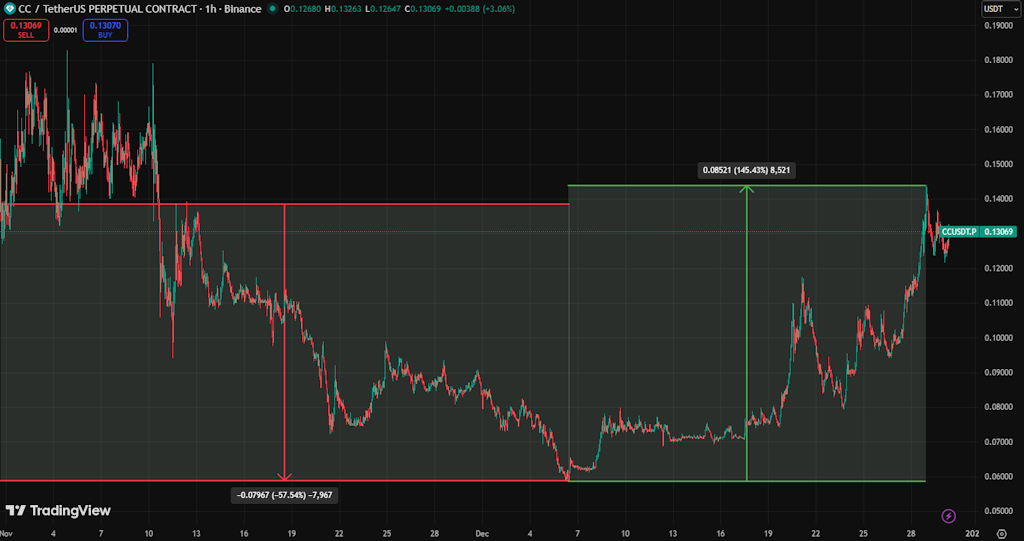
The Canton Network, a specialized blockchain infrastructure built exclusively to address the rigorous compliance, privacy, and interoperability demands of financial institutions, has experienced a notable resurgence. Following the transferability launch of its native token on November 10, the asset underwent an initial market correction exceeding 50%. However, it has since erased those losses entirely, posting a 47.6% gain over the trailing month and drawing fresh scrutiny from market analysts tracking enterprise blockchain adoption.

The fundamental driving force behind Canton’s recent visibility is the sheer scale of real-world asset activity already traversing its rails. Data extending through the fourth quarter of 2025 indicates that the network has processed a cumulative $6 trillion in real-world assets. Furthermore, it currently sustains an impressive throughput of approximately $350 billion per day in United States Treasury activity. Much of this heavy institutional volume is anchored by established fintech heavyweights. Broadridge Financial Solutions, a global leader in trading, clearing, and settlement infrastructure, utilizes Canton to power its Distributed Ledger Repo platform. That specific system processes more than $8 trillion per month in repurchase agreement transactions, leveraging blockchain rails to drive operational efficiencies across one of the most vital segments of traditional global finance.
Momentum within the ecosystem has expanded through high-profile integrations designed to bridge traditional financial architecture with digital asset ledgers. A strategic partnership with Nasdaq connects the Canton Network directly to Nasdaq Calypso, establishing automated margin and collateral management workflows. This integration allows major institutional participants to move, manage, and reuse capital with greater agility across both traditional and digital asset classes.
Further cementing its position as critical market plumbing, the Depository Trust and Clearing Corporation (DTCC)—the central clearing and settlement backbone of United States financial markets—selected Canton to support the tokenization of institutional assets. The upcoming rollout will enable a designated subset of US Treasurys held within the DTCC depository to be issued on the Canton Network, pending regulatory clearance from the Securities and Exchange Commission. Given that the DTCC clears roughly $10 trillion in securities transactions every single day, transitioning segments of settlement from traditional multi-day windows to near real-time finality holds the potential to unlock significant capital efficiencies across legacy market infrastructure.
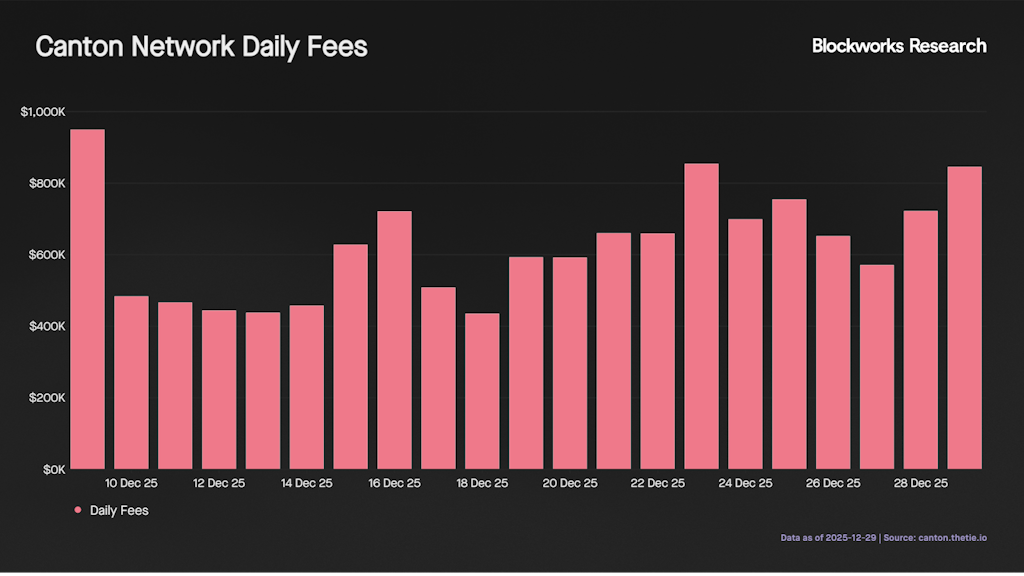
Network utility and token economics are tightly coupled within Canton’s design. The protocol relies on a mechanism known as the Global Synchronizer to coordinate transactions seamlessly across disparate institutions, with predictable transaction fees settled in the network’s native token, CC. Crucially, these fees are permanently burned as network utilization scales upward. Over a recent twenty-day observation window, the network burned a median of 6.71 million tokens daily, translating to roughly $627,000 per day, with peak activity driving burn rates between $750,000 and $850,000. To put these figures into perspective, Solana recorded a daily economic value generation averaging approximately $670,700 over a comparable seven-day period, yet trades at a fully diluted valuation roughly sixteen times higher than that of Canton.
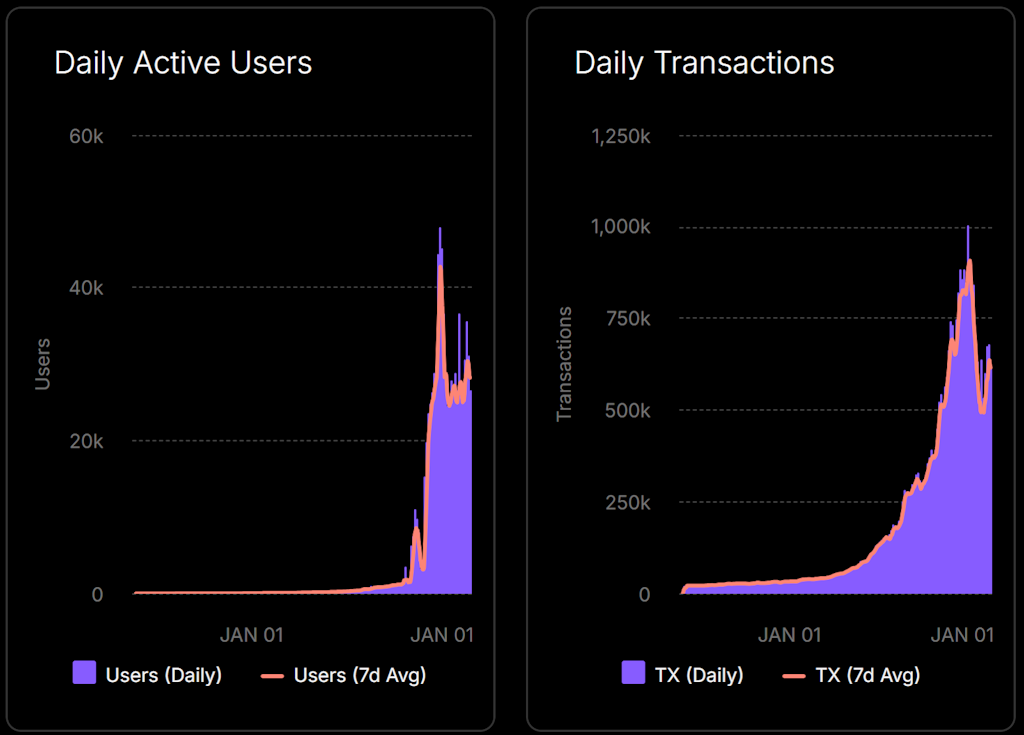
Underlying operational metrics corroborate the financial data. Since November, the network has maintained an average of approximately 28,500 daily active users alongside 678,300 daily transactions. This level of activity places Canton on par with prominent consumer and application-focused layer-one networks regarding user counts and raw transaction throughput. While questions regarding the network’s underlying architecture, validator distribution, and long-term tokenomics remain subjects of ongoing technical evaluation, the early empirical signals are difficult to dismiss as the industry looks ahead.
Lighter’s TGE
While institutional infrastructure quietly scales on enterprise networks, the decentralized derivatives sector has experienced its own structural milestones, highlighted by the long-anticipated token generation event for Lighter. The protocol airdropped and officially launched its native LIT token, bringing closure to a multi-month valuation process that traders had actively stress-tested via predictive market contracts serving as a functional proxy for the token generation event. Market conviction experienced brief intraday volatility, with market-implied odds slipping to approximately 60% immediately prior to the official deployment.
The initial tokenomics of LIT feature a maximum supply capped at 1 billion tokens, with 250 million tokens circulating at launch, representing a 25% day-one float. The airdrop distribution was financed by accumulated points from Seasons 1 and 2, resulting in the conversion of 12.5 million points into LIT tokens, which translates to a headline ratio of roughly 20 LIT per point. The broader allocation blueprint distributes 50% of the supply to the ecosystem, divided evenly between immediate circulation and future distributions, with the remaining supply split between the core team at 26% and early investors at 24%. Allocations designated for the core team and investors are subject to a strict one-year lockup cliff, followed by a three-year linear vesting schedule. Following the public debut, premarket points valuations adjusted downward significantly, leaving secondary market points buyers down roughly 50% from peak valuations that had previously implied a theoretical value of approximately $100 per point.
Beyond the immediate market mechanics of the airdrop, industry discussions have increasingly centered on the broader question of token holder value accrual and governance alignment. Lighter has positioned itself directly within the ongoing debate surrounding the structural mismatch between protocol equity and token utility. The project contends that revenues generated by its core decentralized exchange and planned future product suites can be tracked transparently onchain in real time, allowing revenues to be dynamically allocated between protocol growth initiatives and token buybacks depending on prevailing market conditions.
Going a step further, the protocol asserts that economic value created across its entire suite of products and services will accrue entirely to holders of the LIT token. The token itself is issued directly from a United States C-corporation structured to operate the protocol on an at-cost basis. While industry observers note that this architectural stance offers a stronger alignment model than traditional corporate structures where a separate lab entity captures the vast majority of profits, the operational definition of running a business "at cost" remains flexible, subject to structural overhead such as administrative and engineering expenditures.
When evaluated against established sector comparables, the market is currently pricing Lighter at valuations closely mirroring those of Hyperliquid. Lighter trades at a fully diluted valuation of $2.7 billion with $700 million circulating, translating to a circulating float of approximately 25.9%, nearly identical to Hyperliquid’s circulating float of 25.4% derived from a $24 billion fully diluted valuation and $6.1 billion circulating supply. More significantly, Lighter is trading on a fee multiple that places it directly within Hyperliquid’s valuation band. Lighter commands a multiple of 26.6 times its fully diluted valuation relative to annualized fees, and 6.9 times its circulating valuation relative to annualized fees, compared to Hyperliquid at 29.9 times and 7.6 times, respectively. These valuation parallels persist despite a substantial gap in absolute scale; Lighter recorded $8.5 million in fees over a thirty-day window compared to $66.8 million for Hyperliquid, while supporting an open interest figure of $1.45 billion against Hyperliquid’s $7.44 billion.





Comments (0)