


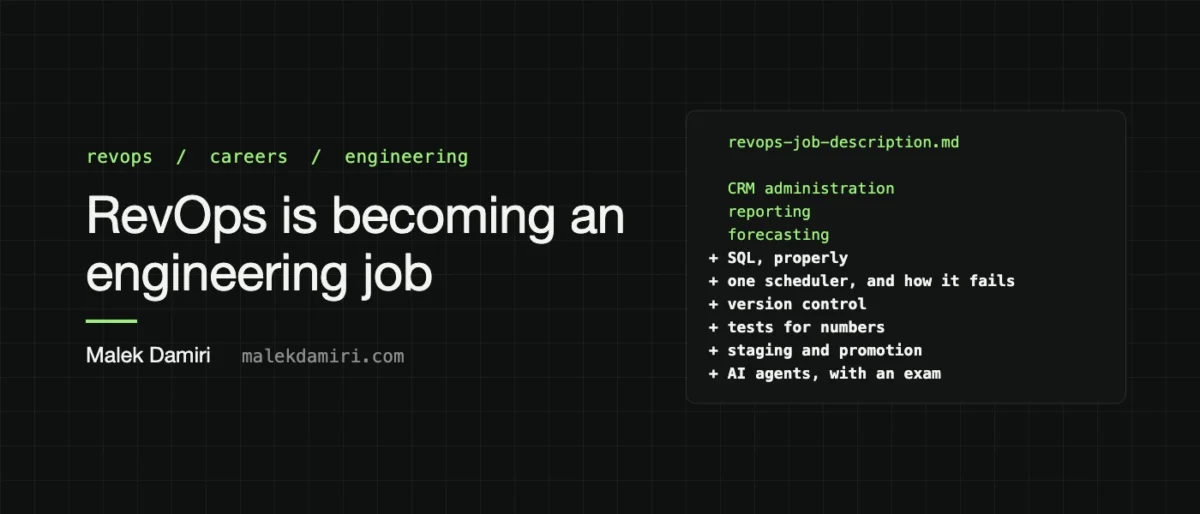
Over the past two weeks, a peculiar set of technical anomalies and systemic puzzles has dominated the daily workflow of modern revenue operations. Among them was a calendar table uniquely designed to recognize that November 1 briefly contains twenty-five hours due to daylight saving adjustments, a customer health score algorithm that barely outperformed a coin toss in predictive accuracy, and a vintage 1961 warehouse formula resurrected to unearth dormant, forgotten deals buried deep inside a customer relationship management system. Other curiosities included a Slack reporting script configured to double-check its own metrics before daring to post them to a public channel, a specialized examination designed to test the capabilities of autonomous artificial intelligence agents, a macOS background job that routinely crashed simply because of where it arbitrarily chose to store its log file, and a critical mathematical examination revealing why the industry-standard three-times pipeline coverage metric is often little more than an educated guess.
For Malek Damiri, whose official corporate title is Head of Revenue Operations based in Atlanta, these intricate technical troubleshooting tasks represent the reality of his day-to-day responsibilities. Yet, looking closely at standard corporate job postings across the technology and SaaS sectors, very few of these engineering-grade challenges ever appear in a formal Revenue Operations job description.
Damiri’s professional journey began in the world of supply chain management before transitioning into revenue operations, a path during which he taught himself SQL out of sheer necessity. For the vast majority of that tenure, the role adhered strictly to its traditional definition: own the CRM, build the standardized reports, run the quarterly forecast, and act as the crucial bridge ensuring that both the sales department and the finance team were looking at the exact same numbers. Fundamentally, that core responsibility remains the bedrock of the profession. However, the methods, tools, and technical environments used to execute these tasks have undergone a radical transformation, evolving at a pace that far outstrips the outdated language found in contemporary job descriptions.
What Changed?
The rapid modernization of the function stems primarily from two monumental shifts in the corporate technology stack. First, enterprise data has decisively migrated out of individual software applications and directly into centralized data warehouses. Historically, revenue operations teams lived entirely inside the confines of the CRM environment and its native report-building wizards. Today, however, the critical revenue numbers that actually matter—spanning billing data, granular product usage telemetry, payment gateway histories, and core CRM records—now land directly in enterprise data platforms like Snowflake or BigQuery. Consequently, the professional tasked with reconciling these massive, disparate datasets now requires a firm grasp of structured query language rather than a simple report-generation interface.
Second, the cost of writing computer code has dropped precipitously. Modern artificial intelligence coding agents are now capable of writing the exact scripts required to synchronize CRM data, construct complex workbooks, or post formatted reports into communication channels within minutes. This represents the true structural turning point for the industry. When code becomes virtually free to produce, a larger portion of revenue operations inevitably transforms into code, meaning someone within the department must take ownership of running and maintaining it.
The operational catch, however, is that the ongoing execution and maintenance of that code did not experience the same drop in cost. Writing a simple script is effortless. Ensuring that a script runs reliably at 7:45 every single morning for two consecutive years, successfully survives unexpected operating system updates, posts absolute silence when the underlying data is corrupted or incorrect, and instantly alerts an administrator when it fails to execute at all—that is true operations engineering. This discipline has increasingly become a core revenue operations problem simply because these scripts govern critical revenue metrics, and no other department owns the underlying business logic.
What I’d Learn Now
For professionals currently working in revenue operations, sales operations, or finance operations who find themselves wondering where to invest their time and educational efforts, the path forward requires a pivot toward technical resilience. SQL mastery heads the list of essential competencies, moving well beyond basic database queries and group-by clauses. Modern practitioners must thoroughly understand data grain, complex table joins that inadvertently duplicate rows, advanced window functions, and the notoriously tricky nuances of time zones. A vast majority of the incorrect figures that need chasing down eventually trace back to a faulty table join or a mismanaged day boundary.
Beyond querying data, understanding a reliable task scheduler and recognizing precisely how it fails is paramount. Whether utilizing cron, launchd, GitHub Actions, or Airflow, operations professionals must select the system they will genuinely use and master its failure modes. Every scheduler possesses unique characteristics that can lead to silent failures, making it vital to understand the exact points of vulnerability within the chosen architecture.
Furthermore, implementing version control for any process that generates a quantitative metric is no longer optional. If a data point is destined to be presented directly to a chief financial officer, the underlying logic belongs in a git repository. The common scramble to answer which specific version of a query generated a particular slide deck should always have a definitive, traceable answer.
Testing must also expand beyond mere code execution to rigorously evaluate the numbers themselves. Relying on automated reconciliations, check cells, and established golden questions with predetermined, known answers ensures that code which successfully runs is actually producing correct outputs. Establishing safe staging environments is equally critical, providing a designated sandbox to break things far away from production databases, alongside a deliberate, structured promotion step between the two states.
Writing down explicit definitions remains the least technical competency on the list, yet it is arguably the most powerful mechanism for preventing internal conflict. Every core metric requires a clear, written definition that both the sales leadership and the finance department have formally agreed upon. Finally, embracing modern AI agents by providing them with secure sandboxes, structured testing criteria, and explicit boundaries regarding what they are never permitted to touch allows practitioners to offload routine typing and accelerate project delivery.
What Not to Become
The inherent risk within this technological evolution is that revenue operations inadvertently devolves into a shadow data engineering team, characterized by fragile data pipelines that nobody else understands, a dozen unmonitored scheduled jobs living on a single employee’s laptop, and a dangerous single point of failure where only one person knows how the entire system functions. That fractured scenario is undeniably worse than having no automation at all.
To prevent this architectural trap, clear operational boundaries must be drawn. Traditional data engineering should retain ownership of the core infrastructure platform, encompassing data ingestion pipelines, the central data warehouse, and the shared technical environment. Conversely, revenue operations should maintain ownership of the business logic and the crucial last mile of delivery: the standardized definitions, the reconciliations, the final reports, and the lightweight automations designed to route accurate revenue numbers directly to the stakeholders who rely on them.
Moreover, every successful automation must have a clearly defined operational exit strategy. When a revenue operations script or tool becomes so vital to daily business functions that an unexpected failure would directly harm the company, it must graduate from an ad-hoc script to official platform status. This graduation requires implementing proper system monitoring, establishing an accountable owner on call, and ensuring that at least a second team member fully understands its underlying architecture.
The Job Description Hasn’t Caught Up
Despite these profound shifts in daily responsibilities, the vast majority of current revenue operations job postings continue to request traditional competencies such as CRM administration, routine reporting, and strong analytical skills. While those foundational abilities certainly remain important, the professionals observed executing this role at a high level today are equally comfortable operating within a command-line terminal, capable of reading a complex software stack trace without panic, and adept at treating a routine scheduled data job like a consumer-facing software product with active users.
The official professional title may still carry the word operations, but the actual day-to-day work increasingly resembles systems engineering. The individuals who will thrive in this environment are those willing to take both professional disciplines seriously, bridging the gap between business strategy and technical execution as revenue operations continues to redefine its place in the modern enterprise ecosystem.




Comments (0)