



Cryptocurrency markets continue to navigate a complex macroeconomic and sector-specific landscape, caught between a modest short-term price recovery and a broader monthly downtrend. While token prices have stabilized somewhat following the severe market correction witnessed in November, underlying market breadth and relative underperformance compared to traditional financial benchmarks indicate that a cautious, bearish environment still prevails across the digital asset ecosystem.
Market observers tracking the week-over-week performance note that leading digital assets have attempted to claw back some of their recent losses. Bitcoin (BTC), for instance, has rebounded to around $90,400, sitting approximately 12% above its recent correction low of $80,700. This short-term relief rally has injected a degree of optimism into specific niches within the crypto economy. Over the trailing twenty-four-hour trading window, assets tied to the artificial intelligence and modular blockchain sectors emerged as the primary outperformers. Tokens such as Bittensor (TAO), which posted a 6.4% gain, and Celestia (TIA), up 6.2%, served as notable catalysts driving this localized strength.

Conversely, other segments of the market experienced downward pressure over the same timeframe. The perpetual swaps index registered as the top-performing loser among tracked sectors, weighed down by tokens like DYDX, which dropped 3.1%, and HYPE, which saw a modest decline of 0.6%. Despite these daily and weekly fluctuations, the broader market remains largely rangebound, struggling to establish a definitive direction that could signal a sustained reversal of November’s harsh selloff.
Indices
When zooming out to a monthly perspective, the market picture turns significantly less favorable for digital asset investors. While traditional finance benchmarks such as Gold, the Nasdaq, and the S&P 500 have printed green returns over the past month, every major crypto index tracked by analysts currently measures negative returns.
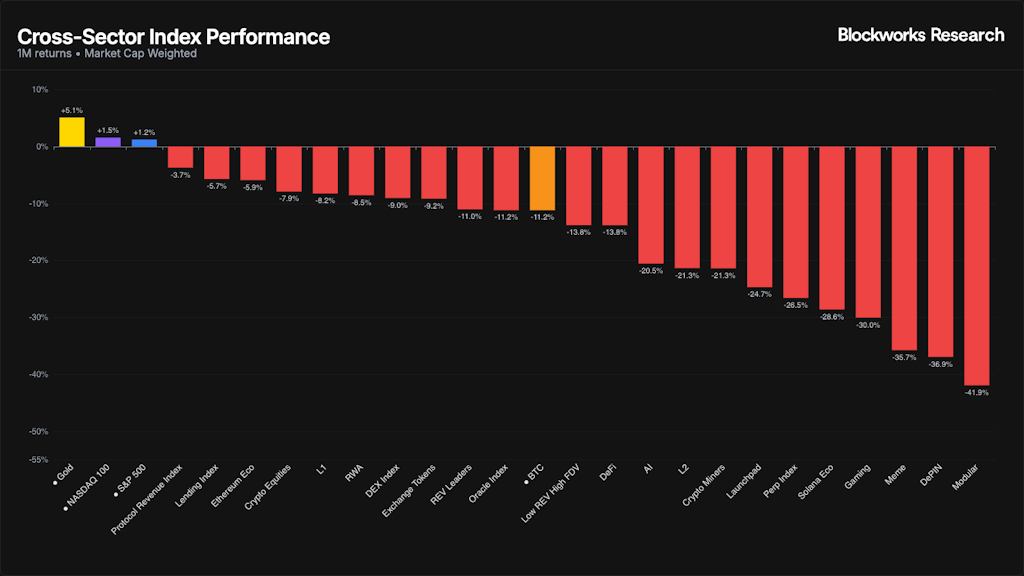
Market breadth is decisively negative across all crypto indices on a monthly timeframe, indicating that investors have found very few safe havens within the asset class. Within this challenging environment, however, certain sectors continue to demonstrate relative resilience. Notably, the Protocol Revenue index has emerged as the top-performing category among various crypto sectors. This relative strength points to an underlying market preference for protocols backed by strong fundamental positioning, robust revenue generation, and sustainable business models rather than pure speculative momentum.
Despite the recent price stabilization, analysts emphasize that it remains entirely undetermined whether this current relief rally is merely a countertrend bounce within a more prolonged downtrend, or if the ultimate cyclical low has already been established for the remainder of the year. The lack of clear macroeconomic tailwinds and persistent selling pressure continue to complicate short-term forecasting for traders and institutional participants alike.
Market Update
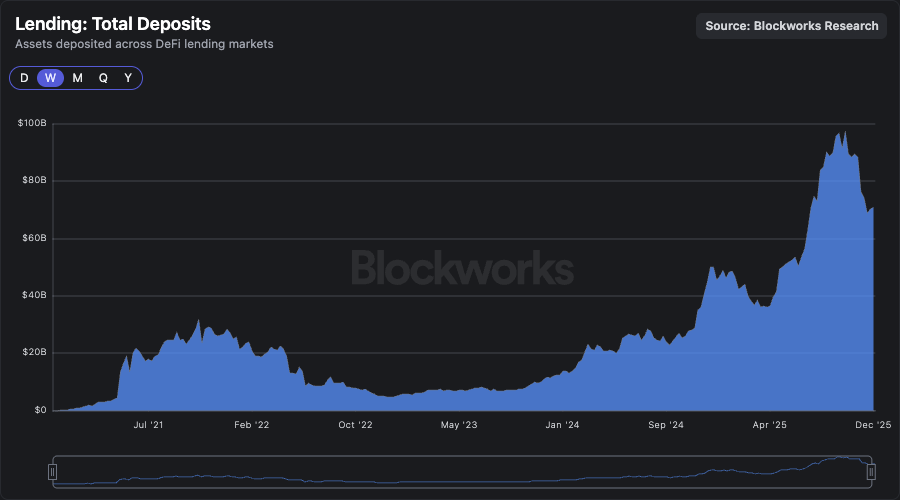
Amid the ongoing drawdown in spot crypto prices and the prevailing market caution, industry analysts suggest that market participants should not lose sight of the bigger picture. Taking a moment to evaluate the secular growth trajectory of decentralized finance reveals how dramatically the underlying infrastructure has matured over the past several cycles.
At the depths of the previous bear market, lending applications operating within the decentralized finance ecosystem accounted for a mere $5 billion in total deposits—a relative rounding error when compared to the vast scale of the traditional global financial system. In the years that have transpired since those bleak lows, that figure has experienced staggering expansion, rising to $71 billion in active deposits after having recently touched nearly $100 billion at local market peaks.
A similar story of expansion plays out when examining active credit issuance across these same platforms. Total outstanding loans on decentralized lending applications stood at just $1.6 billion during the bear-market lows. Since then, active loans have climbed steadily to over $27 billion, having recently crossed the $38 billion threshold during periods of higher market activity. These aggregate figures have grown to a scale that demands attention far beyond the boundaries of crypto-native participants and venture funds.
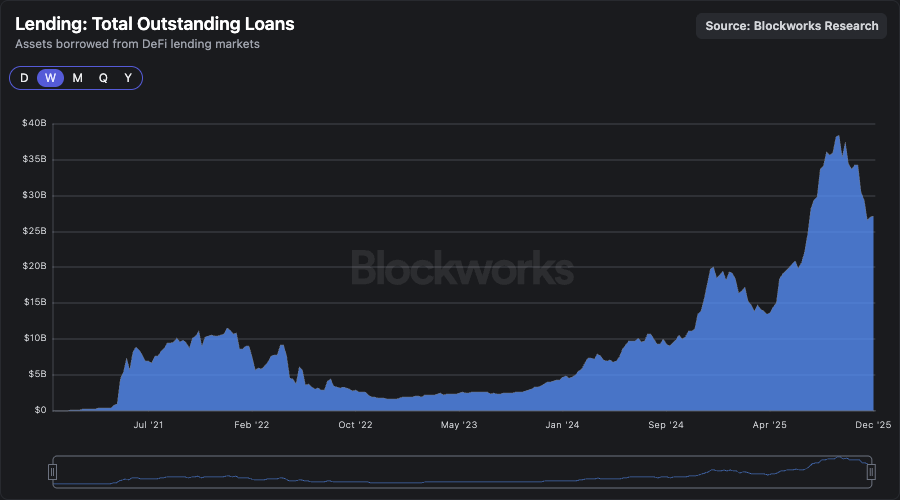
While financial metrics and spot prices are inherently subject to two-way variance—experiencing sharp movements to both the upside and the downside—the twenty-fold growth observed in topline decentralized finance metrics over just a few years suggests that the sector remains a long way off from reaching its terminal growth rate. The foundational pipes of onchain credit and liquidity are deepening regardless of short-term price volatility.
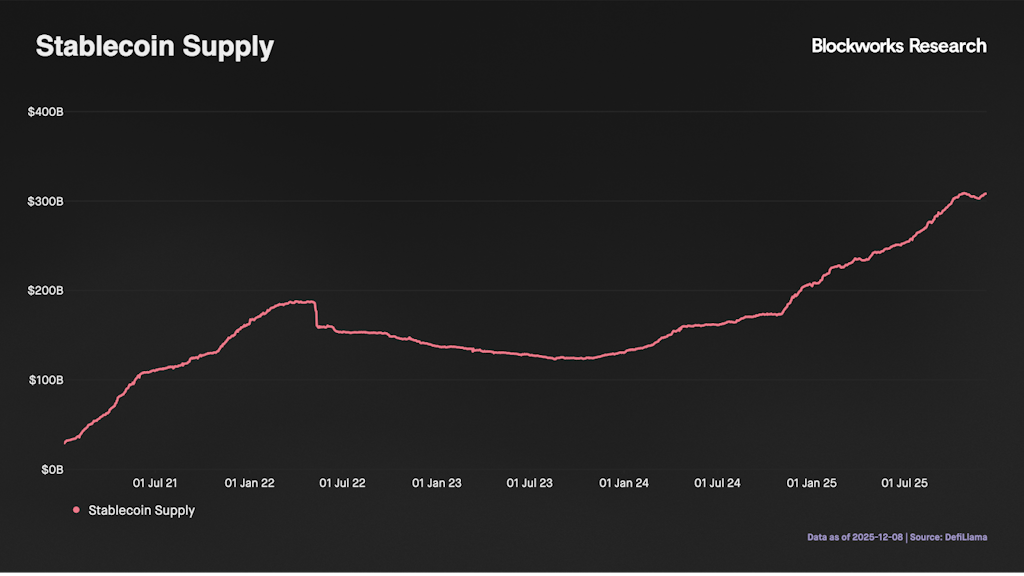
Simultaneously, the broader stablecoin economy has demonstrated remarkable durability in the face of macro headwinds. Amid the ongoing drawdown in wider crypto asset valuations, the aggregate stablecoin supply has fully retraced back to its all-time high of $310 billion. This recovery comes on the heels of a temporary contraction that saw roughly $10 billion leave the ecosystem in capital outflows.
The structural growth in stablecoins represents a secular trend that market analysts argue is difficult to bet against. Onchain money markets stand as the primary beneficiaries of this expanding stablecoin supply, functioning as the foundational applications for capital utilization. Within these environments, stablecoin lenders actively seek yield on their digital dollars, while borrowers look to secure leverage for trading and liquidity management. Although spot crypto assets will undoubtedly remain volatile over the near term, this structural secular trend is expected to persist as a durable, long-term tailwind for decentralized finance applications.
Even so, this growth is not occurring in a vacuum, and certain structural headwinds are beginning to emerge. The continued expansion in aggregate stablecoin supply is currently taking place against a backdrop of very modest onchain yields. Benchmark supply rates across major decentralized lending applications are hovering around 3.6%, representing a discount when compared to legacy financial benchmarks like the Secured Overnight Financing Rate (SOFR), which sits at 3.9%.
As the depth of onchain stablecoin liquidity continues to grow, this abundance of capital may act to dampen the upside potential for lending supply rates. Absent a material risk premium capable of outperforming legacy rates, the future pace of growth in stablecoin utilization across decentralized money markets could potentially face headwinds, forcing protocols to adapt to a lower-yield reality as the onchain economy matures.





Comments (0)