


As the artificial intelligence boom matures, the industry faces a rapidly evolving bottleneck that extends far beyond the physical manufacturing of semiconductors or the sourcing of electrical grid capacity. While supply chains for advanced silicon, high-bandwidth memory, and specialized cooling infrastructure remain severely strained, the single most critical gating factor for the next phase of artificial intelligence expansion is access to capital—specifically, institutional credit.
When the massive artificial intelligence infrastructure buildout first commenced several years ago, the capital expenditure was overwhelmingly financed through internal cash reserves. Hyperscale technology companies dipped deeply into their balance sheets, absorbing free cash flow deficits that drew intense scrutiny from Wall Street analysts and investors. Because these tech titans were deploying their own accumulated earnings, they possessed total autonomy over their strategic trajectory, regardless of market skepticism.
However, burning through internal cash balances represented merely the opening chapter of a much larger financial campaign. As the capital requirements for training advanced frontier models and constructing next-generation data centers escalated exponentially, corporations shifted their funding strategies toward the public equity markets. High-profile equity offerings, such as Alphabet’s $85 billion capital raise alongside major share dilution efforts by Meta and other industry leaders, demonstrated a willingness among shareholders to bankroll capital-intensive artificial intelligence roadmaps. Investors who trusted the historical track records of these corporate giants readily supplied the necessary funds. Yet, even these massive equity injections proved insufficient to fully satisfy the insatiable appetite of the expanding technological infrastructure.
Consequently, the financial weight of the artificial intelligence revolution is shifting decisively toward global credit markets. This transition introduces entirely new dynamics, primarily because the sheer magnitude of worldwide credit dwarfs traditional equity capital. However, utilizing debt financing requires navigating a complex web of risk assessments, counterparty verifications, and collateral evaluations that differ fundamentally from the mechanics of corporate cash deployment or equity dilution.
The Evolution of Capital Sourcing in Tech
Financing infrastructure through corporate balance sheets demands zero external visibility or third-party approval. Similarly, equity offerings rely on existing investors trusting a company’s leadership without requiring a granular understanding of underlying operational dynamics or hardware depreciation schedules. Credit markets, by contrast, operate under a fundamentally different paradigm. A lender extending capital for multi-billion-dollar data center builds must possess absolute certainty regarding repayment terms, cash flow predictability, and robust legal recourse if contractual obligations are breached.
To gain this level of confidence, lenders rely on a specific set of foundational assumptions regarding market demand, customer creditworthiness, and hardware longevity. However, industry analysts note that many of these conventional lending beliefs are currently contradictory. Bridging this educational gap between traditional finance and cutting-edge artificial intelligence infrastructure is essential if the global ecosystem is to unlock the massive pools of liquidity required for future expansion.
Skeptics of the artificial intelligence boom generally anchor their bearish outlook on two primary concerns: the risk of an artificial intelligence overbuild and the assumption that hardware depreciates so rapidly that multi-year investments will quickly become obsolete. Addressing these core anxieties requires examining the actual economics of compute demand, which indicators suggest points toward structural scarcity rather than a temporary glut.
Infinite Demand Versus Overbuild Concerns
Agentic artificial intelligence demand is currently expanding at a rate of two-and-a-half to five times annually. Meanwhile, industry supply projections indicate that manufacturing capacity will, at best, double by the end of 2030 based on visible foundry pipelines. This widening supply gap is compounding with each passing year, exemplified by high-bandwidth memory allocations being fully sold out well in advance and semiconductor executives warning that shortages are intensifying rather than easing. Aggregate compute commitment contracts now stretch into the trillions of dollars, with major cloud and artificial intelligence infrastructure providers sitting on order backlogs worth hundreds of billions.
Because advanced semiconductor supply cannot be manufactured instantaneously, and because the economic diffusion of artificial intelligence across the broader economy continues to accelerate, certain sectors face seemingly limitless compute demand. Industries ranging from automated logistics and molecular drug discovery to autonomous robotics and enterprise-wide workflow automation do not operate under rigid token budgets. For these organizations, compute has transformed from an experimental software line item into a primary means of production. Companies utilizing these technologies gain structural competitive advantages that make continuous compute acquisition an existential priority.
If market observers argue that compute demand is finite, they must inherently believe that global efficiency gains will plateau, that artificial intelligence adoption will saturate, and that economic output will cease to benefit from enhanced intelligence. Historical data regarding model efficiencies and algorithmic improvements suggests the opposite. Every time the cost of intelligence decreases by ninety percent, usage surges by a much larger proportion, frequently exceeding a tenfold increase at baseline. This economic phenomenon consistently unlocks entirely new commercial use cases, driving higher overall compute consumption rather than reducing it.
The Misunderstanding of Off-Take and Counterparty Risk
With the risk of an overbuild minimized by structural demand, institutional lenders must also reevaluate their approach to customer off-take agreements. Traditional credit providers often analyze data center compute capacity through the lens of commercial real estate. While superficial similarities exist, the comparison is fundamentally flawed. In commercial real estate, the pool of potential tenants is geographically constrained. Compute, by contrast, is a highly fungible digital asset that can be allocated across global networks instantaneously.
Despite this fungibility, many credit syndicates remain hyper-fixated on securing investment-grade counterparty off-takes, frequently demanding lengthy two-to-three-year contracts accompanied by steep down payments ranging from twenty to fifty percent. Lenders implement these stringent requirements in an attempt to guarantee contract fulfillment and secure their principal. However, in an aggressive market where compute demand significantly outstrips supply and will likely remain constrained for the next five to ten years, such restrictive clauses often backfire.
In an environment where a cancelled commitment can be filled almost immediately by any number of waiting enterprises, forcing rigid, long-term contracts undercuts market realities. Furthermore, as market compute prices climb steadily upward, locking in long-term contracts at significant discounts means lenders are effectively taking a net-short position on compute assets. Given that rental prices for compute capacity have risen dramatically over recent quarters, aggressive demands for long-term security can actually extend payback periods and weaken overall loan economics.
Reframing Hardware Depreciation and Useful Life
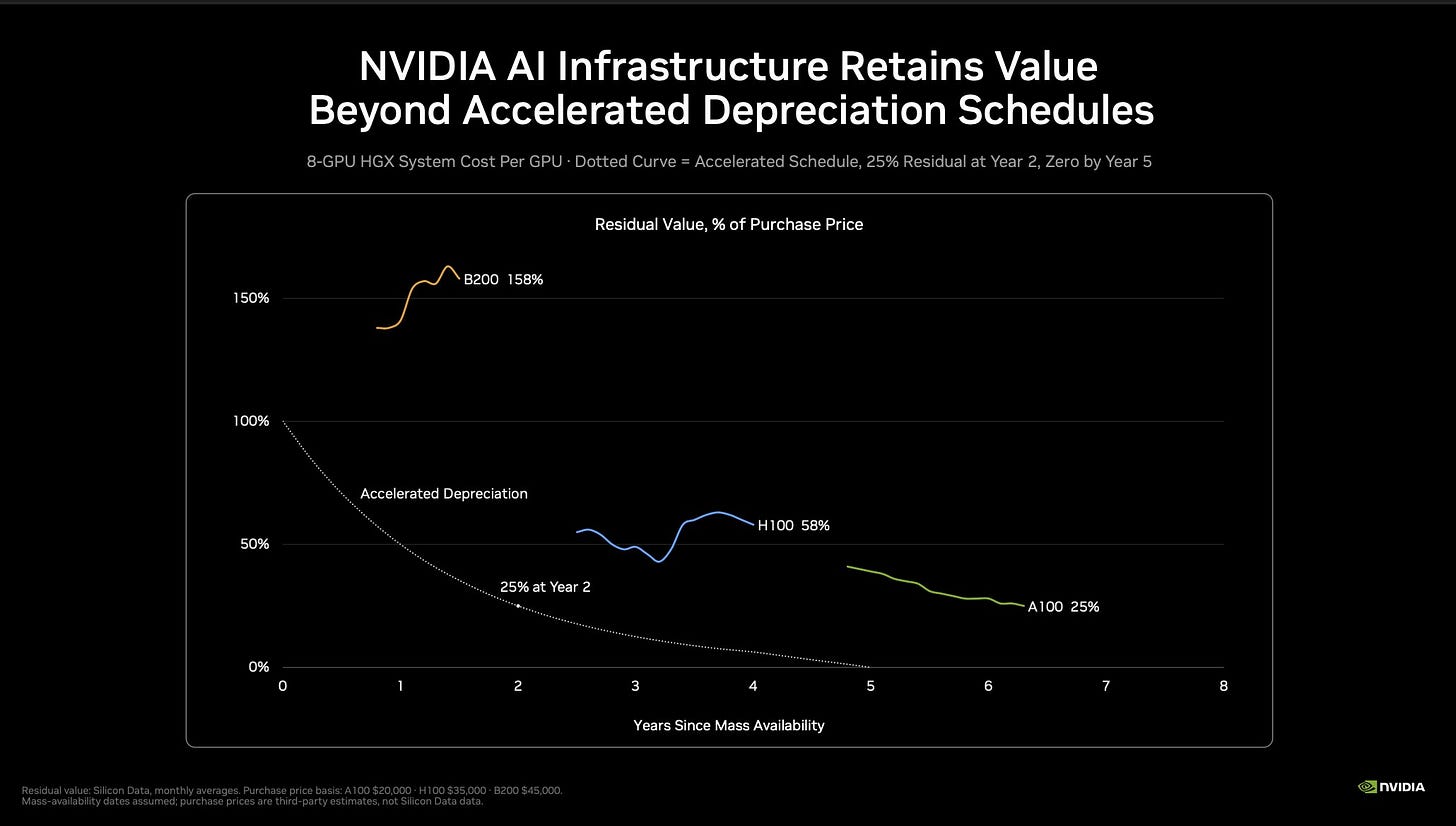
Perhaps the most persistent misconception among market skeptics concerns the depreciation schedules of specialized hardware. Bearish projections frequently claim that high-performance graphics processing units and accelerators possess short useful lives, rendering them technologically obsolete within a few years. Real-world utilization data tells a starkly different story. Earlier generation chips, such as the A100 architecture introduced in 2020, continue to operate continuously and remain in high rental demand. Operational history establishes a reliable baseline of at least nine years of useful economic value for enterprise-grade hardware, with newer generations like the Blackwell architecture projected to run profitably for well over a decade.
Market pricing trends further challenge conventional depreciation models. Secondary market valuations for advanced processors have frequently appreciated or maintained significant residual value long after initial deployment. Hardware units deployed years ago continue to retain substantial fractions of their original value, far outstripping the aggressive, short-term write-offs traditionally applied by conservative corporate accountants.
While newer semiconductor architectures offer greater raw efficiency, the argument that efficiency reduces overall machine demand ignores the realities of Jevons Paradox. As computational efficiency increases and the cost of inference drops, the volume of tasks delegated to artificial intelligence expands exponentially, driving even greater demand for underlying silicon.
As the financial ecosystem adapts to these structural realities, compute infrastructure is poised to emerge as one of the largest asset classes on the global stage. Navigating this multi-decade shift requires a sophisticated synthesis of advanced technology comprehension and modern financial market structuring. For institutions willing to engage directly with the mechanics of hardware deployment and credit-backed financing, the compute market represents a generational growth opportunity that is only just beginning to unfold.




Comments (0)