



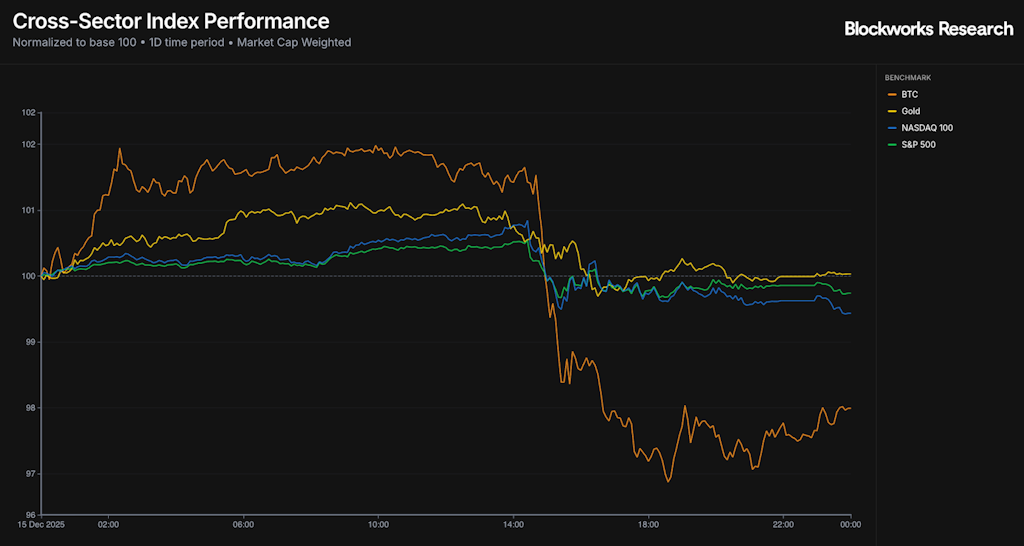
Global financial markets shifted into a risk-off posture as crypto assets underperformed traditional equities and safe-haven commodities ahead of a data-heavy economic week. Bitcoin (BTC) retreated below the $86,000 threshold, slipping 2.01% on the day. The leading cryptocurrency lagged behind broader traditional markets, where gold closed flat and major equity benchmarks drifted lower. Investors adopted a cautious stance, pulling back defensively as they awaited crucial macroeconomic updates during what marks the final full trading week of the year for traditional stock exchanges.
The broader stock market reflected this cautious sentiment, with the S&P 500 declining 0.26% and the Nasdaq 100 dropping 0.57%. On the macroeconomic calendar, market participants braced for the release of both October and November nonfarm payrolls reports. The October employment data had been delayed earlier in the quarter due to a temporary U.S. government shutdown, creating a compressed schedule for labor market analysis as the year draws to a close.

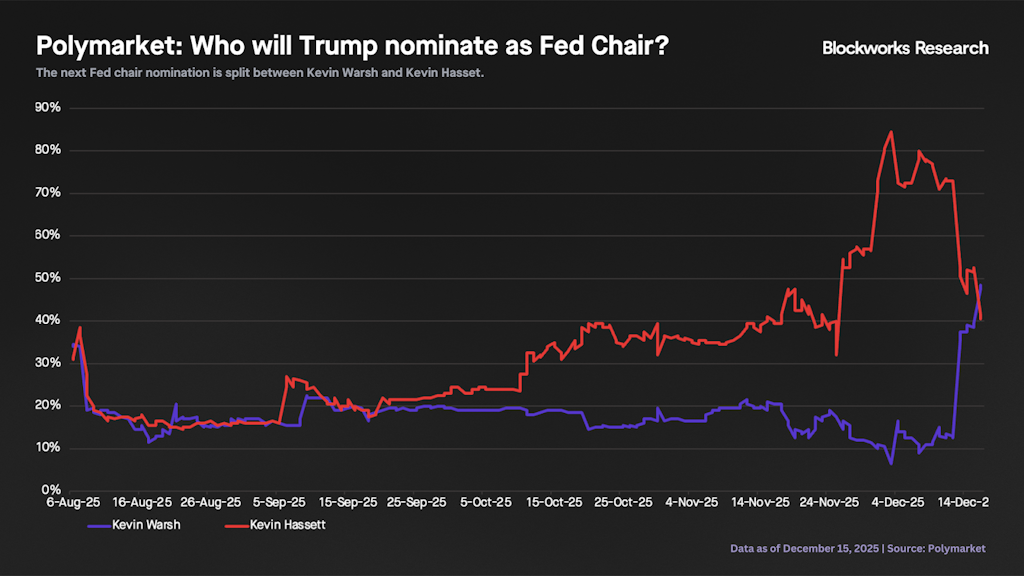
Simultaneously, political and monetary policy speculation has intensified regarding the leadership of the Federal Reserve. With Federal Reserve Chair Jerome Powell’s term scheduled to conclude in May 2026, discussions surrounding his potential successor have taken center stage. While Kevin Hassett emerged earlier in the month as the clear frontrunner for the position, Kevin Warsh has since captured a slight lead in the race, highlighting a fluid and rapidly evolving political landscape. Regardless of the eventual nominee, market consensus anticipates a more dovish Federal Reserve under incoming leadership, raising expectations for continued interest rate reductions through the coming year.
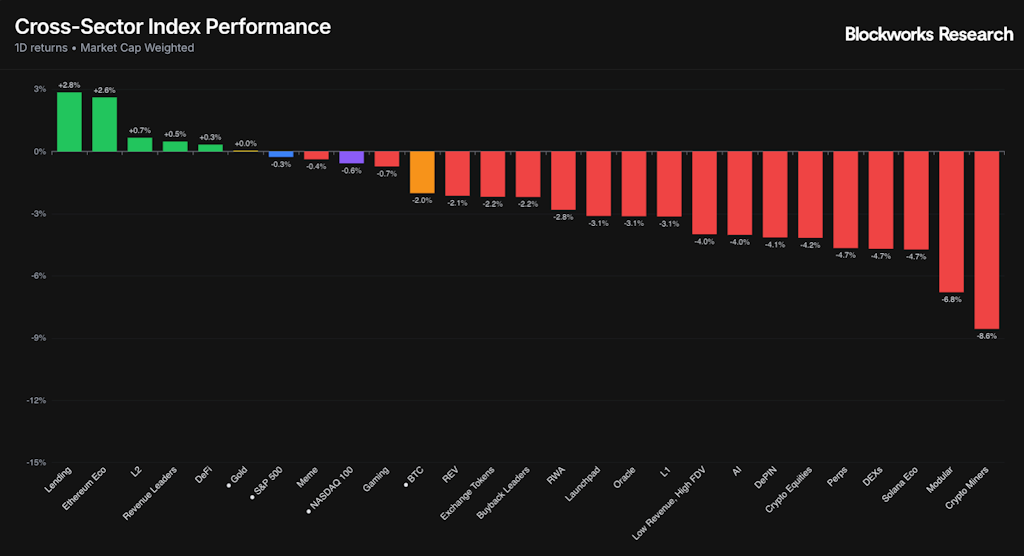
Despite the prevailing market downturn, specific sectors and tokens displayed notable relative strength. The Lending index rose 2.8%, while the Ethereum Ecosystem index gained 2.6%. AAVE emerged as the standout performer across both categories, climbing 3.0%. The upward momentum followed a high-profile move by Aave founder Stani Kulechov, who swapped approximately $10 million worth of wrapped Ethereum into AAVE tokens. The purchase was widely interpreted as an intentional signal of alignment with the native token following recent friction between the Aave DAO and Aave Labs.
Market Update: The Wave of Consolidation and the Broken State of Tokens
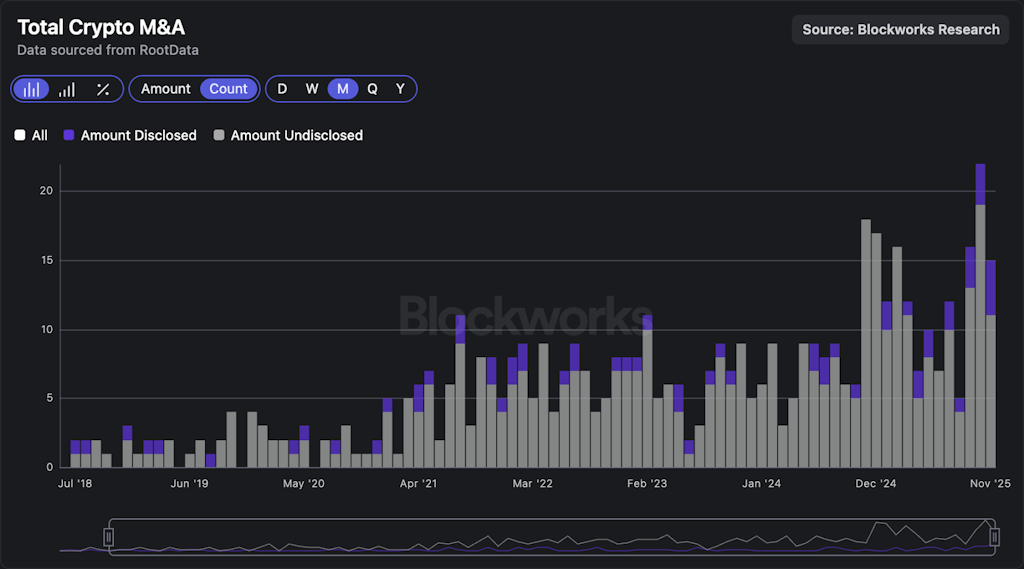
A defining structural theme for the cryptocurrency industry heading into 2026 is consolidation, with various market sectors coalescing around a handful of dominant players. Merger and acquisition (M&A) activity within the crypto space has accelerated noticeably over the past year, marking the early innings of this broader maturation process. According to data from RootData, the industry has recorded 143 M&A deals throughout the year. However, transaction values remain largely opaque, with only 21 deals disclosing financial terms. Among the most prominent transactions is Naver’s $10.3 billion acquisition of Dunamu, illustrating the scale of corporate consolidation entering the digital asset ecosystem.
Although industry consolidation signals a maturing market, recent transaction activity has exposed a critical structural vulnerability: traditional crypto tokens are frequently broken, leaving most uninvestable from a fundamental standpoint. A recurring pattern has emerged across high-profile corporate buyouts, including Pump’s acquisition of Padre, Coinbase’s acquisition of Vector, and Circle’s acquisition of the Axelar core team and associated intellectual property. In nearly all of these instances, the transactions largely neglected existing token holders. For example, Pump only addressed the concerns of PADRE token holders following significant public backlash from the community.
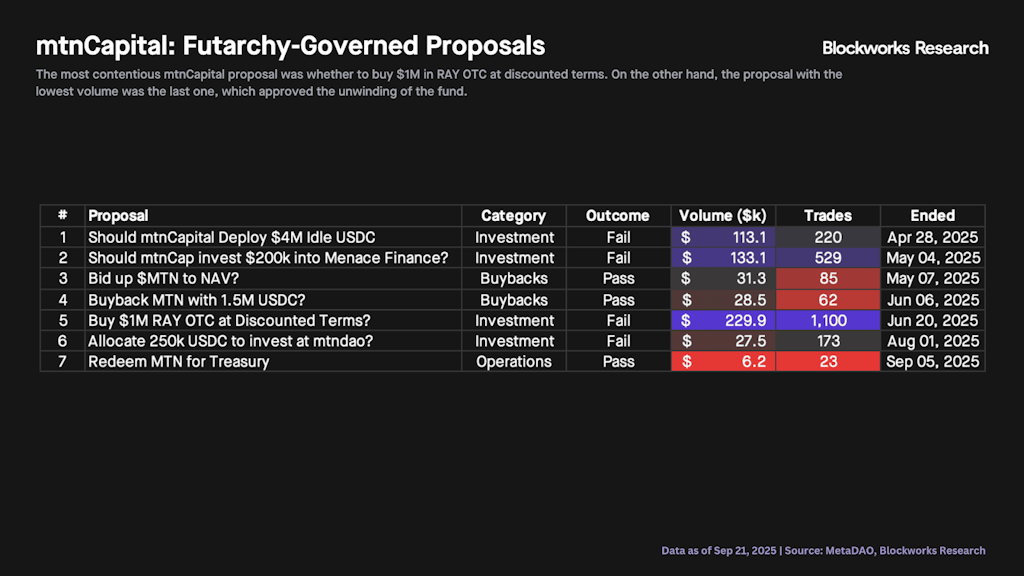
This persistent misalignment has fueled experimentation around alternative governance and ownership models. Projects like MetaDAO are attempting to address these structural flaws by embedding mechanistic protections directly into token architecture, allowing holders to utilize treasury clawback proposals as a last resort when governance experiments fail. The recent unwinding of mtnCapital demonstrated this framework in action, enabling token holders to redeem their MTN tokens directly for USDC held within the treasury.
Parallel to native token restructuring, alternative projects are attempting to solve the problem by bridging traditional equities and primary capital formation directly onto public blockchains. Platforms like Superstate’s Opening Bell enable partner issuers, such as Galaxy, to move shares seamlessly between traditional financial markets and tokenized representations on Ethereum and Solana. Superstate recently introduced Direct Issuance Programs designed to modernize traditional capital formation infrastructure. This framework allows SEC-registered issuers to receive stablecoins directly into corporate wallets from KYC-verified investors, instantly issuing tokenized shares to the investor’s wallet while updating corporate shareholder registries in real time.
Industry analysts suggest that as onchain markets mature, investors will increasingly care less about whether an instrument is classified as a native token or a tokenized security, provided the asset conveys a clear legal claim on cash flows, underlying assets, and proper legal recourse. Both token-centric and tokenized equity approaches are expected to coexist and play foundational roles in the years ahead.
Top of Mind: Evaluating the Durability of Onchain Demand and Rented Liquidity
Incentive programs, token airdrops, and points-farming campaigns remain enduring features of the user experience across decentralized finance. For individual participants, these mechanisms offer lucrative risk premiums and additional return kickers for interacting with emerging financial applications. For protocols, token incentives function as a non-cash customer acquisition expense, helping bootstrap initial liquidity and solve the classic cold start problem required to achieve critical mass. However, these community reward budgets are finite and will eventually be exhausted, leaving the broader market to determine whether a financial product can sustain organic viability absent yield-boosting incentives.
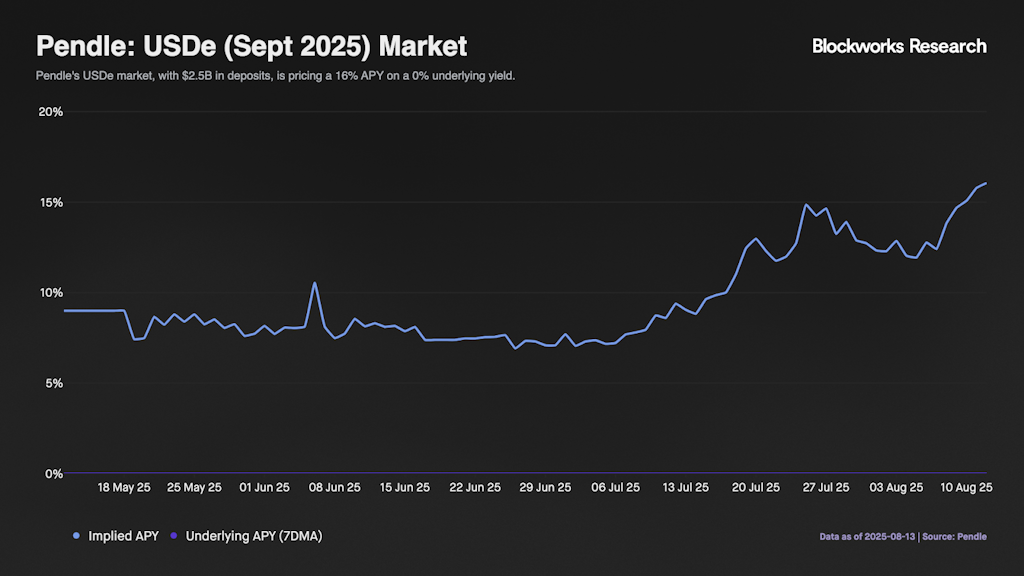
A clear historical case study involves the market for Ethena’s USDe synthetic dollar on Pendle leading up to its September maturity. During this period, the market accumulated a 70x points boost. Despite the underlying instrument generating zero native yield, the implied yield on the Pendle market surged above 16%, driving total deposits past the $3 billion mark.
Participants engaged in leveraged yield loops, securing a 10% to 15% fixed yield on USDe principal tokens while borrowing against them on lending markets like Aave at a cost of 5% to 7%. Simultaneously, ENA token incentives subsidized the yield spread. Between the USDe and sUSDe markets on Pendle, this architectural feedback loop propelled total USDe supply from $5 billion toward $15 billion. However, following the September maturity of over $5 billion in USDe-related instruments, the conclusion of Ethena’s Season 4 points campaign, a broader market deleveraging event on October 10, and declining crypto funding rates, the circulating supply of USDe sharply contracted back to $6.8 billion.
A similar pattern emerged with Kinetiq’s kHYPE token ahead of its network token generation event. Pendle markets priced the yield on kHYPE as high as 15% against an underlying base staking yield of just 2% to 3%. This market rapidly amassed over 40% of the total kHYPE supply, becoming Pendle’s second-largest listing. Bulls purchased kHYPE principal tokens to lock in fixed yields while looping exposure on platforms like HyperLend or Felix. Yet, following the token generation event and the expiration of that specific Pendle maturity, the supply of kHYPE contracted by 40%.
More recently, USD.AI—a protocol aggregating onchain stablecoin suppliers to finance real-world GPU infrastructure—attracted more than $600 million in deposits in a compressed timeframe. Fueled by a capped points campaign, demand for airdrop exposure became so intense that sidelined participants bid the stablecoin above its $1 peg by $0.04. USD.AI markets on Pendle offered some of the highest stablecoin yields available, with implied yields launching near 30% before drifting toward 10% against an underlying yield of zero, with over 80% of the total USD.AI supply utilized on Pendle.
As protocol incentives conclude and token generation events pass, projects relying heavily on rented liquidity must transition to supporting yields entirely from underlying business revenues. In cases where underlying loan books generate nominal cash flows compared to massive deposit bases, maintaining user appeal without external incentives presents a significant hurdle. While points farming remains an entrenched mechanic within the onchain economy, mobile capital will invariably rotate toward the most attractive risk-adjusted returns available in the market.



Comments (0)