


For many lean engineering teams and data-driven startups, the quest for operational efficiency often leads them to unconventional tools. One such setup involves using a continuous integration platform to power a morning ritual: a lightweight bot posts a concise report straight to a team workspace on Slack every single day, breaking down what moved volume and revenue over the previous twenty-four hours, driver by driver. Operating via a GitHub Actions schedule while independently verifying its own metrics before hitting publish, the system represents a remarkably frictionless architecture for a small team. There are no dedicated servers to babysit, configuration logs and authentication secrets reside safely in a single, centralized location, and any member of the engineering or data team can inspect the full run history at a glance.
Yet, this arrangement—while elegant and remarkably low-maintenance—comes with a set of operational constraints that require careful navigation. Nearly all of these fine-print details revolve around a singular, anxiety-inducing scenario: the morning the expected report simply fails to arrive. To understand the viability of relying on a code repository platform for operational business reporting, engineering leaders must examine official scheduler documentation, evaluate the inherent risks of daily automation, and implement robust safeguards designed to bridge the gap between convenience and reliability.
The Fine Print
The operational caveats associated with repository-based scheduled tasks are explicitly outlined in platform documentation, yet they frequently catch developers off guard. Understanding these limitations is essential for anyone considering continuous integration tools for operational reporting.
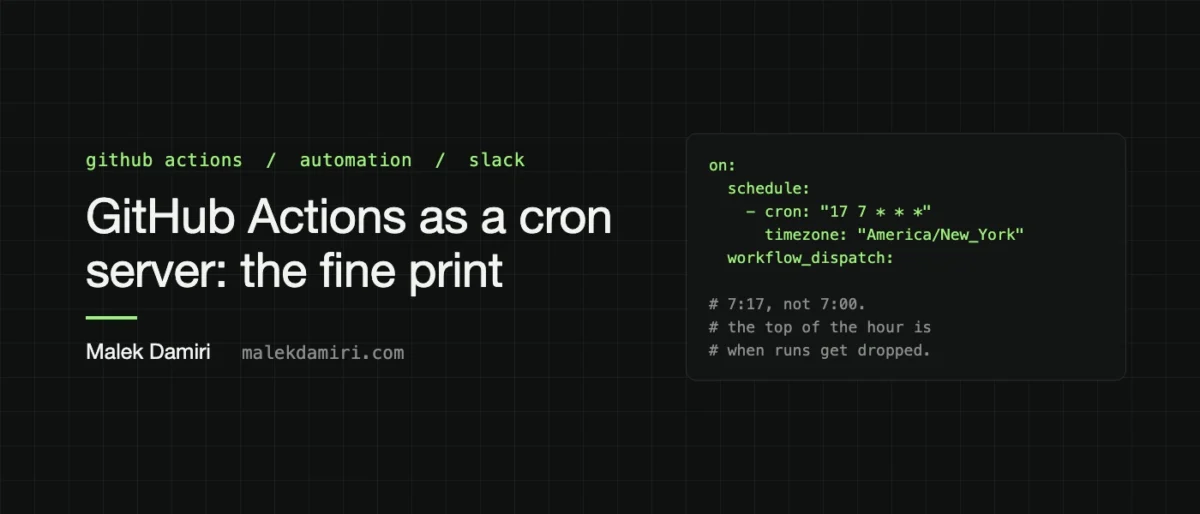
First and foremost, scheduled runs are never guaranteed to execute precisely on time, and some may fail to happen altogether. Platform documentation explicitly warns that scheduled workflows are susceptible to significant delays when the underlying automation infrastructure experiences heavy network or computational loads. The start of every hour is noted as a particularly congested window. Under extreme system loads, queued jobs may be quietly dropped entirely rather than deferred indefinitely. Crucially, a dropped run does not register as a system failure; it simply vanishes from the execution queue without throwing an error.
Furthermore, schedules operate in Coordinated Universal Time by default unless explicitly configured otherwise. While modern workflow configurations accept specific regional time zones using standard IANA identifiers such as Eastern Time, omitting this configuration invites severe timing drift. Without a specified time zone, a morning report intended to run at a consistent local hour will shift backward or forward twice a year when daylight saving time transitions occur. On spring-forward days, if a scheduled execution time falls into the nonexistent hour, the system automatically defers execution to the next valid timestamp.
Another critical limitation involves branch targeting. Scheduled workflows will only execute when placed on the default repository branch and aligned with its latest commit. Developers testing modifications to a schedule on a feature branch will find that the system provides no immediate feedback on whether their cron syntax or timing logic is functional until the code is merged into production.
In public repositories, an additional hurdle exists: schedules automatically deactivate if a repository experiences sixty consecutive days of total inactivity. Discovering that a reliable automated report has quietly ceased functioning after two months of silence represents one of the most frustrating failure modes of this architecture. Although the shortest possible interval for cron triggers is five minutes—a specification largely irrelevant for daily reporting but critical for high-frequency polling architectures—the daily use case remains the most common application for these lightweight scripts.
The Workflow Implementation
To mitigate the inherent unpredictability of continuous integration schedules, engineers must design their workflow configurations with defensive programming principles in mind. A typical implementation for a daily business metrics report utilizes a carefully timed cron expression paired with manual override capabilities and concurrency controls.
Rather than scheduling a job for the top of the hour, developers often offset the execution time to avoid peak infrastructure congestion. Setting a trigger for seventeen minutes past the hour rather than precisely on the hour significantly reduces the likelihood of encountering heavy platform traffic. If a report arrives slightly later than planned, it remains vastly preferable to a report scheduled for the top of the hour that gets dropped entirely during peak traffic periods.
To account for mornings when the automated schedule fails to trigger, workflow configurations can incorporate manual dispatch capabilities. This introduces an accessible execution button directly within the repository interface, allowing operators to trigger the report by hand whenever the automated schedule misses its window. Concurrency rules can be established to ensure that a manual rerun and a delayed scheduled execution never overlap or publish duplicate information to the communication channel. Additionally, strict permission controls restrict repository access to read-only capabilities, while automated quality assurance rules execute as internal unit tests before the reporting script ever attempts to assemble the final data payload.
The Report Checks Itself Before It Posts
A fundamental rule of automated data distribution is that a daily report should never publish a metric it cannot successfully defend. Before any numerical summary is transmitted to a team communication channel, the underlying script must execute a series of rigorous internal validation checks to ensure data integrity.
These diagnostic checks evaluate several vital dimensions of the dataset. The script verifies the freshness of the underlying data by checking whether the most recent date present in the source database aligns with expectations. It calculates mathematical reconciliation, ensuring that the foundational metrics, individual drivers, and final totals reconcile accurately without unexplained discrepancies. It guards against classification failures by monitoring whether catch-all categories disproportionately explain the daily variance. Furthermore, it compares current row counts against historical rolling averages to detect sudden database omissions or ingestion pipeline failures.
When any of these automated checks fail, the system alters its destination entirely. Instead of broadcasting potentially corrupted or stale metrics to a public team channel, the report is intercepted and routed directly to the system owner or data engineer. The notification outlines the precise nature of the failure, transforming what could have been a public embarrassment into a quiet, actionable internal alert. Each validation rule is backed by dedicated unit tests, ensuring that the verification logic itself remains sound over time. Holding back a faulty report is treated as a successful outcome, signifying that the automation caught an anomaly before an entire room full of stakeholders could spot it.
Don’t Post Twice
In the architecture of automated reporting, retry mechanisms and manual reruns are essential for operational reliability, yet they create persistent headaches within chat applications by risking duplicate messages. To prevent notification fatigue, the execution script must inspect the communication channel’s recent history before transmitting any new content.
The system queries the communication platform’s application programming interface to retrieve messages posted since midnight. By searching for a specific daily title marker within the message history, the script determines whether today’s summary has already been successfully broadcast. If the marker is detected, any subsequent rerun triggered by an engineer or an automated retry mechanism safely exits without sending a duplicate update. If the initial run was held back due to a data anomaly, a manual rerun executed after the underlying data pipeline has been repaired will proceed normally, posting the corrected metrics once the validation checks pass successfully.
Watch for the Morning Nothing Happens
While internal validation checks and duplicate prevention mechanisms handle data anomalies effectively, none of these safeguards can intervene when a scheduled run fails to start altogether. Because a dropped schedule does not register as a workflow failure within the continuous integration platform, it produces no error logs and triggers no default alerts.
To solve this blind spot, engineering teams frequently deploy a secondary monitoring workflow configured to run at a slightly later hour. This watchdog process executes a single, focused query: it checks the repository’s run history to determine whether the primary reporting workflow has successfully completed its execution for the current calendar day. If the query returns a zero count, indicating that no successful run has occurred, the watchdog immediately fires an external webhook notification to alert the system owner.
While this secondary monitor relies on the same underlying scheduling infrastructure and therefore shares its susceptibility to occasional platform delays, it provides a valuable second layer of defense. For reporting systems where absolute continuity is paramount, engineering teams often pair this approach with external heartbeat monitoring services. In such architectures, the reporting bot pings an independent monitoring endpoint upon successful completion, and that external service raises an alarm if the expected signal fails to arrive. The underlying philosophy remains consistent: systems should be engineered to alert operators on the absence of success rather than merely reacting to the presence of explicit failures.
When to Move Off GitHub Actions
For organizations evaluating their infrastructure needs, the decision of whether to rely on repository-based automation for scheduled tasks depends entirely on operational tolerance for disruption. When a business report must arrive at an exact, uncompromised minute, or when tasks run with such high frequency that even a few dropped executions a month would severely disrupt operations, teams are encouraged to migrate toward dedicated scheduling platforms. Enterprise cloud schedulers, workflow orchestration engines like Airflow, or monitored traditional cron servers offer strict execution guarantees that continuous integration platforms are simply not designed to provide.
However, for lightweight administrative tasks such as a single daily business summary that can tolerate a minor timing variance without disrupting operations, using a continuous integration platform for scheduled reporting remains an exceptionally pragmatic choice. The key lies in understanding the operational fine print, respecting the inherent limitations of shared developer infrastructure, and proactively building safeguards for the inevitable morning when the automated report does not show up on time.



Comments (0)