


As the artificial intelligence landscape matures, a growing chorus of power users and developers are finding themselves bumping up against the hard limits of centralized cloud infrastructure. For heavy consumers of large language models—those processing upwards of 100 million to 200 million tokens a day—the era of cheap, seemingly unlimited cloud compute is rapidly coming to a close. Subscription plans are tightening, session limits are creeping in, and the underlying costs of supporting massive AI workloads are finally catching up with the major labs.
For one dedicated AI developer, this looming squeeze served as the catalyst for a radical dive down the rabbit hole of hardware ownership. Driven by a firm belief that independent compute will become increasingly scarce and that relying on major labs poses risks regarding data privacy and proprietary ideas, the developer made a bold decision. Rather than continuing to hop between corporate subscription plans, they opted to build a custom, high-end local inference machine, investing roughly $15,000 into a state-of-the-art hardware setup designed to achieve true digital sovereignty.
The journey toward local independence begins with a fundamental understanding of hardware constraints. While general-purpose servers can handle traditional computational tasks with ample system RAM and multi-core processors, artificial intelligence inference operates under entirely different rules. The primary bottleneck in running large language models locally is not merely memory capacity, but memory bandwidth and VRAM—the specialized RAM embedded directly onto the graphics processing unit. As GPU cores execute complex intermediate mathematical calculations during inference, they require an ultra-fast local scratchpad to store data instantly. Without sufficient VRAM, local execution grinds to a halt.
This realization immediately ruled out several popular alternatives. While Apple’s consumer hardware utilizes an innovative unified memory architecture that pools system and graphical memory together, it suffers from a significantly slower Time To First Token compared to dedicated discrete graphics cards. Similarly, while enterprise server racks might boast impressive core counts and standard DRAM, they remain ill-equipped for heavy LLM inference without specialized hardware acceleration.

Initial research pointed toward NVIDIA’s older RTX 3090 graphics card as a potential budget-friendly entry point for hobbyists. Boasting 24GB of VRAM and featuring NVLink capabilities that allow two cards to bridge together at high speeds, the aging 3090 offered a compelling price-to-performance ratio. However, as the scope of the project expanded to encompass larger context windows, concurrent model serving, and heavier experimentation, 24GB quickly began to feel restrictive. Running massive frontier-class models—which routinely scale into the hundreds of billions or trillions of parameters—requires monumental amounts of memory, even when heavily quantized.
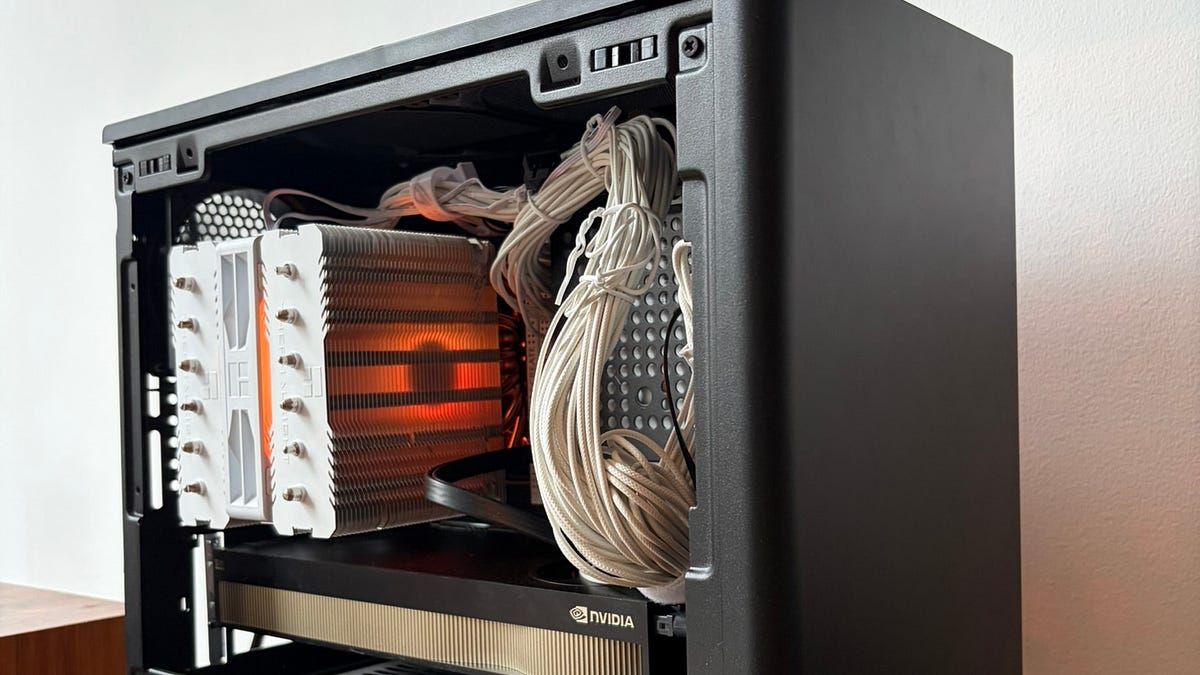
Recognizing that multiple lower-end cards would introduce complex power, motherboard, and cooling constraints, the builder decided to bypass intermediate solutions entirely in favor of top-tier consumer hardware. The centerpiece of the final build became the NVIDIA RTX 6000 Pro, a formidable enterprise-grade consumer card packing a staggering 96GB of VRAM. With a price tag sitting near the $10,000 mark, the card represents the absolute pinnacle of what is achievable outside of massive data center installations, offering long-term viability and a compact form factor capable of fitting within a mini-ITX chassis.

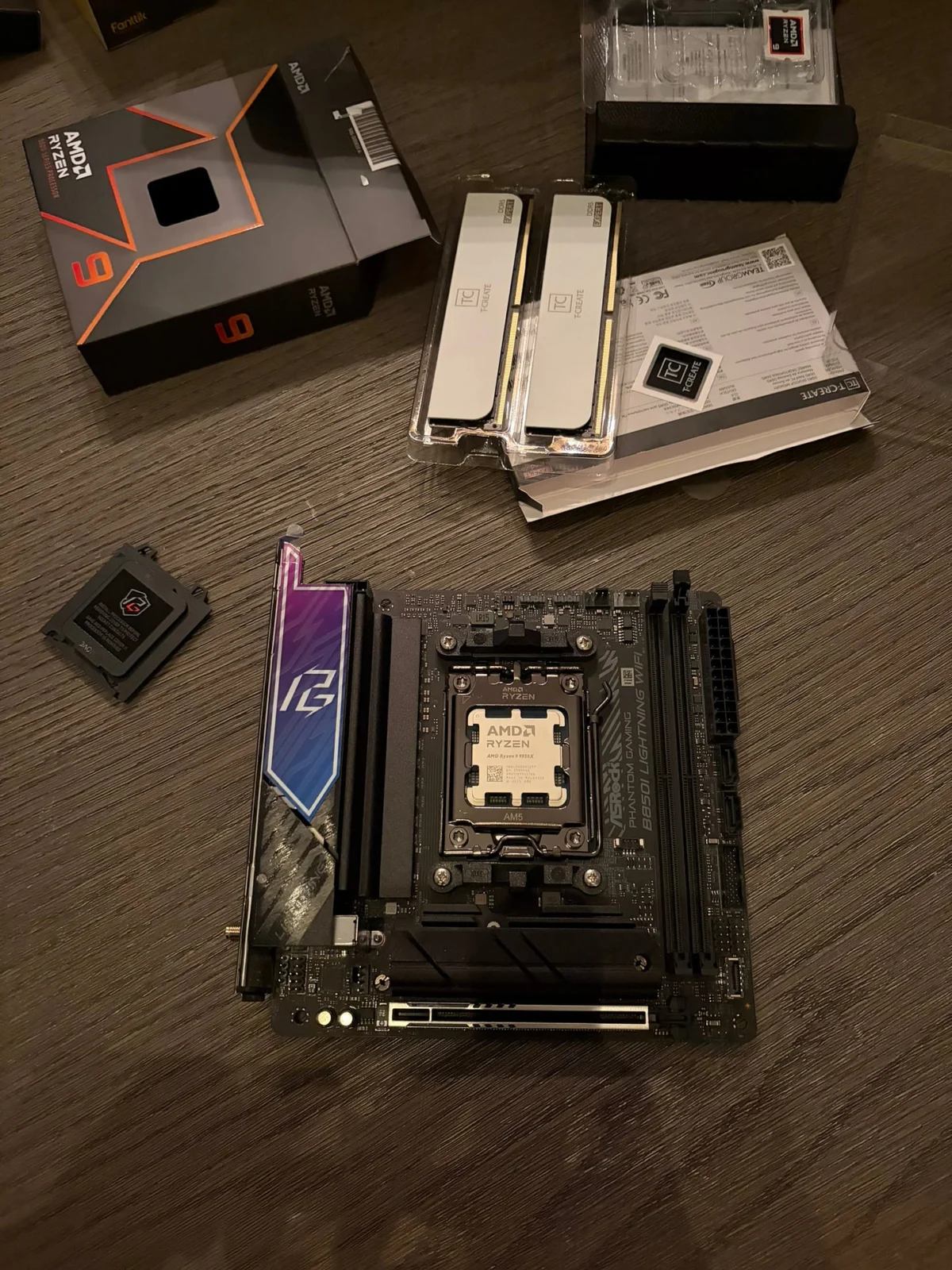
Designing a small-form-factor machine around such a powerful component required careful navigation of hardware engineering limitations. Opting for a mini-ITX build meant accepting strict physical boundaries: a single GPU slot, a maximum of two storage slots, and space for only two RAM sticks. To anchor the system, the builder selected an ASRock AMD B850i motherboard paired with a Ryzen 9950X processor, 128GB of high-speed DDR5 RAM, 4TB of NVMe.2 SSD storage, and a Peerless Assassin cooling system.
A particularly deliberate choice involved selecting a Max-Q variant of the RTX 6000 Pro. By drawing 300 watts instead of the standard 600 watts while sacrificing only a marginal percentage of processing power, the builder successfully minimized heat generation and power requirements, allowing for a quieter, more compact power supply unit without sacrificing core performance.

Assembling the machine proved to be a high-pressure undertaking. Unlike pre-built gaming systems purchased in youth, building a machine of this caliber with one’s own hands introduces a unique psychological weight. Every individual component held during the assembly process represents a significant financial investment, where a single misstep or a clumsy connection could instantly damage thousands of dollars worth of hardware. Over the course of a tense weekend spanning roughly ten hours, guided largely by manufacturer manuals, online resources, and technical assistance from AI models themselves, the physical construction came together piece by piece.
The process was not without its moments of anxiety. A troubleshooting phase involving a blank HDMI display upon first boot required backtracking and careful component isolation, while securing the massive GPU into its PCIe slot remained a delicate, high-stakes procedure. Yet, the culmination of the effort—witnessing the compact rig power on successfully—offered a profound sense of accomplishment.

With the physical infrastructure now fully assembled, the focus shifts toward deploying practical applications, managing always-on autonomous agents, and executing complex local workloads at the cost of little more than electricity. As commercial AI providers continue to impose stricter usage caps and restructure their pricing models, the push toward local hardware ownership highlights a broader cultural shift among technical power users. For those willing to make the significant financial and technical investment, building an independent AI powerhouse is no longer just an expensive hobby, but a foundational step toward true digital autonomy in an increasingly constrained technological landscape.


Comments (0)